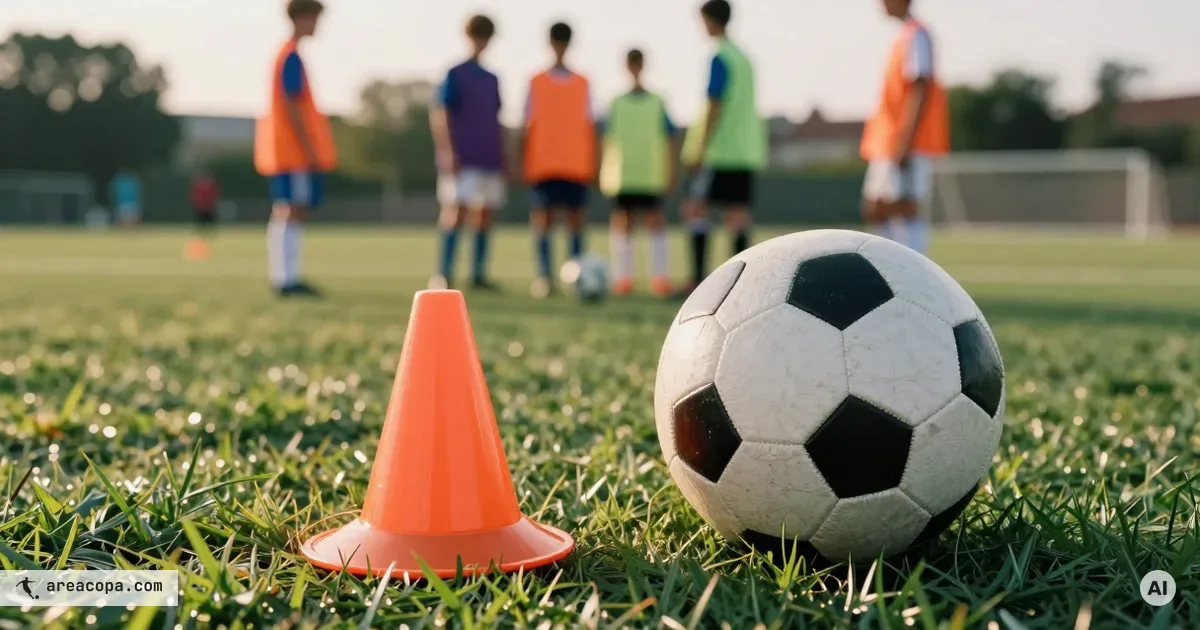
It is Tuesday evening, 5:50 pm. Stefan, a volunteer youth football coach, or soccer as the game is known in North America, stands at the touchline watching 14 children warm up. Two are running with the ball, four are chatting, three are kicking balls into the grass. Stefan has decided to work on passing today. In his head is the drill he learned as a child, the same one most of us did: three cones in a line, one child passes, the next controls, dribbles two metres, passes back. Twenty minutes of drilling.
What Stefan does not know: sports science has debunked precisely that drill for twenty years. What he knows even less: the methods now standard at Mainz 05, Schalke 04 and Bayer 04 Leverkusen were published by a man named Horst Wein back in 2004. The professionals have long since adopted them. Stefan on Tuesday evening has not yet.
That is precisely the exciting shift in youth football in 2026. Not that revolutionary new methods have suddenly appeared. But that the well-evidenced methods of two decades are finally making it into the weekly training session. New studies, the UEFA Coaching Newsletter of March 2026 and the DFB with revised game formats all point in the same direction. The following five methods have the highest leverage for your next training sessions with the youngest age groups.
Why the Classic Training Session No Longer Suffices in 2026
German youth football training in the 1980s and 1990s was shaped by two waves. First the fitness wave of the 1970s: strength, endurance, athleticism. Then the technical wave of the 1980s: slalom dribbling, passes in lines, isolated shooting technique. Both produced a type of player who was physically and technically adequate but often read game situations poorly.
Memmert and König of the German Sport University Cologne wrote as early as 2011: "A ball loss in a game is caused more than 50 percent by a wrong decision, not a technically incorrect movement." In other words: your players do not lose the ball because of bad technique at the cones, but because they do not recognise in the game when to apply that technique.
Exactly this decision-making component is not learned through drilling but only through what sports scientists call Game-Based Learning: repeated exposure to similar game situations that the player must solve themselves. A 2026 review paper evaluating 21 independent studies on this approach reaches a clear conclusion: Game-Based Learning consistently improves decision-making ability and game understanding more than technique-based training. The five methods below make this concrete.
Method 1: Smaller Pitches, More Ball Contacts
Horst Wein, former adviser to the Spanish Football Federation and inventor of the Mini-Football concept, recorded a central figure in 2004: In 4v4, a player has five times as many ball contacts as in 11v11. This figure has been reproduced multiple times since. A 2025 market analysis shows: 90 percent of all worldwide football participation now runs through smaller game formats, especially in youth football.
5× as many ball contacts
in 4v4 compared to 11v11 per player
Source: Wein, H. (2004). Entwicklung der Spielintelligenz im Fußball.
Why does this matter so much? Every ball contact is a repetition of perception and decision-making. Anyone who wants to develop talent needs these repetitions, and they only arise on small pitches. What talent actually is and how it arises is explored in our guide to talent development. Wein puts it in a single sentence: "Talent develops in the repeated encounter of many players in small-sided games, while the large pitch exhausts the creative, lively and imaginative player."
The DFB progression:
- Bambini and youngest group: Mini-football 3v3 on four mini-goals, no goalkeeper
- Next age group: 5v5 to 7v7
- D youth (first year): 7v7
- D youth (second year): 9v9
- C youth and above: 11v11
Game formats per age group
How the pitch grows with the children, DFB progression
Source: DFB Youth Regulations 2024, Annex IV; fussballtraining 8/2011.
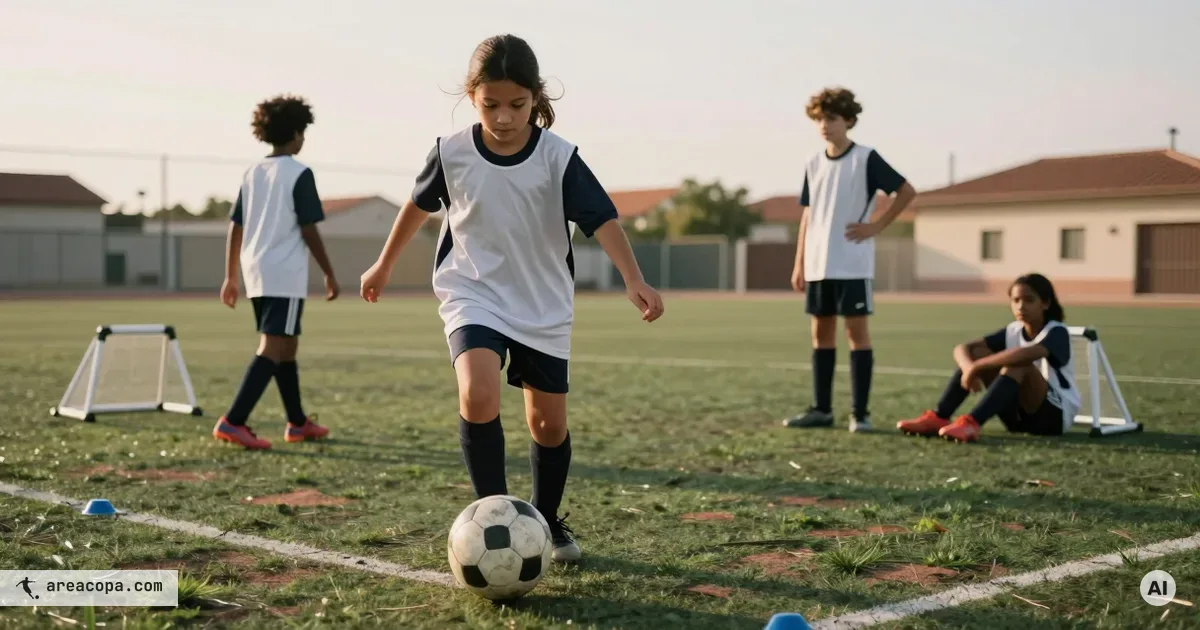
For your Tuesday this means: if you have 12 children, you do not run one 6v6 on two goals but two parallel 3v3 pitches each with four mini-goals or cone-goals. You need eight extra cones and every child has the ball continuously. How to carry the same equal-time logic into the season at 9-a-side and 11-a-side so the bench does not become a drop-out trap is laid out in fair playing time in youth football.
A common objection comes from parents and older children: "But we want to play like the pros!" The answer: the professionals also do not play 11v11 in training. They play positional games like 4v2, 5v3, 6v3 under time and space pressure. Helmut Schulte, former youth coordinator at Schalke 04, puts it this way: "When 3v3 is played in a tight space, coached where necessary, children learn to act creatively and cleverly." Exactly what you want.
Method 2: Stimulate Rather Than Instruct
The second trend is methodologically the hardest because it does not change the training session but the coach themselves. Horst Wein captures it in four words: "Stimulate rather than instruct." While the children play, you talk less and ask more. Sounds simple. It is not.
Daniel Memmert and Stefan König (German Sport University Cologne) formalised the concept in an influential 2011 paper as Deliberate Coaching. The core message: children receive no hints from the coach that narrow their attentional focus. Early tactical "reading instructions" lead to perceptual restrictions.
How strong this effect is is shown by a study from the same research group: 45 percent of test subjects missed free teammates under pressure when they had previously received tactical instructions. Coaching cues like "Play it wide right!" narrow the gaze and cause the child to literally no longer see the open centre.
For your next training session this means concretely:
- Blow the whistle, state the rule, then stay silent. While the children play, you observe. You do not speak.
- After the game ends, ask one question, not an instruction. For example: "What was actually possible in the situation at the back left?" or "Where could your teammate have stood free?"
- Wait for the child's answer. Even if it takes twenty seconds. Precisely that thinking process is what you actually wanted to train.
A good self-test: at the next training session, have someone count how many times you speak during a game form. Anyone at the start of this trend quickly reaches twenty to thirty coach interventions per game form. Target: under five.
Method 3: Sport Variety Instead of Early Specialisation
The well-intentioned ambitious reflex of many clubs is: if a child is talented, they should play only football from an early age. Methodologically wrong, health-risk-wise dangerous, and not even effective in the long term.
The first study to demonstrate this cleanly in Germany comes from Daniel Memmert and Klaus Roth in 2007. A 15-month field study with 135 children compared three groups: one football-specific, one handball-specific, one multi-sport. Result: the multi-sport group developed clearly higher game intelligence and game creativity than the football-specific comparison group. Memmert formulates it in the original: "Non-specific concepts can even prove to be more workable in the long term." Variety beats early specialisation.
A current study from New Zealand confirms the injury side with hard data. Researchers examined 20 male youth players, eleven of them specialised, nine multi-sport. Results in change-of-direction tests:
- Specialised players: 9 percent asymmetry
- Multi-sport players: 4 percent asymmetry (p=0.01)
This asymmetry between the left and right leg increases the risk of knee and hip injuries. Sprint performance was identical between both groups. Early specialisation therefore brings no measurable performance advantage but a measurable injury risk.
An extensive UEFA study comparing German and English talent development reaches the same conclusion. It identifies "over-professionalization at young age" as the central weakness of the English Premier League model.
In club life this does not mean your D youth needs additional handball training. It means:
- Allow other sports in parallel. Swimming, athletics, basketball on school afternoons are not competition but complementary.
- Integrate other movement forms yourself occasionally in your warm-up: throwing-shooting competitions, handball games across the centre line, rounders as a fitness finish.
- Avoid a year-round football programme. A 4 to 6 week summer break is valuable for health and mental wellbeing.
Method 4: Six Basic Tactics as a Common Thread
A common problem for volunteer coaches: searching for a new drill each week, browsing the internet, scrolling through football coaching apps, sitting frustrated in front of an empty training plan on Monday evening. Memmert and König offer a way out: six cross-sport basic tactics that according to empirical studies explain around 50 percent of match performance in football, handball and hockey.
The six basic tactics:
- Targeting the goal: finding the route to goal, with or without the ball
- Moving the ball towards the goal: gaining ground spatially, through pass, dribble or carry
- Combination play: playing the ball to partners quickly and appropriately to the situation
- Exploiting gaps: recognising spaces and using them for passes or runs
- Protecting the ball in 1v1: securing and shielding possession in a direct duel
- Creating numerical superiority: creating an advantage through offering and orientating
The didactic idea: each training session you focus on one basic tactic. This gives your season plan a recognisable architecture without you having to rethink every week. Three weeks in a row on "creating numerical superiority" with different game forms, then three weeks on "exploiting gaps", and so on.
A concrete game form example for "creating numerical superiority" from Memmert's practice collection:
Forbidden Zone. Two teams of four players each. In the centre of the pitch a 4x4 metre zone is marked with cones. Each team's objective: ten touches among themselves without the other team touching the ball. No ball contact may occur in the marked zone. If it does, possession switches. Which team has the most ten-touch sequences after five minutes?
What the game teaches: if the opponent stands centrally (in the "forbidden zone"), you can only win via the flanks. If you immediately try to play through the middle, you lose the ball. That is precisely the lesson of "creating numerical superiority" in the real game.
Variation for older children: double the zone in length, add a joker on each flank, or prohibit all contact with the ball in the zone.
Method 5: Futsal Instead of Indoor Kickabout in Winter
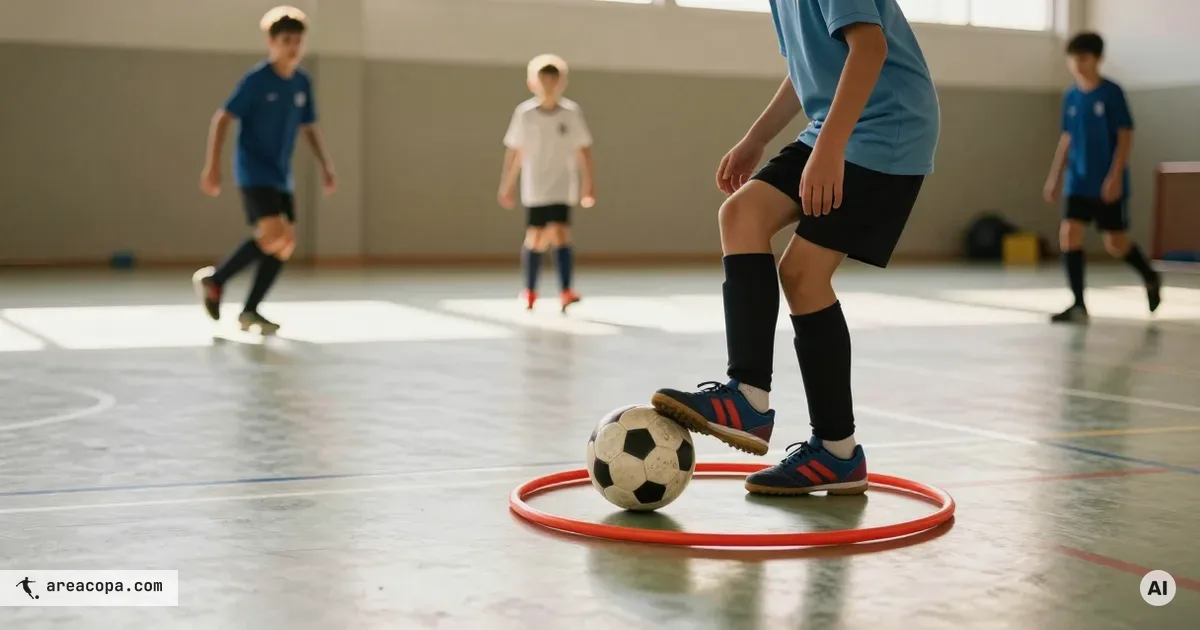
In winter most clubs move to the sports hall and play what they always play: 7v7 with boards and a standard football. Anyone who does this wastes the format that has been the most important talent accelerator in Spain, Portugal and Brazil for decades.
Futsal follows different rules:
- Out-line instead of boards (the ball can go out of play)
- Smaller ball with reduced bounce (size 4 for E and D youth, size 3 for the youngest group)
- Four outfield players plus goalkeeper instead of the usual 7
- Flying substitutions (at any time, without referee approval)
- Playing time 2x20 minutes effective
What happens methodologically is precisely what you want: every player has high responsibility, cannot hide behind the boards, must apply precise passing and receiving techniques under pressure. Spanish international players such as Andrés Iniesta, Xavi and David Silva played almost exclusively futsal as children. Their legendary ball-handling does not come from a special talent but from this format.
José Hierro Venancio López, head of the UEFA Futsal Advisory Group, explained it in the UEFA Coaching Newsletter of March 2026: "Futsal helps young footballers because in 5v5 you always touch the ball and always think. When you play 11v11, you sometimes barely touch the ball." UEFA founded its own Futsal Advisory Group in the same month to build coach education pathways in the national associations. Germany is explicitly mentioned in the newsletter as a country that has taken first steps towards futsal integration over the last ten years.
For the next indoor season at your club:
- Mark an out-line with tape along the hall wall (one metre distance is enough)
- Bring a futsal ball (15 to 25 euros, size 4)
- Play 5v5 with flying substitutions. With 16 children: two teams of eight, always five on the pitch, three outside.
That is all it takes to transform indoor training from a board kickabout to game intelligence training.
How to Implement This from Next Week
Introducing all five methods at once will make training chaotic and leave you lost. A realistic plan for the next 30 days:
- Next session (Method 1): Instead of one large game at the end, let them play two parallel 3v3 matches with mini-goals or cone-goals. You need nothing extra except eight additional cones.
- In two weeks (Method 2): Run one complete training session without any tactical correction. Only rules and kick-off, then observe and ask one question after the game ends. Have a co-coach count how many times you intervene.
- In four weeks (Method 4): Take one basic tactic from Memmert's six (for example "exploiting gaps") as a common thread for three consecutive sessions and vary it with different game forms.
Anyone using a tool like AreaCopa can apply the new methods directly in the club's summer tournament or a mini-cup, rather than only seeing them in training. Competition is the most honest feedback on whether the methodology has reached the children. When your 3v3-trained player suddenly spots free teammates in the summer tournament, you know you are on the right track.
Plan my next club tournamentFree and no sign-upSources and Further Studies
The studies and books on which this article is based:
- Wein, H. (2004). Entwicklung der Spielintelligenz im Fußball. Institut für Jugendfußball / Carolus-Sportverlag, ISBN 3-927570-60-5. Source of the "5x ball contacts in 4v4" figure and the Mini-Football concept.
- Wein, H. (2006). "Mehr Spielintelligenz!" In: fußballtraining 5+6/2006, pp. 56–62, Philippka-Sportverlag. With comments from Helmut Schulte (Schalke 04) and Dr Matthias Lochmann (Mainz 05) on practical implementation.
- Memmert, D., & König, S. (2011). "Zur Vermittlung einer allgemeinen Spielfähigkeit im Sportspiel." German Sport University Cologne. Source for the four methodological principles (One-Dimension Games, Diversification, Deliberate Play, Deliberate Coaching) and the six basic tactics.
- Memmert, D., & Roth, K. (2007). "The effects of non-specific and specific concepts on tactical creativity in team ball sports." Journal of Sports Sciences, 25(12), 1423–1432. 15-month field study with 135 children on sport variety vs. specialisation.
- Memmert, D., & Furley, P. (2007). "'I spy with my little eye!': Breadth of attention, inattentional blindness, and tactical decision making in team sports." Journal of Sport & Exercise Psychology, 29(3), 365–381. Source for the "45 percent miss free teammates" figure in the handball-specific decision test.
- Furley, P., Memmert, D., & Heller, C. (2010). "The dark side of visual awareness in sport: Inattentional blindness in a real-world basketball task." Attention, Perception & Psychophysics, 72(5), 1327–1337. Replication of the effect with adults in basketball.
- Piri, N., Ihsan, F., Makadada, F. A., Lolowang, D. M., & Sobko, I. (2026). "Game-based learning strategies to enhance tactical awareness in youth football: a mixed-methods systematic review." Health, sport, rehabilitation 12(3), 26–34. Review of 21 independent studies on Game-Based Learning in youth football.
- Zoellner, A., Read, P., Whatman, C., & Sheerin, K. (2026). "Does Specialisation Impact Sprint and Change of Direction Performance in Youth Football Players?" International Journal of Strength and Conditioning, 6(1). Sport Performance Research Institute New Zealand. Source for the 9 percent vs. 4 percent asymmetry data.
- Mueller, J., Küchle, A., & Kübel, T. (2025). Developing Elite Footballers Across Europe: A Comparative Study of German and English Youth Development Philosophies. UEFA Research Grant Final Report, Loughborough University London and International Football Institute. Source for the "over-professionalisation at young age" criticism of the English Premier League model.
- UEFA (March 2026). The Technician: A Blueprint for Success. Enhancing the quality of futsal coaching and the growth of the game at all levels. UEFA Futsal Advisory Group, interview with José Hierro Venancio López. Source for the futsal recommendation and the new Advisory Group.
- FRANdata (March 2025). Small-Sided Soccer: A White Paper on Industry Trends and Market Analysis. Market analysis on small-sided soccer participation. Source for the "90 percent of worldwide participation runs through smaller formats" figure.