
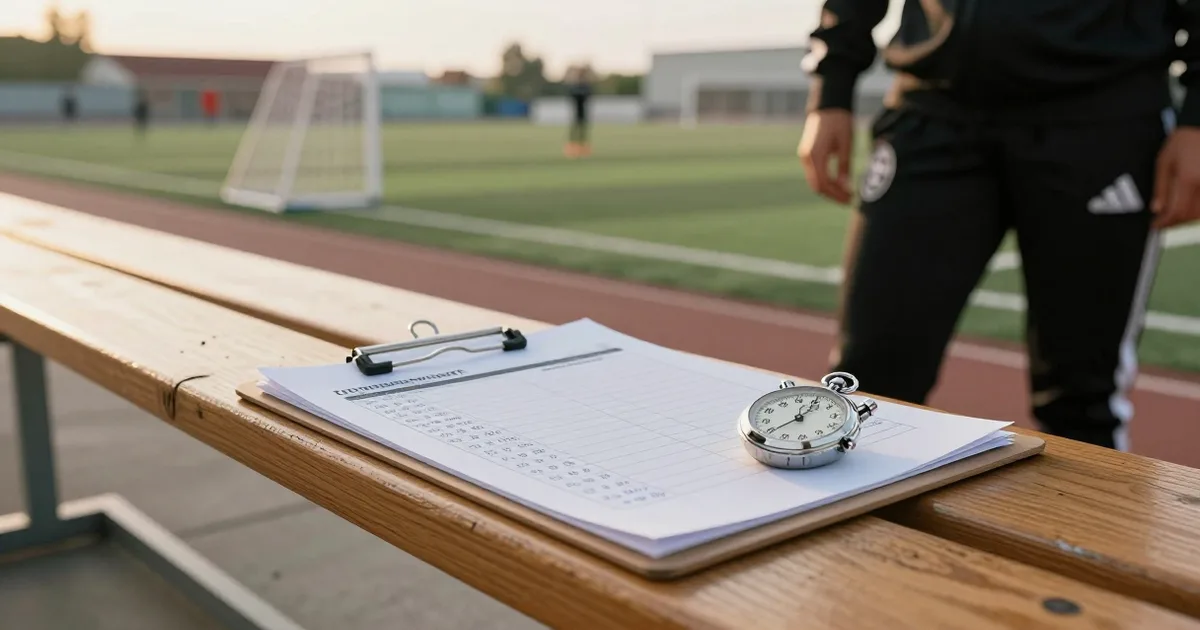
It is 14:32, the third match should have kicked off two minutes ago, and you are standing at the clipboard wondering whether you have to cut the semi-final already. Every tournament organiser knows that moment. It almost never happens because the tournament was too big. It happens because the plan never had an honest pause calculation.
This article shows how to plan kickoff times so that small delays absorb themselves and bigger ones do not drag the whole tournament with them. If you are still at the format stage and want to know how many matches 5, 7 or 10 teams actually need, start with the schedule guide by team count. Here we focus on the mechanics: the brutto formula, the four buffer types, and the three escalation stages when something slips anyway.
What a good kickoff-time plan delivers
A schedule that only carries match times and a format is a promise without backing. Three requirements must sit before the first clock time hits the clipboard.
An honest brutto formula. A match does not just take its match time. It takes match time plus pause for substitutions and the next kickoff. Anyone counting in net time arrives 15 minutes short.
A clear buffer separation. The pause between matches is only one of four buffer types. Block-buffer, lunch break and end-reserve are their own categories with their own purpose. Pooling them loses precisely the reserve you need later.
A rule for the plan-B moment. Delays are not the exception. They are the norm. Without a pre-thought escalation, you make bad decisions on the day under pressure.
The mechanics: brutto formula and four buffer types
The brutto formula is simple:
Brutto per match = match time + micro-buffer
That is all. A round robin with 6 teams, 10-minute match time and 3-minute pause comes to 15 games at 13 minutes each, equal to 195 minutes. The same tournament with 8-minute match time and 3-minute pause comes to 165 minutes. Match time is the most important variable, not the number of games.
The DFB recommendation for youth football names a clear figure: 3 minutes of pause between rounds in the festival format for U6 to U11, with up to 10 minutes of match time per round. That pause is enough for the squads to rotate to the next pitch, for a quick drink, and for the referee to whistle the next kickoff. Experienced coaching teams from U13 upwards cut it to 2 minutes in indoor halls because substitutions run faster. Below 2 minutes the plan turns hectic the moment a substitution goes wrong.
The four buffer types each fill a distinct role:
| Buffer type | Duration | Where in the plan? | Function |
|---|---|---|---|
| Micro-buffer | 2 to 3 min | between every match | Substitutions, kickoff, quick drink |
| Block-buffer | 5 to 10 min | between group stage and knockout | Final standings, communicating the knockout draw |
| Lunch break | 30 to 45 min | after 50 to 60% of matches (outdoor) | Catering, parent handover, real player recovery |
| End-reserve | 15 to 30 min | before the trophy ceremony | Catching up every prior delay in one place |
The most common mistake in pause planning is pooling everything into one pot and believing at the end that you have enough reserve. In reality you have a badly placed lunch break that does not substitute for the other buffers. The block-buffer is the most-overlooked category, because on paper it looks like wasted time. Without it, the semi-final starts 6 minutes too early, because coaches are still discussing the final standings.
A fifth category, the recovery-buffer, is not in the plan but in the reaction to it. More on that below.
Indoor kickoff times: 8 teams in 3 hours on one field
The standard club indoor cup with 8 teams in 3 hours is the most common format. Two four-team groups with semi-finals and a final yield 15 matches total: 12 group games plus 2 semi-finals plus 1 final. We skip the third-place playoff to keep the closing phase from getting tight.
With 10-minute match time and 3-minute pause we would land at 15 times 13 equals 195 minutes. That does not fit a 180-minute hall block. Two options solve the issue: cut match time to 8 minutes (the standard for U8 and U10 in indoor play), or stay at 10 minutes and shorten the pause to 2 (practical from U13 upwards). We go the DFB-aligned variant here: 8-minute match time plus 3-minute pause equals 11 minutes per match. 15 times 11 equals 165 minutes, plus 15 minutes of room for the block-buffer and the end-reserve.
Kickoff times: 8 teams, one field, 14:00 to 17:00
Two four-team groups plus semi-finals and a final. 8-min match time, 3-min pause, 5 min block-buffer, 10 min end-reserve.
The match order is not random. Group A and Group B games alternate, so that no team plays two matches back to back. In this layout, each team has at least two foreign games between its own appearances. Anyone who plays the schedule block by block (all of Group A first, then all of Group B) risks dead legs and red faces in the last rounds.
To run the same tournament with 10-minute match time, extend the hall block to 14:00 to 17:15 or drop the pause to 2 minutes. Both are legitimate. The 8-minute variant has the advantage that someone at the end of the tournament is still awake.
Anyone who wants to minimise the planning effort uses a tool like AreaCopa and saves the spreadsheet. The mechanics from this article are built into the schedule generator: enter team count, hall block and match time, get the finished kickoff times. If you still want to track the calculation, you find it in the table above.
Outdoor kickoff times: 12 teams on two parallel fields
Outdoor day tournaments have more elasticity than indoor ones. The block is usually 6 to 8 hours, and one to two hours of reserve at the end is normal: for weather, for the routine morning lateness, for long trophy ceremonies with ten squads and parents. The mechanics do not change, but the options grow.
We take 12 teams in three four-team groups: A, B and C with four squads each. Each group plays 6 matches, 18 group games in total. Knockout phase: two quarter-finals (for the two best group runners-up, while the group winners get a bye into the semi-final), two semi-finals, one third-place playoff, and the final. That is 6 knockout games, 24 matches in total.
With 12-minute match time and 3-minute pause every round takes 15 minutes. On two parallel fields, Groups A and B run simultaneously through 6 rounds (90 minutes). Group C then takes both fields for its 6 matches, another 3 rounds (45 minutes). Group stage finished 135 minutes after kickoff. Knockout phase: quarter-finals in parallel on both fields, then semi-finals, third-place and the final consecutively on Field A so the audience stays on one line.
Kickoff times: 12 teams, two fields, 9:00 to 16:30
Three four-team groups plus quarter-finals, semi-finals, third-place playoff and final. 12-min match time, 3-min pause, 45-min lunch break.
The lunch break sits deliberately between group stage and knockout, not in the middle of the group stage. Reason: this is the natural cut in the tournament. The standings are settled, the knockout draw can be communicated, and parents know when their team plays next. A lunch break in the middle of the group stage tears the rhythm and costs an extra 10 minutes of warm-up after the restart.
The knockout phase runs on one field only, because the tension then sits on one line and the referee logistics are simpler. The quarter-final is the exception: both games run in parallel on the two fields, because they do not yet carry the weight of a semi-final and parents from both squads want to watch their team simultaneously.
The end-reserve of roughly two hours between trophy ceremony and the hard cut-off is the outdoor standard. It covers three risks: weather (thunderstorm break), morning delays (one squad arrives 20 minutes late), and unplanned overtime in the knockout games if a tie leads to penalty shoot-out or golden goal.
When the plan slips: the three escalation stages
Delays come from ordinary reasons: a player is down, a referee needs a clarification, a squad walks out of the changing room late. Three stages are enough to lock in the right reaction in advance.
The three escalation stages when behind
Which action for which delay. Do not skip a stage, or a small delay breaks the whole plan.
Stage 1: breathe
Up to 5 minutes behind, do nothing. The micro-buffer absorbs it across the next three or four matches automatically, if the referee whistles a bit tighter. First-time organisers overreact here most often and tear into the block-buffer for no reason.
Stage 2: cut the block
Between 5 and 15 minutes behind, nibble at the block-buffer and end-reserve. Cap half-time talks, call substitutions tight, run the knockout draw in 3 minutes instead of 10. Never cut match time, that causes disputes between squads.
Stage 3: emergency brake
Above 15 minutes behind, do it once and uniformly: shorten every remaining match by 1 to 2 minutes, announced cleanly. Alternative: skip the third-place playoff. Knockout games stay at full length, the trophy ceremony just starts 10 minutes later.
Three additional rules that do not sit in any stage explicitly but shape the practice:
Never cut a single match in isolation. If you reduce match time, do it uniformly for every remaining match at the same time. A single reduction favours or disadvantages one team and that causes disputes. Announced uniformly, it is a matter-of-fact plan adjustment.
Knockout games are sacred. Semi-finals and the final stay at full length, even if the ceremony then starts 10 minutes later. Parents accept a later finish. A shortened final feels worthless to the teams.
Active pause between a squad's own matches. Players with 20 minutes of rest between their own two games should not jog continuously, but also not sit completely. A mix of brief warm-down, mobilisation drills and a drink works better than either extreme. Studies on recovery between bouts suggest passive pauses have their own justification (Dähler 2017): teams kept constantly warmed up rarely return to the next match with cool focus.
What comes next
You now have the brutto formula, the four buffer types and the three escalation stages. What remains is the actual schedule calculation: pick the format, work out the kickoff times, drop them onto a schedule, print it for the clipboard. Anyone doing this by hand sits at the kitchen table again for the second tournament and double-checks the numbers anyway.
The schedule generator does exactly this in under 5 minutes: enter team count, match time, hall block and pause, get finished kickoff times with a spectator link for everyone involved. The mechanics behind it are in this article.
If you are still uncertain about the format and do not know whether 5, 7 or 10 teams fit your hall, start with the schedule guide by team count. For the classic 8-team indoor cup with everything around it, see the indoor tournament checklist. And for the most common traps before your first tournament, see the five biggest tournament-planning mistakes.
Kickoff times in 3 minutes instead of 3 hours in Excel: create your schedule now
Free and no sign-upSources
- DFB: Competition Formats in Youth Football, Booklet, edition September 2024. Recommendation of 3-minute pauses between rounds in the festival format for U6 to U11; up to seven rounds of ten minutes each per match day.
- DFB: FAQ Youth Football, edition 31 May 2022. Explanation of the festival format and the rotation of teams between pitches.
- Dähler, Cyril (2017): Different effects of active versus passive recovery on endurance performance during a handball-specific 4x4-min HIT block. Master's thesis, University of Salzburg. Background on whether players should warm up actively or rest passively in the gap between their own matches.