
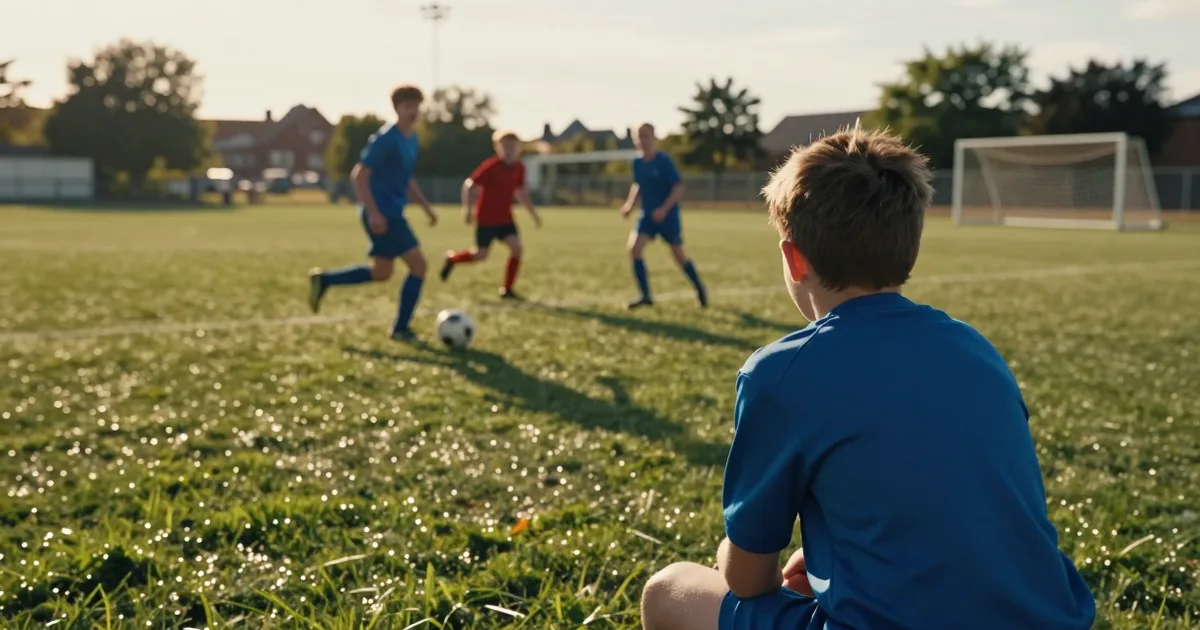
You're on the touchline, your team has the ball in the opposition third, a cross comes in, overhit, the opponent turns over, three passes, goal. On the way back you look at your shape and realise: there was literally no one at the back. All six outfield players were somewhere between the halfway line and the opposition box.
That's exactly what the term rest defence is for. You heard it in a coaching course, maybe in a live commentary during a televised match. But the concrete bridge is missing: How do I actually train this on a Wednesday evening with my U13s? This article closes that gap. Definition, principles, three drills, common mistakes, coaching in games.
When everyone rushes forward, the counter comes
The typical picture in youth football: the ball is up front, everyone wants in on it. The full-backs push up, the holding midfielder steps higher, the centre-backs are on the halfway line. It feels brave. It works as long as the attack finishes.
The problem starts the moment the ball is lost. Two opposition passes are enough, and your team is sprinting 40 metres back while an opposition striker runs in alone on your keeper. In the post-match chat you hear the usual lines: "I thought Max was covering." "Why didn't anyone track back?" And at the end: "Just unlucky."
That wasn't unlucky. That was missing rest defence. Exactly the same risk shows up in active forward pressing: a team that bravely presses high without rest defence behind it invites every counter. How to train pressing at U13/U14 without opening that hole is in the article on counter-pressing.
What rest defence actually is, in two sentences
Rest defence refers to the players who deliberately stay back during your own attack to prevent an opposition counter. They cover the space behind the attack, not a specific opponent, but the space itself.
That's the difference from "marking". Marking means: I track my man. Rest defence means: I hold a specific position and cover the space a counter would run through. This distinction isn't trivial for young players. That's exactly why you have to teach it to them.
Rest defence is one component of transition play. For the broader context around ball wins and ball losses, see the article on transition play in youth football.
Why rest defence works differently in youth football
In the pro game, rest defence is about fine-tuning: does the six drop between the centre-backs? Does the far-side full-back cover half a half-space? That's irrelevant for youth players and just overwhelms them.
What matters in youth football is three simple things:
- There is actually someone at the back when the ball is up front.
- That someone is positioned to stop a long ball or a counter.
- The players know themselves that they have this role right now. It isn't decided by chance.
If your team internalises those three points, you've covered 80% of the topic. Anything beyond that is detail work for older age groups.
The three principles: number, staggering, distance
If you want to explain rest defence to your team, boil it down to these three words. You can use them at any age group.
Number. How many players stay back? Rule of thumb: one more than the opposing strikers. If two strikers push up, three of yours stay back. If one striker pushes up, two are enough. Plus keeper.
Staggering. The rest defenders don't stand on one line. One deeper, one slightly higher, offset sideways. That creates a depth stagger that intercepts both a long ball and a short pass through the middle. Lines can be played through, staggered shapes can't.
Distance. The rest defenders don't stand 30 metres apart. Between two rest defenders, 10–15 metres maximum. Too much distance = the opponent runs between them. Too little distance = one one-two and both are beaten.
Three words your players can remember. They don't need more.
Line vs. depth stagger
On a flat line (left) the counter runs through the gap. Offset and staggered (right) the two rest defenders close both routes.
Who stays back, by playing system
Here it gets concrete. The players need to know what role they have in the rest defence. It depends on the system and the age group.
Small-sided 7v7 (U8/U10): The two deepest outfield players stay back. Full stop. Anything else is too much at this age. In practice these are usually the two defenders, even though 7v7 has no formal positions.
9v9 (U12): In a 3-3-2 or 3-2-3, the three defenders stay back. The holding midfielder pushes to the halfway line during your team's possession, no further. Result: three rest defenders plus one screener = an overload against one or two opposing strikers.
11v11 with a back four (U14 and up): The two centre-backs stay back. The ball-near full-back pushes up, the far-side full-back stays deeper and tucks into the half-space. The holding midfielder drops between or in front of the centre-backs depending on which side the ball is on. Result: three to four rest defenders in a staggered triangle.
11v11 with a back three (U16 and up): The three centre-backs stay back as a baseline. The two holding midfielders alternate: one pushes up, the other screens. Result: four rest defenders, classic cover box.
Remember the pattern: up to U12 you don't need a back three, no dropping sixes, no asymmetric full-backs. Two clear rest defenders with staggering are enough. From U14 it starts to pay off to introduce finer distinctions.
At what age this makes sense
Below U8: not at all. At that age "everyone goes to the ball" is normal and actually correct, because the kids are only just starting to understand the game.
U10: light hints, no drills. You can say "Lars, you stay back when we're attacking", but keep the structure loose. Who tracks back is secondary, the main point is that not everyone is up front.
U12: entry point. Children between 10 and 12 are in a phase where they first become able to grasp abstract concepts like "covering space". That's exactly the developmental window you exploit with U12: introduce the three principles, run your first drills. Two sessions a month are enough.
U14: core topic. From here on, rest defence is a fixed part of every tactical session. This is where they learn that rest defence also applies to transitions, not just to set pieces.
U16 and older: fine-tuning. Asymmetries, system-specific adjustments, individual role allocation depending on the opponent. This is the area where coaches often overdo it. Here, quality matters more than quantity.
When to introduce rest defence
Recommendation by age group, from first hints to a systematic session.
Own classification after Wein (2009) and Piri et al. (2026)
All three drills below follow the same principle: players learn rest defence not through isolated tactical lectures but through real game situations with a counter trigger. Research on game-based learning in youth football consistently shows that game forms outperform drill-based practice for transferring decision-making and tactical awareness into matches.
Drill 1: Positional play 6-v-3 with cover
Drill 1 setup: positional play with rest cover
25 by 15 m field split into front and back zones. On the counter call the two strikers receive a long ball and attack the rest defenders.
Setup
Field 25 × 15 metres, split into two zones: front zone 15 metres, back zone 10 metres. Six attackers in the front zone, three defenders also in front. Two "rest defenders" from the attacking team stand in the back zone. Two strikers from the opposing team wait behind the front zone and can receive a long ball on call.
Flow
The six attackers play in the front zone with the ball, target: ten consecutive passes. At random moments the coach calls "Counter!". At that same moment the two opposing strikers receive a long ball and set off. The two rest defenders have to stop the counter. 60 seconds on, 30 seconds rest, then rotate.
Variation
Instead of "Counter!", use turnover as the trigger: as soon as the three defenders win the ball, they play it to the strikers in the back zone, a genuine counter-moment.
Coaching focus
Staggering of the two rest defenders. Not on one line but slightly offset, 8–10 metres apart. One takes the first attacker, the other covers the second. Don't both go for the same ball.
Drill 2: 4-v-4 plus two rest defenders
Drill 2 setup: 4 v 4 with rest defenders
30 by 20 m field. Attackers attack the big goal, defenders counter on a ball win to either mini-goal. R1 / R2 are not allowed to cross the halfway line.
Setup
Field 30 × 20 metres, one big goal with a keeper on one end, two mini-goals on the other. Four attackers against four defenders over the whole field. Plus: two rest defenders for the attacking team, who aren't allowed to cross the halfway line towards the big goal.
Flow
The attackers attack the big goal. The defenders defend and can counter on either mini-goal at any time after winning the ball. The rest defenders have one job: prevent the counter. Every counter goal counts triple. Play three minutes, then switch ends.
Variation
From U14: the rest defenders may push up to the halfway line during their team's attack, but have to drop immediately on turnover. Forces players to decide their height during play, not stick to fixed zones.
Coaching focus
The moment of turnover. The rest defenders shouldn't ball-watch. They need to scan the space and anticipate counter options before the ball is actually lost.
Drill 3: Game form with counter goals
Drill 3 setup: game form with mini counter goals
Regular 7 v 7 or 9 v 9. Four extra mini counter goals (two per side, 15 m from the penalty area). Counter goal counts triple if the shot lands within 7 seconds.
Setup
Regular 7v7 or 9v9 on whatever field you have. Two extra mini counter goals to the right and left of each big goal, 15 metres from the penalty area.
Flow
After winning the ball, the defending team can either attack the opposing big goal (one point) or finish directly on one of the counter goals (three points). Condition for a counter goal: the counter has to be completed within seven seconds of winning the ball. After that, only regular goals count.
Variation
For U16: the attacking team can only score if at least two players stayed in their own half during the attack. A good rule to make rest defence a precondition for the attack.
Coaching focus
Before every attack, the attacking team has to decide: who stays? Who pushes up? After each round, a 30-second pause where the players themselves name who had which role. A player who explains their decisions in their own words remembers them longer than from coach feedback alone. The talking matters more than the coaching.
The five most common coaching mistakes
Mistake 1: only introducing rest defence from U14. Too late. You can already plant the principles in simpler form at U12. Waiting until U14 is three years of wasted potential.
Mistake 2: not naming the role. "Someone has to stay back" isn't enough. Before every match, say it concretely: "Lars and Jonas, you are rest defenders. When we attack, you stay behind the halfway line, staggered, 10 metres apart." Otherwise nobody does it.
Mistake 3: too much complexity. Dropping sixes, half-space cover, far-side full-back as an extra centre-back: all nice, but not for U13s. Stick to two or three principles.
Mistake 4: rest defence only in isolated drills. If the topic only shows up in an isolated 6-v-3 exercise, players don't grasp that it's a basic attitude. Build it into every game form, including loose finishing games.
Mistake 5: not addressing mistakes concretely. If a counter gets through and you say "we need to cover better", nobody learns anything. Instead, say: "Paul, you were inside the opposition box just now, even though you were the rest defender. That's your space at the back, not up front." Concrete, player-specific, without blame.
How to coach it in-game: three simple cues
Players need cues they can understand from 40 metres away. Three have proven themselves in practice:
"Rest!": shout at the rest defenders when they push up too far. Short, loud, clear. The players know: I'm too high, I have to drop.
"Stagger!": shout when two rest defenders are on the same line. One should drop, one should push up.
"Inside!": shout at the far-side player when he isn't tucking in and is stuck out wide. He has to slide towards the centre as soon as the ball is on the other side.
More than three cues overload everyone. Studies on young players' attention show that too many live instructions actually narrow their focus: players notice open teammates and spaces less well because they are busy processing the coach's prompts. Three cues are enough. The rest you can discuss at half-time and after the game.
From training into a tournament
The best test of whether your team has internalised rest defence isn't Sunday's league game, there are too many other variables at play. The best test is a controlled environment where you see the same team in several short matches against different opponents.
A small internal tournament is perfect for this. Two or three teams, four to six short matches of 10 minutes, with a minute between them where you have a quick word with your rest defenders. You see in direct comparison what works and what doesn't. The players get repetitions under real competitive pressure. And at the end you have a table that motivates more than any drill session.
A complete preparation template is in the football tournament checklist. Set up the fixture list digitally, print it out, and pin it to the sideline:
Plan your own tournament in 2 minutesFree and no sign-upSources
- Wein, H. (2009). Developing Game Intelligence in Soccer (2nd ed.). Meyer & Meyer Sport. — Five-stage development model (U10 to U16), entry to tactical game forms from U12 (age 10+).
- Memmert, D., & König, S. (2011). Teaching tactical creativity in sport. In A. Güllich & M. Krüger (Eds.), Sport — Das Lehrbuch für das Sportstudium. Springer. — "Creating numerical superiority" as a basic tactic; deliberate-coaching principle; finding that too many instructions narrow attentional focus.
- Piri, N., Ihsan, F., Makadada, F. A., Lolowang, D. M., & Sobko, I. (2026). Game-based learning strategies to enhance tactical awareness in youth football: a mixed-methods study. Health, Sport, Rehabilitation, 12(3), 26–34. — Systematic review showing that game forms consistently improve tactical understanding and decision-making; game-based learning most effective at ages 10 to 14.