
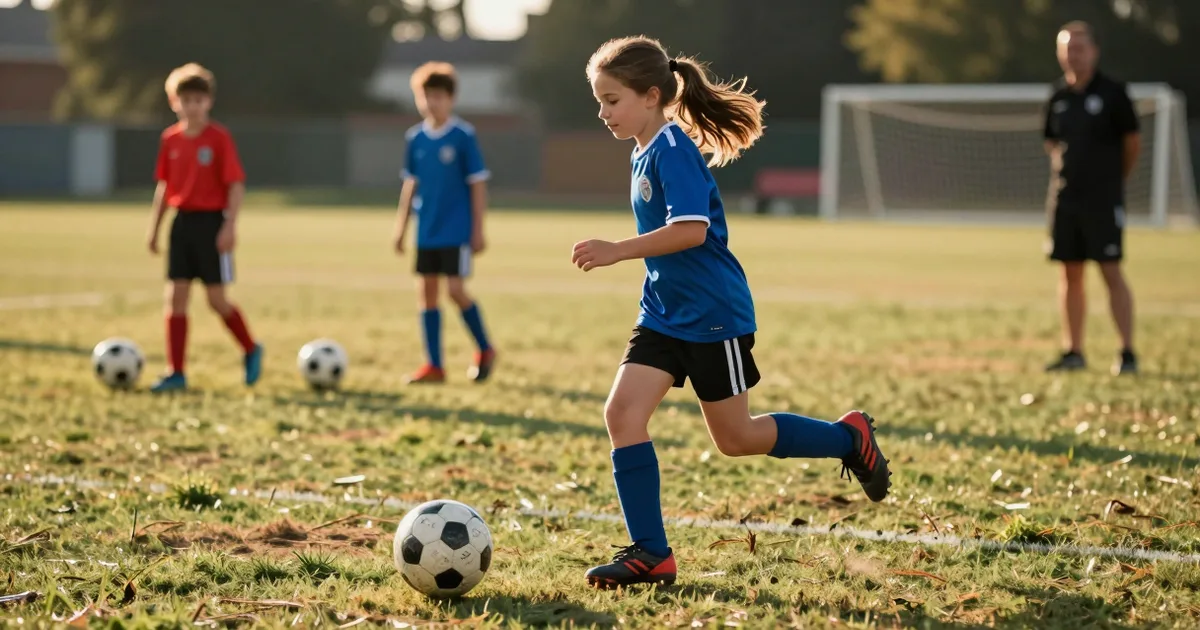
You're at the pitch, the car from yesterday's match has been emptied out, and the equipment bag is missing. Or it's your first season as a U11 coach and you simply don't have a stash of cones yet. Or you've stepped in last-minute as a parent helper and the head coach said: "Run a 15-minute warm-up." In all three cases you need drills that work without equipment.
This article gives you six concrete warm-up drills for a U11 squad that work without cones, poles, bibs, or coordination ladders. Three drills without a ball, three with a ball, plus a 15-minute plan you can run from memory at the side of the pitch.
U11 Warm-up Without Equipment – Checklist15-minute plan for coaches and parent helpersDownload PDFWhen you warm up without equipment
Three situations come up again and again in U11 football:
- The first training of the season. You've just taken over the squad and your equipment bag is still being assembled. The cones arrive next week.
- The away game with a half-empty car. Bag at the clubhouse, venue 40 minutes away, kick-off in 30 minutes.
- The shared pitch. Main pitch closed, you train on the schoolyard or on the sideline of the U18 game, and you're not allowed to set anything up.
The good news: U11 players don't need professional equipment. What they need is movement, fun, and a bit of cognitive stimulation. That works with shoes, T-shirts, and a few balls just as well as with the full bag.
What a U11 warm-up actually has to deliver
A good warm-up for 10- to 11-year-olds has three jobs. If you know the three, you can judge any drill on whether it fits.
Mobilisation. Get joints and muscles up to working temperature. With U11 that happens almost automatically through movement; you don't need to put the kids through static stretches.
Activation. Heart rate up, breathing deeper, muscles firing. Short, intense bursts with brief breaks work better than long continuous running. U11 attention holds a full-out 60 seconds, then concentration drops off.
Cognition. Wake up reaction, decisions, game-feel. This is the often-forgotten part. If your warm-up is pure running, the kids are physically warm but mentally still in school. A drill with a reaction to a cue or a teammate works wonders here.
What else doesn't belong: long standing-around phases, long explanations of complex rules. If the explanation takes longer than the drill, it's the wrong drill.
Three drills without a ball
Mirror jog in pairs
Two players face each other two metres apart. Player A bounces in place with direction changes, squats, jumps, turns. Player B mirrors everything. After 60 seconds, swap.
What you save: no cones for a pitch needed; the players stay within two metres. What you gain: joint mobilisation, light activation, plus a reaction component because B never knows what A will do next.
Variation: Player A isn't allowed to talk and has to lead through movement only. That trains observation and anticipation as well.
Cue game
All players spread out in a roughly bounded area (last resort: four shoes or T-shirts in the corners). You call cues: "left," "right," "sprint," "backwards," "down," "jump." Players react as fast as they can.
What you save: cones, poles. What you gain: activation (pace) and cognition (reacting to changing cues) at the same time.
Variation: Invert two cues ("left" means right, "sprint" means slow). Switches the brain fully on.
Tag in the square
Mark a 10-by-10-metre area with whatever you have: shoes, T-shirts, water bottles, a line that's already on the grass. One player is the catcher, the rest run inside the square. Whoever gets caught takes over. Swap every 30 seconds so one kid isn't permanently catching.
What you save: everything. What you gain: maximum activation, high fun factor, plus feints, direction changes, and pace variation as a side effect.
Variation: Two catchers at once. Intensity doubles without you doing anything different.
Three drills with a ball
Walking pass
In pairs, about five metres apart. Both players walk slowly across the pitch in the same direction and pass the ball back and forth. Clean first touch, second touch is the pass. After a minute, increase the pace to a relaxed jog.
Sounds banal but at U11 it's the most important warm-up drill with a ball: low intensity, high first-touch volume. Players who are stressed make a poor first touch. Here they practise it without any pressure.
Variation for more cognition: Before every pass, the receiver has to look over their shoulder first. Small detail, but it shapes the player long-term.
1-v-1 to the line
Two players, one ball, five to eight metres apart. A line as the target, which can be a pitch line, a row of shoes, or simply "the bench over there." Player A starts with the ball and has to carry it past Player B and over the line. Player B defends. One action, then swap.
What you save: no goals, no cone markings. What you gain: 1-v-1 activation, ball protection, acceleration, plus duel cognition (when do I knock it past, when do I dribble around).
Variation: With two balls. Both players dribble, both try to get over the opponent's line. Full chaos, full fun, double the activity.
Tag with a ball
Like "Tag in the square," but every player has a ball at their foot. One or two catchers, the rest run. The twist: whoever loses their ball automatically becomes a catcher.
What you gain: activation (running under pressure), ball-handling (keeping the ball under stress), and cognition (tracking teammates, catchers, and your own ball at once) all at the same time. One drill, three stimuli.
Once your squad handles this format well, you can move toward rondo variations. The rondo warm-up variations are the natural progression for older or more advanced U11 squads.
Order: a 15-minute plan
If you really want to run the warm-up from memory, you don't need all six drills, you need a tight sequence. Here's the simplest one that works regardless of the day's mood and the venue:
- 0 to 5 minutes, mobilisation: mirror jog in pairs (3 min) and cue game (2 min)
- 5 to 10 minutes, activation: tag in the square or tag with a ball, depending on whether everyone has a ball
- 10 to 15 minutes, ball work: walking pass (3 min), then 1-v-1 to the line (2 min)
15-minute warm-up without equipment
Three phases from mobilisation to activation to ball work — every effort block stays under 60 seconds at full pace.
DFB coach-education guideline: 60-second full-pace bouts as the standard for U11 warm-ups before match load.
Three drills without a ball at the start, three with a ball at the end. Progression from mobility to intensity to game-likeness. If you want variations for other phases of training, read the article on training in a small space. It covers drills that are similarly equipment-light but suited to the main phase. For dedicated dribbling drills right after the warm-up, the article on dribbling drills for U9, U10, U11 is the natural follow-on. If you want to roll the warm-up straight into a Funino or FA FutureFit 3v3 main phase, the FutureFit Coaching Guide: 3v3 Funino drills for Under-7s to Under-11s has eight drill variants ready to drop in.
Once your squad is ready for an internal mini-tournament (three 4-v-4 pitches, short games, mixed teams), you can set it up in five minutes.
Set up your first internal mini-tournament in five minutesFree and no sign-upDownload the checklist
The six drills plus the 15-minute plan as a printable PDF. Made for coaches without the gear bag and for parent helpers stepping in at short notice.
U11 Warm-up Without Equipment – Checklist15-minute plan for coaches and parent helpersDownload PDFSources
- DFB: Kinderfußball — Guidelines for implementing the new competition formats in age groups U6–U11, version 09/2024. Playing-time windows and movement duration for U11 as the basis for the 60-second effort rule.
- Behm, D. G. & Chaouachi, A. (2011): A review of the acute effects of static and dynamic stretching on performance. European Journal of Applied Physiology 111. Evidence that static stretching before athletic load can short-term reduce performance; dynamic mobilisation is the age-appropriate alternative.
- Memmert, D. (2011): Sportspiel-Vermittlung. Hofmann publishing. Cognitive component (reaction, decision) in the warm-up to activate game intelligence.