
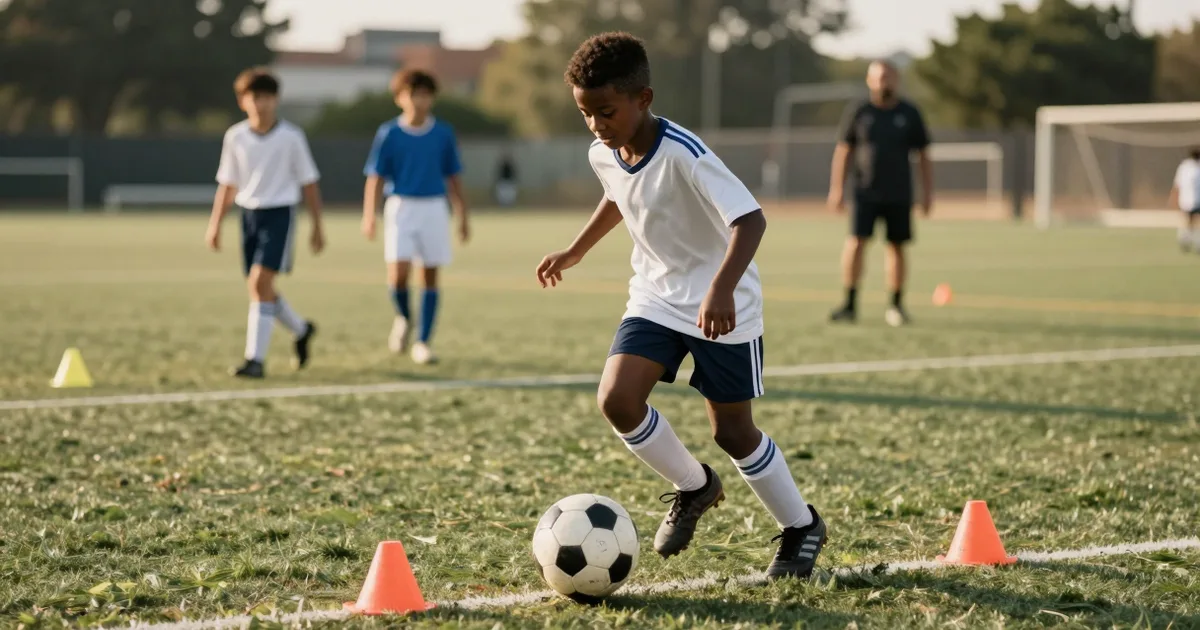
You're taking over a youth team, you may never have played organised football yourself, and you're supposed to lead a training session on dribbling on Tuesday. The internet has a thousand drills, but no answer to the question of which one suits your age group and what you should focus on while coaching. That's exactly what this article is for.
You'll get nine concrete dribbling drills, three per age group (U9, U10, U11), each with setup, flow, coaching cues, and a variation. The article also explains what really changes between the year groups, four coaching ground rules you can apply immediately even without a coaching license, and a complete 60-minute training plan you can use one-to-one on Tuesday.
Why dribbling is the core skill at this age
In adult football, attention goes to passing, pressing lines, and tactical systems. In youth football it's different. With eight to eleven year olds, the 1-vs-1 decides almost every goal. A player who can't keep the ball when an opponent closes in loses it. A player who can keep it has a goal-scoring or assist chance.
There are two reasons:
- Pitch sizes. U9 plays 5-a-side, U10 and U11 mostly 7-a-side. On these small pitches, space is tight and the opponent arrives quickly. A player who needs three touches to bring the ball under control has already lost it.
- Tactical maturity. Eight to eleven year olds don't yet understand passing geometry and shifting movements reliably. But they understand very well how to get past an opponent, if you show them often enough.
A player who dribbles confidently at twelve carries an advantage for the rest of their footballing life. Passing is learned later. Dribbling has to come early because child-appropriate technique training has its highest impact at this age according to DFB coach education and Horst Wein's coaching school.
What really changes between U9, U10, and U11
Coaching guides often treat "youth football" as a homogeneous phase. It isn't. Worlds separate an eight-year-old from an eleven-year-old, both physically and cognitively. Coaching a U9 like a U11 bores some kids and overwhelms others.
U9 (7 to 8 years old). Ball-loving, short attention span (realistically 60 to 90 seconds of full focus), still motorically uncoordinated. Dribbling drills must be simple, repetitive, and have a clear cue ("run to the red cone"). Complex instructions evaporate. Goal: lots of ball contacts, fun at speed, first inside-foot and outside-foot technique.
U10 (8 to 9 years old). First motor stability, attention extendable to 2 to 3 minutes, competitive spirit growing. Dribbling drills can include first decisions ("which gate do you dribble through?"). Goal: movement with the ball at speed, first 1-vs-1 situations against an opponent.
U11 (9 to 10 years old). Clear asymmetry between players: some are already advanced motorically and cognitively, others still in transition. Dribbling drills can include decisions, pressure situations, and simple combinations. Goal: dribbling as a means, not an end in itself. So "dribbling to open a passing lane" or "dribbling to escape pressure".
A drill that's perfect for U10 can be too complex for U9 and too boring for U11. That's why this article gives three dedicated drills per age group.
What changes between U9, U10 and U11
Concentration, training focus and drill complexity at a glance.
- Attention span
- 60 to 90 seconds of full focus
- Training focus
- Many touches, speed, inside/outside foot
- Drill complexity
- Simple, repetitive, clear cue
- Attention span
- extendable to 2 to 3 minutes
- Training focus
- Movement with the ball, first 1-v-1 with opponent
- Drill complexity
- First decisions (which gate?)
- Attention span
- holds under pressure
- Training focus
- Dribbling as a means: open passing lanes, escape pressure
- Drill complexity
- Decisions, pressure, simple combinations
Stage breakdown follows DFB coach education and the Wein school.
These three age groups are also the phase in which the DFB reform's new game formats apply (3-vs-3 with mini-goals, 5-vs-5, 7-a-side). For how the formats are structured per year group, see the article on youth football game formats 2026.
Four coaching ground rules for every dribbling session
No license, holding a whistle for the first time: these four rules account for 80 % of the difference between a good and a bad training session. If you take nothing else away, take these.
1. Every player needs a ball. Sounds trivial, isn't. If four kids share a ball, each gets 25 % of the ball-contact time they could have. Wein school, short calculation: in 4-v-4 a player has about five times as many touches as in 11-v-11. In U9 the DFB coaching manual aims at "many, many, many ball contacts" per session, which in practice means around a thousand. If you only have two balls, walk over to the equipment manager, send a WhatsApp to the parents, borrow balls from the women's team. But don't make the kids wait.
Ball contacts: 11-v-11 vs 4-v-4
In a small-sided format a single player gets about five times as many touches per session.
Wein school (Game Intelligence in Soccer); see also DFB coaching manual for Bambini to D-Jugend.
2. No queue lines. Classic mistake: eight kids in a single file, one dribbles through the course, the others wait. The first kid's focus is already gone before the fourth has even had a turn. Build two or three parallel stations instead, or switch to a circle formation where everyone dribbles at the same time.
3. Keep instructions as short as possible. Anyone who needs three nested clauses to explain a drill hasn't fully thought it through. Maximum two sentences, then demonstrate, then start. Fine-tuning happens during the drill, not before.
4. Let them play, then correct. Beginner coaches stop every three minutes to demonstrate a correction. It's well-meant and kills any training flow. Let the kids dribble for five minutes, then blow the whistle, give one coaching point ("look up briefly while you dribble!"), then carry on.
Three dribbling drills for U9
Cone slalom
Cone slalom
Inside and outside foot in turn, stop at the end, then back.
Setup. Six cones in a line, 1 metre apart, one line per player. If equipment is short, two lines for four players each, with one running at a time.
Flow. Player dribbles through the cones, alternating inside and outside foot. At the end of the line, stop the ball with the sole, turn, and come back.
Coaching cues.
- Keep the ball as close to the foot as possible
- Use both feet, not just the strong one
- Brief look up between cones
Variation. On the call "switch!", the player swaps to the other line. Adds a reaction element.
Traffic-light game (red-yellow-green)
Traffic-light game
Everyone dribbles in the square, the coach calls colours.
Setup. Large square, around 15 by 15 metres, all kids dribbling inside the square with a ball.
Flow. Kids dribble freely. The coach calls colours:
- "Green": full-speed dribbling
- "Yellow": slow dribbling
- "Red": stop the ball with the sole
Coaching cues.
- Even at full speed, keep the ball close
- On stop, freeze instantly, no fancy sole work
- Don't bunch up, heads up
Variation. Add commands: "Spin!" (full turn with the ball), "Swap!" (exchange ball with a teammate).
Shadow dribbling in pairs
Shadow dribbling
B follows A at a distance of about two metres.
Setup. Form pairs, each pair in open space, one ball per pair.
Flow. The front player dribbles freely, the back player is the "shadow" and follows two metres behind. After 60 seconds, swap.
Coaching cues.
- Front player changes pace and direction, not just running straight
- Shadow keeps the same distance, doesn't overtake
- Both look up briefly, not only at the ball
Variation. On the whistle, the front player passes the ball to the shadow without stopping. Reaction element added.
Three dribbling drills for U10
Cone-gate dribbling against the clock
Cone-gate dribbling against the clock
Through as many cone gates as possible in 60 seconds.
Setup. Four cone gates (two cones, 1 metre apart) spread inside a square of about 15 by 15 metres. One ball per player.
Flow. On the whistle: 60 seconds to dribble through as many cone gates as possible. Every gate counts. The coach can count, or the kids count themselves.
Coaching cues.
- Change pace between gates
- Don't go through the same gate twice in a row
- Ball clearly under control while passing the gate
Variation. Two groups, competition: which group gets more gates combined? Competition at this age is hugely motivating.
1-vs-1 with halfway line
1-vs-1 with halfway line
First to dribble through the opposing goal wins. Attacks allowed past the midline.
Setup. Square 10 by 10 metres, a midline made of cones, two small goals on opposite sides.
Flow. Two players, one ball each. Player A dribbles from their side towards goal B, Player B from their side towards goal A. The first to dribble through the opposing goal wins. From the midline onward, players may attack the opponent and try to win the ball.
Coaching cues.
- Head straight for the goal with the ball, not in an arc
- At the opponent, change pace, don't stop
- The weak foot counts, don't solve everything with the strong foot
Variation. Winner stays, loser swaps. Builds competitive pressure and a winner's mentality.
Four-goal game
Four-goal game: decision instead of sprint
Four small goals force the attacker to pick the less-defended one, instead of just running straight.
Concept by Horst Wein (Funino); since the DFB 2024 reform the standard format for G- and F-Jugend.
Setup. Pitch 20 by 15 metres, four small goals (cones or poles), one in each corner.
Flow. 4-vs-4. One team defends two goals, the other attacks the other two. Goals only count from dribbling, no passes into the goal.
Coaching cues.
- When the opponent comes, shield the ball with the body
- Pick up pace before the dribble-goal
- Switch to the less-defended goal, don't run into the crowded one
Variation. Passing is allowed, but only the final third must be solved by dribbling.
The four-goal game is a simplified form of Horst Wein's Funino (3-v-3 with four mini-goals), which the DFB has recommended as a standard format for G- and F-Jugend since the 2024 reform; the FA is rolling out the same 3v3 idea as FutureFit for Under-7s from 2026/27 (single goal per end, halfway-line rule). If you know the original format, you can also run the four-goal game directly as 3-v-3 Funino. The FutureFit Coaching Guide: 3v3 Funino drills for Under-7s to Under-11s gives you eight Funino drill variants you can drop into the main phase right after these dribbling sets.
Three dribbling drills for U11
1-vs-1 from a running start
1-vs-1 from a running start
Defender starts two seconds later from the side.
Setup. Pitch 15 by 10 metres, a small goal on one short side, a starting line on the opposite side.
Flow. The attacker starts from the line with the ball. The defender starts two seconds later, from the side. The attacker has to dribble through and shoot.
Coaching cues.
- Build pace from the first step, don't decide at the defender
- First touch into space, not too small, not too big
- At the opponent, one clear action: pace change, step-over, or sole roll
Variation. The defender starts behind, as a chaser. Different dynamic, the attacker has to shield the ball instead of just attacking.
Dribbling course with decision point
Dribbling course with decision point
Just before the Y the coach shows a colour — decide left or right.
Setup. Slalom of four cones, then a "Y" of two cone gates (left and right). Behind the gates, a coach holding two coloured bibs.
Flow. Player dribbles through the slalom. Just before the Y, the coach shows a colour. The player has to decide: left or right.
Coaching cues.
- Get the head up during the slalom, otherwise the colour is missed
- Decide early, not on the line
- Clean pace changes, otherwise the decision comes too late
Variation. Instead of a coach signal, a second player as a "live defender" stands left or right. The attacker must beat the defender.
Overload dribbling 2-vs-1
Overload dribbling 2-vs-1
First only from dribbling, then passing allowed.
Setup. Pitch 12 by 10 metres, one small goal, three players: two attackers, one defender.
Flow. Attackers start with the ball opposite the goal, the defender stands between attackers and goal. Attackers must beat the defender by dribbling and passing and score. First phase: only goals from dribbling count. Second phase: passing is allowed.
Coaching cues.
- Dribble straight at the defender, don't run around them
- When the defender commits to one attacker, the other becomes free. Spot it and play the pass.
- Pace change just before the defender, not from far away
Variation. Add a second defender, so 2-vs-2. Harder, but more realistic.
Sample training plan: 60-minute dribbling session for U10
This is a complete plan you can run one-to-one for U10. For U9: less competition, more repetition. For U11: more pressure, longer 1-vs-1 phases.
60-minute training plan
Proportional to time: warm-up, technique block, pressure situations, closing game.
Distribution follows the DFB coaching manual for Bambini through D-Jugend (at least 50 % small-sided game).
Minute 0 to 10: warm-up
- Running ABC with the ball: high knees, butt kicks, side-steps, each with the ball at the foot
- Light traffic-light game: red-yellow-green without competition, just easing in
Minute 10 to 25: technique block, no opponent
- Cone slalom (two parallel lines, each player runs four times)
- Cone-gate dribbling against the clock (two rounds of 60 seconds, with a 30-second break in between)
Minute 25 to 28: water break and short coaching note (max. 90 seconds talking)
One point: "look up briefly while dribbling, where's the space?"
Minute 28 to 50: pressure situations with opponent
- 1-vs-1 with halfway line (four pairs in parallel, 90 seconds each, then swap, five to six rounds total)
Minute 50 to 60: small-sided game
- Four-goal game (4-vs-4 if eight players. Otherwise 3-vs-3 with two goals)
What you do as a coach during these 60 minutes:
- Set up the equipment on the sideline before training begins. Otherwise you lose 15 minutes at the start.
- Don't forget the water break, especially in summer.
- One coaching point per block, not twelve.
- Leave the final game open: don't blow the whistle, just count goals.
Four typical first-time-coach mistakes
No license, no shadowing experience, with good intent: the four mistakes below have been made by almost everyone who has coached a U9 or U10 for the first time. They're fixable once you see them.
Mistake 1: long explanations. Two sentences, then demonstrate. Anyone who needs more than two sentences hasn't fully thought through the drill themselves. Stop yourself mid-explanation, shorten it, and demonstrate twice rather than explain at length once.
Mistake 2: correcting instead of letting them play. If you stop every three minutes to correct one player, there's no training flow. Kids learn movements through repetition, not through explanation. Let them run. Correct at the end of the drill, not every 30 seconds.
Mistake 3: only one ball for everyone. If the club has no ball stash, ask the women's team, borrow from the senior side, send a WhatsApp to the parents. A training day with too few balls is a wasted day, because half the kids wait instead of practise.
Mistake 4: lecture-style instead of game-form. Eight to eleven year olds learn best in real game situations: with an opponent, a goal, and a result. A systematic review by Piri et al. (2026) confirms it: game-based methods (small-sided games, conditioned games) reliably outperform isolated drills for tactical understanding, decision-making and engagement. The DFB coaching manual for Bambini through D-Jugend is even more concrete: at least half of every training session should be small-sided game in some variation, not 30 %. Pure technique drills without an opponent belong in the training mix, but should never make up the majority.
From the practice pitch to the match: testing dribbling under pressure
What's solid in training often doesn't come out in matches. Pressure, an audience, and unfamiliar opponents change things. Dribbling coaching has reached its goal when a player keeps the courage in a real game to dribble at an opponent with the ball at their feet, instead of immediately playing it off or looking at the coach.
Match practice needs match dates, and especially in U9 to U11, small-sided tournaments are the right format: short games, lots of matches, plenty of 1-vs-1 situations per child. More than any league fixture.
Anyone who wants to minimise the planning effort and quickly organise their own tournament uses a tool like AreaCopa and skips the spreadsheets for fixtures and tables. The kids play, you coach, the software does the maths. A step-by-step template from the invitation to the awards ceremony is in the football tournament checklist.
If dribbling clicks but goals still don't fall in matches, the next training topic is finishing, not 1-on-1 anymore. Three 5-minute drills for focused finishing training build on top, without rebuilding the whole training plan.
A scouting session is also a good occasion to track dribbling progress deliberately. What to watch for is in the article on scouting sessions in youth football.
Plan your first small-sided tournamentFree and no sign-upDownload the checklist
The nine practical drills plus the 60-minute training plan from this article as a printable PDF. Clip it to your clipboard so you don't have to reconstruct every setup from memory on the touchline.
Dribbling Drills U9, U10, U11 – Checklist60-minute training plan and nine practical drillsDownload PDFSources
- Wein, H.: Game Intelligence in Soccer. Source for Funino, small-sided game formats and the ball-contact multiplier in 4-v-4.
- DFB: Coaching tips for Bambini, F-, E- and D-Jugend (Münchener Fußballschule, DFB coaching manual). Backs the "at least 50 % small-sided game", one-ball-per-player rule and "no long explanations, no queues".
- DFB: Competition formats in children's football, edition 09/2024. Confirms the 3-v-3, 5-v-5 and 7-v-7 formats for G- through E-Jugend.
- Piri, N. et al. (2026): Game-based learning strategies to enhance tactical awareness in youth football. Health, Sport, Rehabilitation 12(3). Systematic review on the effectiveness of game-based training.
- Roth, K., Memmert, D. (2002): Cross-game-sport talent development. BISp-Jahrbuch. Game test situations as a diagnostic tool for game intelligence and creativity in small-sided contexts.
- Mental edge through positional games (Wein school). Concrete number: 4-v-4 = five times as many ball touches as 11-v-11.