
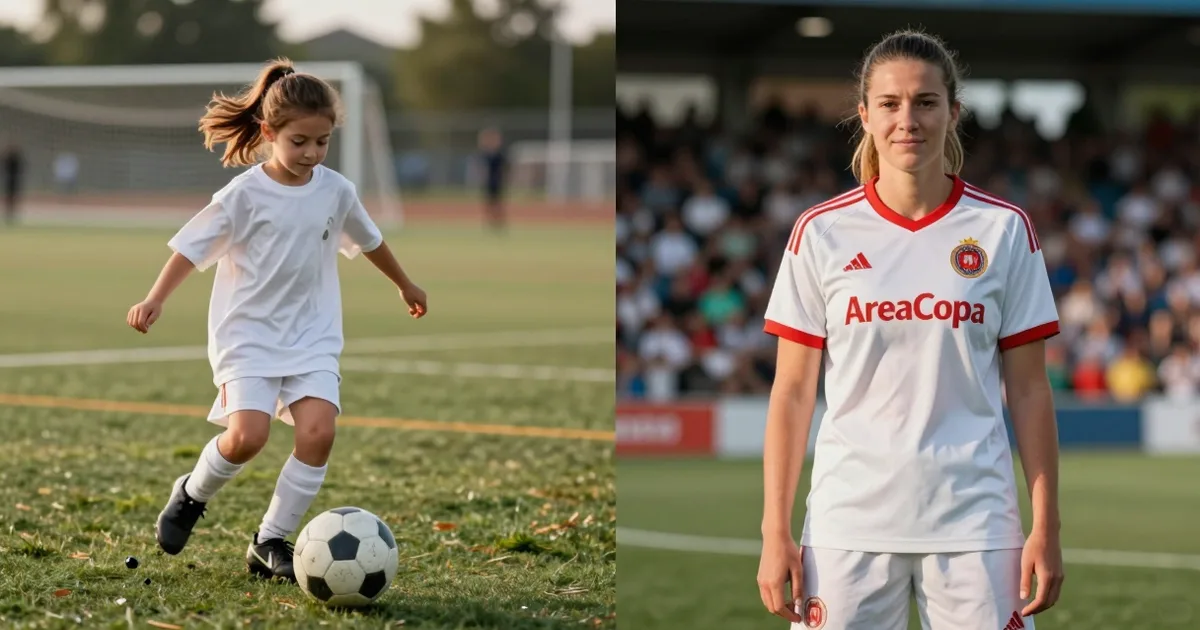
"He just has talent." Few sentences are said more often in youth football, and few are questioned less. It sounds like an explanation but is usually only an observation: a child is better than the others today, so there must be talent. What talent actually is, where it comes from and whether the child will still be ahead in three years stays open.
This article frames the topic for practice: what research means by talent, how it arises, how it develops, how you (do not) spot it and how you really foster it as a coach. It is the bigger picture above our practical guide to the tryout session, which walks through spotting talent step by step.
Talent myths and what the research says
Before asking what talent is, it is worth looking at what it is not. Three assumptions shape the daily life of coaches and parents, and all three are wrong in this stark form.
Three talent myths fact-checked
What gets said about talent in youth football, and what talent research actually shows.
Myth: Talent is an innate gift that you either have or you don't.
What the research shows: Talent arises from nature and environment working together and develops over years, instead of being fixed in advance (Abbott 2006).
Myth: You can spot real talent at once.
What the research shows: What stands out on tryout day is often a maturity head start, not more ability; the snapshot is a weak predictor (Augste & Lames 2011).
Myth: 10,000 hours of practice make anyone a pro.
What the research shows: Practice is necessary but not sufficient: talent is multi-dimensional, and opportunity and environment matter too (Rossing 2018).
Fact-check based on the sources cited in this article.
The shared core of these myths is a confusion: we mistake current performance for talent. Abbott (2006), in her work on talent identification, shows that this falls short. Talent is not a fixed state a child has or has not, but a multi-dimensional and dynamic process. Whoever is ahead today can be left behind tomorrow, and the other way round.
So why does the gift idea persist? Because it is convenient. If talent is innate, nobody has to explain why a child develops or not, it was simply in the genes. Add hindsight bias: in every pro you find the early signs in retrospect and overlook the many equally gifted children who eventually stopped. Research turns the view around. It does not ask who had the talent by nature, but which conditions actually turned an aptitude into performance. Those are exactly the conditions you can influence as a coach; the supposed gift you cannot. That is why a better understanding of what talent actually is pays off.
What is talent?
In everyday use, aptitude, talent and performance get muddled. Research separates them. Thomas (2020), in her conceptual work, distinguishes the aptitude (what a child brings along), the talent (the realistic potential to reach top performance in a field) and the performance itself (what it shows today). Talent is therefore a promise about the future, not a finding about the present.
The decisive word is process. Nobody "has" a talent ready-made. It arises on the basis of aptitude-related preconditions only because a child trains, plays and is challenged over years. Without that process the aptitude stays inconsequential, and with it more can develop from an unremarkable aptitude than from a striking one.
On top of that, talent is not one-dimensional. Reading "talented" only as "technically strong" or "fast" misses most of it. Abbott (2006) and the multi-dimensional talent models describe at least five fields that interact:
- Technical: ball control, first touch, two-footed play.
- Tactical: game intelligence, decisions, spatial behaviour.
- Physical: speed, endurance, coordination, robustness.
- Psychological: willingness to learn, dealing with mistakes, self-regulation.
- Social: team skills, communication, behaviour in the group.
A child can excel in one field and have catching up to do in others. That does not make it less talented, it just shows that talent is a profile, not a single value.
An example makes this tangible. Two twelve-year-olds: one is fast, assertive and scores regularly, the other looks physically unremarkable but solves game situations cleverly and almost always makes the right decision. In the game, the first stands out. In the profile, the second is often the greater talent, because his strength, game intelligence, is harder to train than the first one's. The latter's physical superiority comes with maturity for most anyway, the good decision does not. Reading talent as a profile judges both more fairly than only looking at the visible.
Where does talent come from?
The old "nature or nurture" debate is settled, namely with "both". Children bring different physical and psychological preconditions. But whether talent grows from them depends on what the environment makes of it: how much and how well they train, what role models there are, how the family supports them.
This is where the famous 10,000-hour idea comes in, the popular simplification of deliberate-practice research. It has a true core: top performance demands an enormous amount of focused, structured practice. But the formula misleads when you reverse it. Practice is necessary, not sufficient. Abbott (2006) makes clear that the same training load works very differently across children, precisely because talent is multi-dimensional and dynamic. Counting hours alone explains neither why some get further with less practice, nor why others stagnate despite thousands of hours. More helpful than counting is the question of quality and mix: is practice done with a clear goal, feedback and at the right difficulty, and is there free play alongside it? Especially in childhood, the combination of guided practice and self-organised play carries more than the earliest possible monotonous drilling of a single movement.
And there is an uncomfortable factor that has nothing to do with ability: opportunity. Rossing (2018) shows that players who make it to the top have disproportionately grown up near talent hubs. Whoever grows up far from the nearest academy has worse chances of being seen and developed, regardless of potential. Add the relative age effect: children born early in the year are physically more mature, look more talented and are selected more often (Augste & Lames 2011). Talent therefore never arises in a vacuum, but always where aptitude meets favourable opportunities.
The family environment co-decides too. Whether a child gets to the ball early and often, whether someone drives it to training, whether it has older siblings or role models, shapes how much movement experience it can gather at all. These advantages compound over time: whoever is rated good early gets more playing time, better coaches and more trust, and actually becomes better, while equally gifted children without that early boost fall behind. Talent is in that sense also a question of access. In practice this means creating broad, low-threshold access and waiting before sifting, rather than selecting early and handing out opportunities before ability could even show.
How does talent develop?
Whoever thinks of talent development as a straight line upward will be constantly surprised. It runs in jumps, with phases of standstill and occasional setbacks. Abbott (2006) describes this non-linearity as the normal case, not the exception. In practice that means: a plateau at 13 is no reason to write a child off, and a peak at 13 is no guarantee.
Maturity is especially consequential. A physically early-developed child often dominates at 12 or 13 because it is bigger and faster. That advantage disappears as the others catch up. The unremarkable late developer who keeps losing duels at 13 can be ahead at 16. That is exactly why bio-banding (grouping by biological maturity instead of calendar age) is a topic in youth development (Cumming et al. 2017; Nöcker 2024).
What really carries development are the hard-to-measure traits. Abbott (2006) highlights psycho-behavioural characteristics: how does a child deal with mistakes, how independently does it steer its learning, how much effort does it invest? Zuber (2015) shows for youth football that motivational traits help predict later development, not just current performance. Add the environment: Storm (2015) describes how strongly the sporting culture of a country or club shapes which talents unfold. And Fardilha (2021) shows that even creativity in football is no fixed gift but develops in the right game forms.
These psycho-behavioural traits are no accident, they can be developed. A child that learns to keep playing after a mistake, to set its own goals and to deal with setbacks builds exactly the qualities that carry it later. Williams (2023) shows that the environment of the development pathway is decisive above all: talents develop where they regularly meet manageable challenges, not where everything runs smoothly. A pathway without resistance produces no resilience.
For the late developer this has a concrete consequence. Whoever lags physically at 13 often gathers exactly these mental advantages unnoticed, because week after week they have to hold their own against bigger and faster opponents. If they are not cut too early, they bring these abilities along once the physical deficit disappears with maturity. That is exactly what an assessment that only looks at today's visible misses.
How do you spot talent?
This is where it gets tricky, because from everything said so far it follows: spotting talent is much harder than it seems. The biggest trap is the birth month. Children born early in the year are selected more than three times as often as those born late in German U17 elite teams, because their maturity head start looks like talent.
Relative age effect: who gets selected
Distribution of selected players across the four birth quarters of an age group in German U17 elite teams.
Countermeasure: put the date of birth on the scoring sheet, and discuss both halves of the age group separately in the coaching team.
Augste & Lames (2011): The relative age effect and success in German elite U-17 soccer teams. Journal of Sports Sciences 29.
Add daily form, the "loudest equals best" fallacy and your own favourite player types. A single tryout can never fully resolve this, but good design clearly reduces the bias: provoke reliably visible qualities instead of guessing character, work with two observers, factor in maturity and understand the tryout as a multi-year process rather than a one-off event.
How that works in concrete terms, with four stations, a scoring sheet and evaluation, is laid out in detail in our guide to the youth football tryout. This hub stays with the why, the tryout article delivers the how.
How do you foster talent?
Fostering is the real task, and it begins with an attitude: talent is developed, not discovered. Fischer et al. (2020) sum up talent support as individual support, that is, not one programme for all but fitting next steps for each child. In training that means setting tasks so that every child works at its own limit, instead of having everyone do the same thing. That sounds demanding but is doable in daily life: the same game form with different add-on tasks, a second ball for the fast ones, a safe zone or one extra touch for the still uncertain. The goal is that every child leaves the drill at its own limit, not that everyone managed the same thing in the end.
The second lever is motivation. Zuber (2015) shows how central motivational traits are for development. Motivation grows when children experience autonomy, competence and belonging. Caution is needed exactly here: Nöcker (2024) finds that even well-meant interventions (such as pure maturity groups) can lower the sense of competence and autonomy if used wrongly. Fostering therefore does not mean as much intervention as possible, but the right one.
The most effective and most underrated lever, however, is simple: keep children in the game. Roth and Memmert (2002) show that less successful children often leave the club because they are denied playing time, not because they give up the game. How to share playing time fairly across a whole season, without the bench becoming a drop-out driver, is in our guide to fair playing time. Whoever sorts out early or leaves the weaker ones on the bench loses exactly the late developers who would be ahead later. Successful talent pathways almost never rest on a single selection but on repeated observation and development over years (Sarmento et al. 2026), and on a chain of manageable challenges instead of single selection steps (Andronikos et al. 2026). The urge to specialise early should also be treated with caution. A study of youth footballers found no performance advantage for early specialisers over multi-sport players in sprint and change of direction, but clearly greater movement asymmetries in the specialised group (9 versus 4 percent). Only football early, only one position, therefore rarely brings the hoped-for head start, but raises the risk of one-sided load, injury and burnout. Varied movement experience is the more robust bet in childhood.
And finally the question of how you put all this into practice in training. Game-like forms, that is small games, numerical superiority and inferiority, develop game intelligence and creativity more reliably than isolated drills, because they force real decisions. An autonomy-supportive style that lets children co-decide and also fail strengthens the motivation that carries development. And restraint with constant coaching belongs to it: whoever dictates every action takes away exactly the decisions the child should grow on. Fostering here often means setting the frame and then letting the game do the work.
If you want to build the technical base in an age-appropriate way, you will find concrete drills in the article on dribbling drills for U9, U10, U11.
What this means for you as a coach
If you take only one thing from this article: talent is a process, not a label. That changes how you train and decide. You do not write anyone off at 12, because development runs in jumps. You distrust the fast, early-maturing player a little and look more closely at the slight one who makes good decisions. You give everyone playing time, because the bench is the surest way to lose a talent. And you judge talent where it shows: in the real game, not in isolated tests.
That is exactly what the first team session of a new season is ideal for. A small internal tournament with short games and mixed teams shows you more about your players' game intelligence and behaviour in 90 minutes than any row of individual drills.
Plan an internal tournament for talent observationFree and no sign-upSources
- Abbott, A. (2006): Talent Identification and Development in Sport. PhD thesis, University of Edinburgh. Talent as a multi-dimensional, dynamic process; psycho-behavioural characteristics; current performance as a weak predictor.
- Thomas, A. (2020): Prädiktive Relevanz leistungsmotivationaler Merkmale im Nachwuchsleistungssport. Dissertation, TU Kaiserslautern. Distinguishing aptitude/talent/performance; conditions for psychological selection criteria.
- Zuber, C. (2015): Die Bedeutung motivationaler Merkmale für die Talentselektion im Nachwuchsleistungsfussball. Dissertation, University of Bern. Motivation as a talent predictor.
- Storm, L. K. (2015): "Coloured by Culture": Talent Development in Scandinavian Elite Sport. PhD thesis. Cultural environment shapes talent development.
- Fardilha, F. (2021): Creativity in Football. PhD thesis. Creativity develops in game forms, it is not a fixed gift.
- Rossing, N. N. (2018): Local heroes: The influence of place of early development in Danish handball and football talent development. PhD thesis, Aalborg University. Selection bias from birthplace and proximity to talent hubs.
- Augste, C., Lames, M. (2011): The relative age effect and success in German elite U-17 soccer teams. Journal of Sports Sciences 29. Evidence for the relative age effect in German youth football.
- Cumming, S. P. et al. (2017): Bio-banding in sport. Strength & Conditioning Journal 39. Grouping by biological maturity status.
- Nöcker, C. A. (2024): Talententwicklung durch Bio-Banding im Fußball. Dissertation, German Sport University Cologne. Motivational effects of maturity-based grouping.
- Roth, K., Memmert, D. (2002): Sportspielübergreifende Talentförderung. BISp-Jahrbuch. Drop-out when playing time is denied.
- Sarmento, H. et al. (2026): The road to expertise in U-20 football world champions. International Journal of Sports Science & Coaching. Multi-year development instead of a single selection.
- Andronikos, G. et al. (2026): A Qualitative Investigation of Successful Junior-to-Senior Transitions in Elite Athletes. Athens Journal of Sports 13(1). Development as a chain of manageable challenges.
- Fischer, C. et al. (eds., 2020): Begabungsförderung: Individuelle Förderung und Inklusive Bildung. Waxmann. Talent support as individual support.
- Williams, G. (2023): The Influence of Developmental Experiences on the Talent Pathway in Sport. Professional Doctorate thesis. Environment and manageable challenges of the development pathway as development drivers.
- Does Specialisation Impact Sprint and Change of Direction Performance in Youth Football Players? Youth football study: no performance advantage of early specialisation, but higher movement asymmetry and risks.