
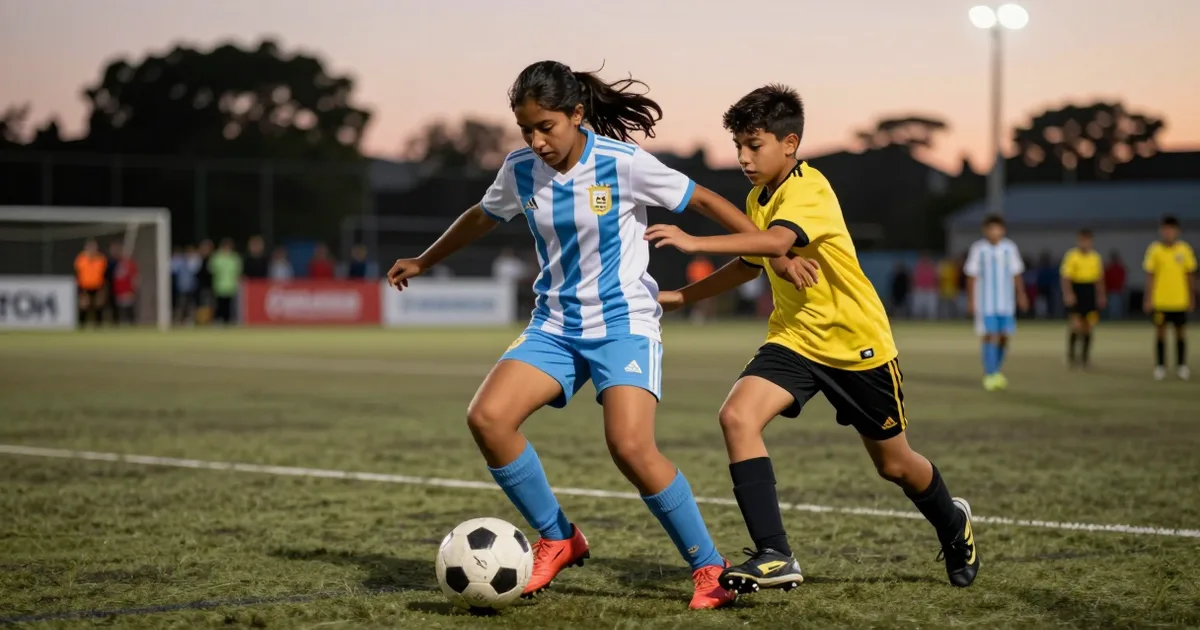
A coach from Santiago de Chile and a coach from Montevideo do not mean the same thing when they say „Baby Fútbol". The Chilean means 5 against 5 on an indoor court the size of a basketball gym, with three-metre-wide goals and free rotation. The Uruguayan means 9 against 9 or 7 against 7 on grass, on a pitch 50 by 35 metres, with four-metre-wide goals and a fully organised league in which eight-year-olds keep the same position for a whole season. Both are right. Both call it Baby Fútbol.
Then Futbolito enters the picture: in Chile it usually means the informal version of the same 5-a-side format that Chiledeportes officially calls Baby Fútbol. In Argentina parents mean table football. In Mexico kids play Futbolito in the schoolyard at break. Anyone organising a tournament for Latin American families risks renting the wrong pitch, buying the wrong ball or fielding a team with two players too many.
This article clears up the confusion. We show what Chile and Uruguay actually mean by the term, which rule differences you really need to know when running matches, and how to pick the right format for your club.
Two names, two countries, one common misunderstanding
The mix-up is not academic. It happens every weekend in Latin American migrant clubs across Europe and the US, when a Chilean father wants to sign his son up for „Baby Fútbol" and the club office sends him to the Uruguayan grass format, where the boy suddenly gets lost among eight teammates instead of four. It happens in Chile, when a club in Concepción recruits a Uruguayan coach and wonders two weeks later why he sets up a 9-a-side training match on a 26-metre court.
The common ground: both formats are organised youth football on a reduced pitch, with substitutions on request, no classical offside rule, and a clear separation of age groups. The difference comes down to three numbers that we show in the table below: player count, pitch size, surface. Practically every other rule difference follows automatically from those three.
The short version: Chile format vs Uruguay format
For readers who do not have time for the full article, the key differences in one table.
| Feature | Baby Fútbol Chile (Chiledeportes) | Baby Fútbol Uruguay (ONFI) |
|---|---|---|
| Player count | 5 vs 5 (1 goalkeeper, 4 outfield) | 9 vs 9 (ages 6–10) or 7 vs 7 (ages 11–13) |
| Pitch size | 26 m × 16 m (basketball-court format) | 50–60 m × 33.5–40 m |
| Goal | 3 m × 2 m | 4 m × 2 m |
| Surface | Hard floor, indoor court, enclosed cancha | Natural grass or artificial turf |
| Match time | 2 × 20 minutes, 5-minute break | Varies by category, per ONFI competition rules |
| Ball | No binding federation standard, usually size 4 or futsal ball | Size 3 (ages 6–9), size 4 (ages 10–13) |
| Substitutions | Free rotation at any time | Max 9 (ages 6–10), max 11 (ages 11–13), 3 of those at half-time |
| Age groups | Varies by local league | 8 official categories: Abejitas to Babys |
Read both columns and you see this: these are not two variants of the same sport. They are two different sports under the same name.
Baby Fútbol Uruguay: 1953, grass, 7-a-side
Uruguay invented Baby Fútbol. The first organised children's football leagues appeared in Montevideo in the late 1950s, and today's governing body, the Organización Nacional de Fútbol Infantil (ONFI), now manages more than 12,000 teams across eight age categories. The statistic is impressive: roughly 85 percent of Uruguayan boys between 6 and 13 years old play organised Baby Fútbol, a participation rate matched in no other country. Suárez, Cavani, Forlán, Cáceres, Valverde: every later Celeste professional spent his weekends between six and thirteen on the Baby Fútbol pitches.
The official name on the ONFI website is in fact „Fútbol Infantil", not „Baby Fútbol". The popular name comes from the youngest competition division: the ONFI category for 13-year-olds is officially called „Babys", because that is the last step before moving up to the youth league. The umbrella term for the entire youth setup grew out of that category name.
If you have never seen a Uruguayan Baby Fútbol match live or in a stadium, this short documentary is worth watching: it shows why almost every professional player in the country came through this system and how deeply the sport is woven into Uruguayan daily life.
The ONFI categories carry affectionate names from Uruguayan Spanish, often with diminutive suffixes for the younger children:
- Abejitas (age 6), Grillitos (7), Chatitas (8), Churrinches (9), Gorriones (10): 9 against 9, up to 9 substitutes
- Semillas (11), Cebollitas (12), Babys (13): 7 against 7, up to 11 substitutes
These categories and player counts are documented in the official ONFI rulebook 2021, Regla 3 „Los Jugadores" on page 12. That younger age groups field more players than the older ones runs counter to most national federations, but is pedagogically consistent: a dense 9 against 9 on a small pitch maximises ball contacts per child, while a looser 7 against 7 on the same pitch gives older players the space for individual technique.
The younger categories play with the ONFI size 3 ball (60 cm circumference, 340 to 360 grams), the 10-year-olds and above with size 4. The penalty spot is at 8 metres for the younger categories and 9 metres for the older ones. This level of detail is typical for ONFI: a 74-page rulebook covers every competition aspect for six- to thirteen-year-olds.
Baby Fútbol Chile: 5-a-side on a basketball court
Chile imported Baby Fútbol from Uruguay and then adapted the sport to its own infrastructure. Where every Uruguayan club has a small natural-grass pitch on site, many Chilean cities relied on asphalt courts or indoor gyms as the practical playing surface. The result: Chile plays Baby Fútbol on a pitch the size of a basketball court, with five instead of nine players per side, and with markedly shorter matches.
The official rulebook comes from Chiledeportes, the Instituto Nacional de Deportes of the Chilean government. The headline figures:
- Pitch: 26 metres long, 16 metres wide, rectangular like a basketball court
- Goal: 3 metres wide, 2 metres high, white posts, with net
- Penalty spot: three metres from goal
- Centre circle: one metre radius
- Squad on the pitch: five players including one goalkeeper
- Minimum players: three, otherwise the match is abandoned
- Substitutions: at any time, any number, free rotation
- Match time: two halves of 20 minutes, five-minute break
Anyone familiar with futsal will recognise these rules. The Chilean variant is in fact closer to international futsal than to Uruguayan Baby Fútbol. The biggest functional difference is the goal rule: in Chile a goal is only valid if scored from inside the penalty area, a direct shot from the halfway line does not count. Futsal has no such restriction. The rule effectively turns Chilean Baby Fútbol into a passing-and-positioning game, not a long-range shooting spectacle.
What sets Chile apart from futsal as well: the goalkeeper may not throw the ball past the halfway line, otherwise the opposing team takes a throw-in from the centre. The keeper may also carry the ball no more than four steps by hand, or the opposition gets a free kick. Both rules force the team to build up from the back rather than launching long clearances.
Futbolito: an umbrella term for 5-a-side in Latin America
While „Baby Fútbol" refers to a fairly well-defined league sport in Chile and Uruguay, „Futbolito" is the fuzzier label. In Chile itself most parents use it for the same format Chiledeportes officially calls Baby Fútbol: 5 against 5, small goals, hard floor. They tend to apply the term to the informal variant: the kickabout between friends on the neighbourhood pitch, the recess match at school, the summer tournament on the sand pitch.
In Argentina, by contrast, „Futbolito" often means table football, the mechanical box with the spinning rods. Invite an Argentinian to play „Futbolito" and they will most likely arrive at a café with a beer in hand, not at the sports hall. In Mexico, Futbolito tends to mean the playground game at school break in whatever team size, without a fixed rulebook.
If you are writing or organising for a Chilean audience you can use Futbolito and Baby Fútbol interchangeably, as long as you mean the informal variant. For official league labels, „Baby Fútbol" remains the right choice. And when communicating internationally, with foreign referees or coaches, it is better to use the term futsal, which is FIFA-codified worldwide and carries no risk of confusion with table football or playground kickabouts.
Pitch, goal and player count compared in detail
Place the two rulebooks side by side and the fundamental gap reduces to three numbers.
Pitch size. Chile plays on 26 × 16 = 416 square metres. Uruguay plays its youngest categories on 50 × 33.5 = 1,675 square metres. That is four times the area per team. Practically everything else follows: denser play, less running, more touches per minute in Chile; more distance and more endurance in Uruguay.
Player count. Chile has five players on the pitch, Uruguay nine or seven. Per player that gives about 83 square metres of moving space in Chile versus about 186 in Uruguay. A Chilean Baby Fútbol child therefore feels more pressure to decide quickly and has less room for long sprints. A Uruguayan child has more space, more options and more room to hide in the pack.
Moving space per player
Pitch area divided by the number of players per team.
Chiledeportes rulebook (26×16 m, 5 players) and ONFI Regla 3 'Los Jugadores' (50–60 m × 33.5–40 m, 9 players).
Goal size. Chile with 3 × 2 metres (6 square metres of goal face) is more compact than Uruguay with 4 × 2 metres (8 square metres). At first glance that seems small. Relative to pitch size, however, the Chilean goal is larger: in Chile the goal makes up 1.4 percent of the pitch surface, in Uruguay only 0.5 percent. Open-play goals fall far more often in Chile than in Uruguay simply because the goal-to-pitch ratio is much higher.
The practical consequence for coaches: transfer a scouting profile from Chile into a Uruguayan team and you get a technically strong but conditionally unprepared player. The other way round, a Chilean coach who signs from Montevideo gets a player who thinks in space but is still inexperienced in tight clusters.
Match time, ball and substitutions
The match-time structures tell the story of each playing philosophy.
Chile: two halves of 20 minutes, five-minute break. 45 minutes total, with no clock stoppages for substitutions. Coaches who want to rotate constantly can do so without the clock stopping. Effective playing time often ends up at 35 to 38 minutes net.
Uruguay: ONFI does not set one fixed match length for all categories, delegating it to the relevant competition regulations. In practice the younger categories play two times 25 minutes, the older up to two times 30 minutes. Substitutions take time because they have to be requested officially.
Ball. Chile prescribes no specific ball size in its rulebook; in practice teams use size 4 or a low-bounce futsal ball. Uruguay is more precise: size 3 at 60 centimetres circumference for 6- to 9-year-olds, size 4 at 65 centimetres for 10- to 13-year-olds. The ONFI ball is a regular football, not a futsal ball: it bounces fully.
Substitutions. This is where the two systems are furthest apart. Chile: free rotation, any time. The same player can come on and off five times in one half. Uruguay: up to 9 substitutions in the younger categories, up to 11 in the older ones, of which 3 must happen during the half-time break. For the Babys (13 years) on a full-size pitch only 7 changes are allowed. A coach moving from Chile to Uruguay has to relearn pre-match line-up planning.
The key special rules every coach should know
Transferring a squad from one system to the other, you trip over five special rules.
1. Goalkeeper may not throw past the centre line (Chile). Chiledeportes is explicit: if the keeper throws the ball with the hand past the halfway line, the opposing team takes a throw-in from the centre. This forces controlled build-up from the back. The rule does not exist in Uruguay.
2. Goal only valid from inside the penalty area (Chile). A direct shot from your own half does not count as a goal in Chile. The ball must be played inside the opponent's penalty zone before a goal is registered. Long-range shooting almost completely disappears from the game.
3. Time penalty instead of yellow card (Chile). Chile has no classic yellow card. Instead, a player who commits repeated or serious fouls is sent off the pitch for three minutes, during which the team plays a man short. Uruguay follows the FIFA standard model with yellow and red.
4. Mandatory half-time substitutions for 11- to 13-year-olds (Uruguay). In the ONFI categories Semillas, Cebollitas and Babys, three of the up-to-eleven substitutions must happen during the half-time interval. The rule guarantees that bench players actually see meaningful time, not just the last few minutes.
5. Penalty spot distance varies by age (Uruguay). For 10- to 13-year-olds the penalty spot sits 9 metres from goal, for the younger categories 8 metres. Chile uses a fixed point at 3 metres.
These are not trivia. Anyone organising an international tournament between Chilean and Uruguayan clubs has to agree on one rulebook in advance, otherwise the first match brings arguments about the first goals and the first foul calls.
Which format for which age group and which club?
If you live in Chile or are founding a club in Latin America, you rarely have a real choice between the formats in practice: the local league you want to join prescribes the format. But anyone with flexibility, such as a school club with its own pitch or a migrant club in Europe, can choose actively. Three questions help.
Three filter questions that decide the format before invitations go out.
Which pitch?
Hard floor, hall or court up to 30 m: Chile 5v5. Natural grass from 40 m: Uruguay 7v7 or 9v9.
How many players?
6 to 8 active players: only the Chile format. 12 to 15: both work. From 18 upwards: two teams.
Which league nearby?
Chile: Chiledeportes league. Uruguay: ONFI. Europe with Latino background: the DFB futsal league, because Baby Fútbol is not institutionalised here.
Question 1: What pitch do you have available?
- Hard floor, indoor court, asphalt court or sand pitch 20 to 30 metres long: Chile-format Baby Fútbol or Futbolito
- Natural grass or artificial turf at least 40 metres long: Uruguay-format Baby Fútbol
Question 2: How many players do you have per age group?
- Six to eight active players: Chile format is feasible, Uruguay is not
- Twelve to fifteen players: both formats work
- More than 18 players: Uruguay format with two teams, or Chile format with three teams in competition
Question 3: What league exists nearby?
- In Chile: almost always Baby Fútbol under the Chiledeportes model or a Futbolito league
- In Uruguay: the ONFI league in your city or region
- In Europe with a Latino background: the DFB futsal league or local equivalent, since neither Baby Fútbol format is institutionalised
In European club work futsal is the official counterpart to both LatAm formats — how to use it as an indoor-season format with youth players is laid out in detail in the practical guide to futsal for football coaches.
If you want to minimise the planning effort for a tournament in any of these formats, use a tool like AreaCopa instead of juggling spreadsheets for fixtures, team registration and referee assignment.
How to plan your first Baby Fútbol or Futbolito tournament
Four concrete steps for the first run, regardless of format.
Step 1: pick the format before sending invitations. Decide whether you are playing Chile 5v5 or Uruguay 7v7/9v9 before you reach out to teams. Put pitch dimensions, goal size and match length explicitly in the invitation. Otherwise a team will turn up with nine players for a pitch built for five.
Step 2: plan the team count. Six to eight teams give you a half-day tournament in the Chile format with two groups and knockout final. The Uruguay format only needs four to six teams because the matches run longer.
Step 3: write the rulebook down. State which special-rule set applies: does the Chilean penalty-area-goal rule count? How many substitutions are allowed? How long is each half? Send these three points in a one-page PDF to every coach before the tournament starts. If you want to set up the fixture grid for 5, 7 or 10 teams, there is a ready-made template here.
Step 4: line up referees in advance. The Chile format needs two referees per match (Chiledeportes recommends it), Uruguay one plus optional linesmen. Plan at least four referees for a one-day tournament on two pitches in parallel.
These four steps will spare you most arguments on match day. Everything else (fixture grid, table, referee plan and parent communication) can be set up in twenty minutes with a tournament tool, instead of three evenings at the club bar with five spreadsheets.
Plan your Baby Fútbol tournament in ten minutesFree and no sign-upSources
- ONFI: Reglas de juego 2021, August 2021. Players per category (Regla 3), pitch dimensions, ball sizes, substitution rules and penalty-spot distance for the eight ONFI age groups Abejitas to Babys.
- Chiledeportes / Instituto Nacional de Deportes: Reglamento de Baby Fútbol. Pitch dimensions 26×16 m, goal 3×2 m, penalty-spot distance 3 m, 5v5 team size, match time 2×20 min, special rules (goal valid only from inside the penalty area, goalkeeper throw not beyond halfway, 3-minute time penalty).
- FIFA: Futsal Laws of the Game 2022/23. Pitch dimensions 40×20 m and standard futsal rules as the reference for the international classification of both formats.