You booked the gym for three months, ninety minutes every week, and at the end of winter you're frustrated that your players need a full training session in March on grass just to pass the ball properly again. That's the experience of countless youth football coaches, or soccer coaches as they're called in North America, every indoor season. It's not your players' fault. It's because you played football in the gym instead of futsal. And that one difference decides whether the winter break is a lost block or a development leap.
Futsal is not the little sister of football. It's its own sport with its own rule set, its own ball, its own game idea. Use it as a training supplement during the indoor season and you don't get less, you get more: faster decisions, better ball control, higher contact density. The professionals all your players know have figured this out long ago.
"As a little boy in Argentina, I played futsal on the streets and for my club. It was tremendous fun, and it really helped me become who I am today." — Lionel Messi, quoted in the FA Beginner's Guide to Futsal
This guide shows you what sets futsal apart from indoor football, which eight rules you have to know as a coach, what a sensible 6-week weekly plan looks like, and which five drills bring the transfer back to the grass. Plus: injury prevention, myths, girls' futsal and a practical CTA for your own indoor season. Written for U13 to U17 coaches in everyday club work.
What futsal is, and what it isn't
Futsal was created in 1934 in Montevideo as an indoor version of football; the teacher Juan Carlos Ceriani mixed elements of football, basketball, handball and water polo into a new game for his students at the YMCA. Today futsal is FIFA's official indoor form, with its own World Cup, its own associations and a rulebook updated annually.
It is mostly confused with traditional German indoor football, which most club coaches know from the nineties: 5-a-side or 6-a-side on a basketball court, with boards, a high ball-in-play share, and a lot of board contact. That is not futsal. Traditional indoor football is not officially banned either, but the German FA has phased it out for children with the 2024/25 reform and declared it the discontinued variant in youth football. Anyone organising an indoor competition today plays either futsal or the DFB Chancenspiel (Funino format).
Futsal court versus indoor football court
Same gym size, completely different markings, and a rule set that follows from it.
Source: FIFA Futsal Laws of the Game 2025-26 (Law 1) + DFB indoor football regulations.
The five basics, without which it is not futsal (FA Beginner's Guide to Futsal):
- Hard-court surface (parquet, sport flooring, linoleum). Not grass, not artificial grass except in exceptional cases.
- Futsal ball size 3 or 4 with reduced bounce (60 to 65 per cent of the rebound height of a normal training ball).
- 5-a-side including the goalkeeper, maximum 14 players in the squad, rolling substitutions without limit.
- Touchlines instead of boards: ball goes out and is restarted with a kick-in (not a throw-in).
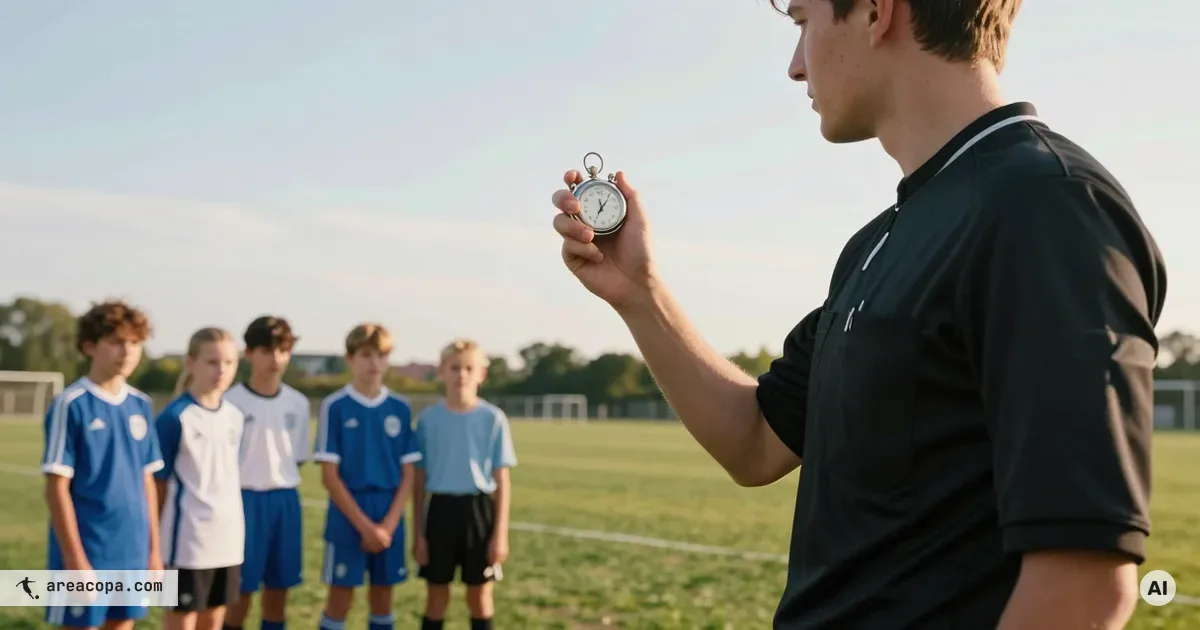
- Referees count off the 4-second rule visibly with their fingers in the air.
If any one of these five elements is missing, you are playing something else. For the exact transition from German children's football to the indoor game and which formats the 2024/25 reform replaces, see the overview of the children's football reform.
Why futsal makes football players better
The quantitative argument runs through ball contacts and playing intensity. In a 40-minute futsal match, a player gets 200 to 300 ball contacts. In 11-a-side, depending on position, it is 40 to 80. This is not just a quantitative difference, it is a different learning situation.
Ball touches per player per match
40 minutes of futsal vs. 90 minutes of football, averages from elite analyses
Source: Spyrou (2023), Doctoral Thesis; FA Beginner's Guide to Futsal.
Every ball contact is a decision. Short pass, long pass, dribble, turn, shoot, chip. Anyone who decides four times as often per match learns to decide four times faster. That is the actual lever for youth development, not technique. The most important driver for tactical maturity is cognitive load: perceive, select, execute under time pressure. Futsal concentrates exactly that.
A second measurable factor is sprint density. In Ukrainian professional futsal, 5.2 percent of playing time involves anaerobic-alactic and 3.0 percent anaerobic-glycolytic demands, short maximum sprints in rapid succession. On the large pitch you do not reach these values because the distances are too long.
Share of high-intensity load in total playing time
Anaerobic-alactic plus glycolytic phases, preparatory period
Source: Stasiuk (2017), Physical Activity and Health 12:25-30, Table 2.
The qualitative argument runs through professional careers. Cristiano Ronaldo: "During my childhood in Portugal, all we played was futsal. The small playing area helped me improve my close control, and whenever I played futsal I felt free. If it wasn't for futsal, I wouldn't be the player I am today." Zinédine Zidane: "The technique of playing futsal is different to the eleven-a-side version; there are spectacular things you can attempt that you would not dare trying in football. It adds more fun to the discipline" (both quoted in the FA Beginner's Guide to Futsal). Iniesta, Xavi, Pelé, Ronaldinho, the list is long and not coincidental.
What your players take away concretely:
- Better ball retention in tight spaces. The pitch forces the sole, body protection between ball and defender, fast turning away.
- Faster game perception. Four teammates including the goalkeeper, five opponents and the referee, all within the normal visual cone.
- Cleaner finishing from mid-range. The goal is 3 by 2 metres, the keeper has less area to cover but the reaction time is shorter. Players who finish cleanly in futsal will finish even better on grass with a bigger goal and more time.
- Higher pressing readiness. The 4-second rule forces immediate pressure after losing the ball.
That first point deserves an honest caveat: what the evidence really supports is the physics of the ball, a direct transfer of the technique to grass has barely been studied, and if you want to train the first touch on purpose instead of hoping for a futsal effect, the method is in the guide to ball control and the first touch.
The 8 futsal rules every football coach must know
You do not need to memorise the entire rule book. Eight points are enough for training and tournament practice. The FIFA Futsal Laws 2025-26 are the full document (free online), DFB Heft 06/2024 (Futsal Regulation) adds the German implementation provisions.
| Rule | Futsal | Indoor football (traditional) | Full pitch 11-a-side |
|---|---|---|---|
| Pitch | 25–42 m × 16–25 m | gym size variable | 100–110 m × 64–75 m |
| Players | 5 vs 5, rolling subs | 5–6 vs 5–6 | 11 vs 11 |
| Ball | size 4, reduced bounce | size 4–5 normal | size 5 normal |
| Out of play | touchline + kick-in | boards, ball stays in play | throw-in |
| Penalty area | D-shape, 6 m radius | rectangle | rectangle 40.3 × 16.5 m |
| Fouls | accumulated, from 6th = direct free kick | variable per regulation | per-foul judgment |
| Restart time | 4 seconds at every restart | no hard limit | referee discretion |
| Substitution | rolling, unlimited | rolling, limited | match stoppage, limited |
The eight rules in detail:
- Pitch 40 by 20 metres. International standard, in practice the gym dictates the size. FIFA permits 25 to 42 metres length, 16 to 25 metres width. In everyday club work you almost always play on a basketball or volleyball court. Lines are 8 cm wide (Law 1).
- The D-shaped penalty area. Instead of a rectangle, two quarter-circles of 6 metres radius around the posts, joined by a 3.16 m line, producing the characteristic D-shape (Law 1, Section 4).
- The 6-metre mark and the 10-metre mark. The 6 m point is the normal penalty kick spot. The 10 m mark becomes relevant on accumulated fouls, from the sixth foul of a half onward, there is a direct free kick without a wall from the 10 m mark or from the place of the offence, whichever is closer to the goal (Law 13).
- The 4-second rule. Every restart (kick-in, corner kick, goal clearance, free kick) must be taken within 4 seconds. The referee counts visibly with their hand. Exceeding this gives an indirect free kick to the opposing team. The same rule applies to the goalkeeper in their own half: 4 seconds of possession, then indirect free kick (Law 8 + Law 12).
- Accumulated fouls. Per half, direct-free-kick offences of one team are counted. Fouls 1 to 5: normal free kick with a wall. From foul 6 onward: direct free kick without a wall from the 10 m point, the defender must keep a 5 metre distance. This becomes the harshest sanction in the game and changes the team's pressing risk tolerance (Law 13).
- No throw-in, only kick-in. If the ball crosses the sideline, the player kicks it back into play from a standing position; the ball must rest. A goal scored directly from a kick-in does not count. The 4-second rule applies (Law 15).
- Rolling substitutions. Unlimited substitutions during play, at a marked substitution zone in one's own half, without referee approval. The substituted player must have left the field completely before the new one enters (Law 3). The day-to-day consequence: fair distribution of playing time is trivial in futsal because you can swap any time. How it works without rolling subs in regular football is laid out in fair playing time in youth soccer.
- Sliding tackles are banned when contesting the ball with body contact. Allowed only when no opponent is near (ball recovery). The penalty is an indirect free kick, in case of dangerous play directly a red card (Law 12).
For the complete comparison of standard situations, corner kick, free kick and wall distance, see the detailed article on corner kick variants in youth football; for futsal, the wall distance is generally 5 metres instead of 9.15.
Futsal in the indoor season: a 6-week training plan
A sensible futsal winter preparation is six weeks with two training sessions of 60 minutes each, twelve sessions in total. More is possible, less is too short for the transfer effect. The structure follows the preparatory period that Stasiuk (2017) documented in Ukrainian professional futsal (54.9 per cent aerobic load, 36.9 per cent mixed, 8.2 per cent anaerobic), scaled down to youth-level and amateur training time.
The weekly structure:
- Week 1, Ball familiarisation and the 4-second rule. The futsal ball runs slower and bounces differently. First session: many touches with sole and inside, pass-and-go without pressure. Second session: first game forms with 4-second restart, the coach acts as referee.
- Week 2, Pivot play and the receiving stations. The pivot is the central reception station with their back to the goal. First session: technical base form (sole reception, lay-off). Second session: 3-on-2 transition games with a fixed pivot role.
- Week 3: 1-on-1 and pressing triggers. In tight spaces the 1-on-1 decides. First session: 1-on-1 turn forms with success pressure. Second session: block pressing with defined triggers (pass to the wing, back pass to the keeper).
- Week 4, Set pieces and goal actions. Corner, free kick, kick-in, pivot reception as set piece. First session: drilling the set piece routine. Second session: set pieces under realistic pressure (4-second counter).
- Week 5, Game forms 3v3 and 4v4. Reduced playing field, lots of rotation. First session: 3v3 in 20 by 15 metres with a target-game principle. Second session: 4v4 with rolling substitutions every 90 seconds.
- Week 6, Mini-tournament simulation. Internal tournament or two training matches against another club's age group in full futsal form: 5v5, 4-sec, accumulated fouls. Reflection afterwards about what should be carried from winter training onto the grass.
The PDF at the top of this chapter contains one page per week with drill bullet points, time windows and coach tips, designed to be printed and taken to the gym. Anyone integrating the plan into the year cycle typically slots it in from late November to mid-January, depending on the match calendar. Games for the first 20 minutes of every session are in the indoor warm-up games.
Five futsal drills with grass-pitch transfer
The five drills are picked so each trains a concrete behaviour that helps on grass. Not a random collection of game forms but five building blocks with a clear cause-and-effect logic.
1. Pivot play with lay-off
The pivot (Latin fulcrum) is the standard role in futsal offence: a player with their back to the goal who receives the ball, holds it firmly, and lays off to teammates moving in. On grass this maps to the centre forward in a 4-3-3 or the classic striker in a 4-4-2.
Pivot play with lay-off
Pass into the feet of the pivot, lay-off to the incoming teammate, finish.
Source: UEFA The Technician (2026), pivot play as a futsal base principle.
Setup: Pivot on the 6 m mark, three reception stations on the 10 m line in a semicircle, one passive defender behind the pivot. Flow: A1 plays into the feet of the pivot, who secures the ball with the sole, does not turn, instead lays directly off to A2. A2 finishes or plays on to A3. Coach point: First touch with the sole, second touch in the direction of play. The defender stays passive in the first run-through, becomes half-active in the progression.
Grass-pitch transfer: The centre forward learns to play with their back to the goal without turning, and to play on immediately. Exactly what decides duels between centre backs in the 11-a-side game.
2. The 4-second kick-in press
The 4-second rule on the kick-in forces an immediate decision under time pressure. In training the drill simulates the pressure moment of a restart.
The 4-second kick-in press
Ball-side player has 4 seconds, three passing options, with pressing.
Source: FIFA Futsal Laws of the Game 2025-26, Law 15.
Setup: A stands outside the sideline with the ball, three possible reception partners stand in the field, one defender approaches from inside. Flow: Coach calls "Ball" and starts a visible countdown (hand in the air or stopwatch app). A must kick-in within 4 seconds. Variation: Coach calls a target zone (front, central, back), A must pass into that zone.
Grass-pitch transfer: Throw-in situations are played faster; the player builds the automated scanning ("where are options 1, 2, 3?") in the seconds before the restart.
3. Station-based shooting
Rotating through three different distances and angles in the same session measurably improves finishing accuracy. Station-based shooting with rotation is the most effective form for this.
Station-based shooting with rotation
Three stations around the goal. Every player shoots from every station, then rotates.
Source: Noonun et al. (2025), African Educational Research Journal 13(4):403-410.
Setup: Three stations with three balls each, one in the left 45-degree angle, one central 10 metres in front of the goal, one in the right 45-degree angle. Flow: Each player shoots three balls per station, then rotates one station to the right. Count hits per station. Coach point: Different distance, different shooting technique, toe, inside, instep, deliberately varied by station.
Grass-pitch transfer: Players build a movement repertoire that is immediately callable for the turn-and-shoot from the box. On the bigger grass-pitch goal the hit rate noticeably improves because the shot selection has been trained.
4. Pressing triggers in the 4-defender block
Pressing triggers are defined game moments that start the team press. In futsal those are above all: pass to the wing, back pass to the goalkeeper, a high ball without a clear target.
Pressing trigger in the 4-defender block
Compact block of four. A pass to the wing triggers an immediate double press.
Source: own synthesis, Spyrou (2023) on match demands in elite futsal.
Setup: 4-on-4 plus goalkeeper in a block field (15 by 20 metres, one gym half). Flow: Coach (or keeper) starts play with a pass. The defending team stays compact, only shifts when the defined trigger occurs, a pass to the wing triggers an immediate double press. Coach point: Do not address pressing behaviour in general, only the specific trigger.
Grass-pitch transfer: Counter-pressing on grass starts with the same mechanism: recognise, shift as a unit, overload the ball-near side. Anyone training that 20 times per session in indoor format has the pattern intuitively callable in March. For the extended grass-pitch version see the dedicated article on counter-pressing for amateurs U13/U14.
5. Wall player and finishing
The wall player, a specific form of the pivot, who plays a one-two, is the fastest finishing pattern in futsal from the half-field.
Wall player and finishing
One-two at the corner of the box, sprint past the defender, finish from the run.
Source: own synthesis, FA Beginner's Guide to Futsal, wall-pass patterns.
Setup: Ball-carrying player A at the top corner of the box (10 m mark), stationary wall player P at the near post with their back to the goal, defender V behind A. Flow: A passes into the feet of the wall player, sprints past the defender straight into the box, P plays it directly into the run, A finishes. Coach point: The wall player must not take a second step. One touch back. A's second touch is the finish.
Grass-pitch transfer: One of the few patterns that is played in futsal exactly as on the full pitch. The one-two at the corner of the box is the base form of "play through the third" that is introduced anyway in the C-Jugend. In futsal it happens ten times per match, on grass maybe twice, the learning gain per training session is correspondingly bigger.
Injury prevention: the FIFA 11+ adapted for futsal
FIFA 11+ is the standardised warm-up programme that FIFA developed in the early 2000s for grass-pitch practice: 20 minutes, three parts (running-based, strength-based, sprint-based), scientifically documented reduction of non-contact injuries by 30 to 50 per cent. The programme was transferred to futsal and reviewed in four sub-studies on amateur players.
The central results:
- No negative effect on performance. The worry of some coaches that a longer warm-up costs game-time energy is not supported by the data.
- Improved balance and proprioception. In particular the single-leg stability drills improve ankle reflex time measurably.
- Reduced knee and ankle incidence in the season-end analysis.
The adaptation for the gym is minimal: the running component is shortened to gym size (instead of 40 metre run with a cone turn, 15 metres with a turn), the sprint component uses the gym diagonal. All strength and balance drills stay the same. Building this into the gym session gives you a scientifically backed warm-up programme and saves 10 to 15 minutes compared to an improvised run-without-plan.
Mandatory components per session, 18 minutes total in the shortened indoor version (the full programme is 20):
- 8 minutes running-based warm-up with direction changes, skipping, short bursts
- 6 minutes strength and balance (bridge variations, single-leg stance, calf raises)
- 4 minutes sprint component with two short sprint turns
The injury epidemiology in futsal is well researched: non-contact injuries to the ankle and knee account for 60 percent of all absences, exactly the injury types that FIFA 11+ addresses. In youth football this applies to an even greater extent, because growth phases additionally increase the risk.
Common myths club football players believe about futsal
Myth 1: Futsal is just small indoor kick-about and does not develop players further. Wrong. The numbers argue against it: more ball contacts, more decisions per minute, higher pressing intensity than on the pitch. The professional path is full of former futsal players, Messi, Ronaldinho, Iniesta, Xavi, Falcao.
Myth 2: The futsal ball is dangerous because it is too heavy and bounces poorly. False in both directions. The ball is lighter in its game effect (it rolls slower and bounces only 60 to 65 per cent as high as a normal ball), which is exactly what makes it safe on a hard floor. Shin bagatelles happen indoors more from board contact in traditional indoor football, not from the ball.
Myth 3: Futsal goals are too small; that frustrates strikers. Wrong. The goal is 3 by 2 metres, smaller than the pitch goal (7.32 by 2.44 metres), but proportional to the hall size. The goalkeeper has less area to defend, the striker has a smaller target, the game principle stays fair. Anyone who regularly shoots at the smaller goal hits the larger pitch goal better afterwards, the narrower corridor disciplines shooting technique.
Myth 4: Futsal ruins my players' shooting power. Wrong. The sorting out of shooting muscle training in the hall is a myth from the eighties. The ball is only slightly less reactive, the shooting technique remains the same. In futsal, the inside, toe and instep are even used more frequently than in 11-a-side.
Myth 5: Girls do not like futsal. Wrong. Female futsal participants in South America have been growing faster than female large-pitch football since 2015. The contact density and the fast playing flow particularly appeal to girls' teams, because they allow less physical confrontation than 11-a-side.
Myth 6: Futsal knowledge has to be built up specially in the club and is not worth it. False. The most important eight rules are explained in 30 minutes, the court exists in every normal gym (or is chalked in), the ball costs 25 euros. Anyone with one weekly gym session integrates futsal as a format without extra effort.
Girls' and women's futsal: the underrated lever
The Argentinian Junior Female Futsal Federation (AJFSF) collected the growth figures globally in its international report Report on the Women's Futsal (2024). Core result: FIFA's efforts for women's futsal are insufficient (quote from the report: "FIFA's lack of commitment to women's futsal"), but at the same time the national women's leagues in South America are growing double digits per year.
For everyday club work in Germany the picture is simpler: girls' teams are hard to build in most clubs because the threshold is high (mixed teams, comparison with the boys' team, shortage of female coaches). Futsal lowers the threshold for three reasons:
- Less body contact compared to traditional indoor football. Sliding tackles are banned, board collisions disappear entirely.
- 5-on-5 indoor formats are socially tighter. The group stays together by the sideline, knows each other after three gym dates better than after three weeks of grass-pitch training.
- Fast successes through high contact density. More frequent touches mean more frequent moments of success.
Girls without prior futsal experience who have completed several weeks of game-based training improved clearly in self-efficacy, motivation and performance compared to a group with conventional training, with simultaneously lower drop-out rates.
Anyone in charge of building a girls' team at the club will find a more detailed walk-through in Building a girls' football team, the most common club obstacles. Futsal as a format fits there particularly well as an entry point because it produces visible early wins.
Setting up your own futsal section? That is a topic in its own right with club structure, German FA competition order and coaching licences. A separate step-by-step guide to setting up a section is coming on this blog; until then the DFB Futsal Regulation Heft 06/2024 is the formal basis (free on the German FA website).
Planning an indoor tournament with futsal rules
When the winter preparation flows into a club tournament, the step to the futsal format is small. Three adjustments are enough compared to a classic indoor tournament:
- Two referees per match. In futsal there are two referees (head referee and second referee), plus a timekeeper with a foul counter on the sideline. For youth level a single referee plus a reliable timekeeper/counter is acceptable.
- Accumulated fouls are counted along, from the sixth foul of a half onward, the 10-metre free kick without a wall applies. Document this visibly on a board or in the score sheet.
- Touchlines instead of boards. A line of tape (or chalk if permitted) is enough. The game flow noticeably slows down here because every ball-out-of-play leads to a kick-in, this is the most important mental adjustment for parents and players.
Match times stay standard: 2 by 10 minutes for group games, 2 by 15 minutes for the knock-out phase. But work the schedule out from the start. Eight teams need two groups of four: 12 group games plus 2 semifinals plus a final is 15 matches. At 2 by 10 minutes with two minutes of changeover, the group games alone run 4.4 hours; with the longer knock-out matches you are at 6 hours on a single court. That fits into a three-hour hall only with two courts in parallel or with shorter matches: 2 by 5 minutes plus two minutes of changeover gives 15 times 12 minutes, exactly 180. The arithmetic is the same one you know from grass.
The schedule itself runs identical to the grass logic: round-robin group, knock-out, calculate breaks, assign fields. Anyone who wants to set it up in 20 minutes instead of two hours takes a ready schedule generator for 5 to 10 teams as a template; the format selection supports futsal play times and accumulated-fouls tracking natively. The complete indoor tournament checklist, from referee pool through catering to the trophy ceremony, is in the article on organising an indoor tournament: the checklist.
Plan my indoor tournament with futsal rules in 2 minutesFree and no sign-upFor anyone who has never organised an indoor tournament: a planning timeline with catering, referee acquisition and trophy ordering typically starts six weeks before the date. Schedule, team registrations and gym booking are the first steps, everything else follows.
Frequently asked questions
The most frequent questions about futsal in youth football, from age group through equipment to tournament organisation, are answered in the FAQ block at the bottom of this page. If a question is missing, send it to the editors; we extend the FAQ block on a rolling basis.
Download the training plan
The 6-week plan with twelve sessions as a printable PDF: phase 1 acclimation, phase 2 technique plus pivot, phase 3 competition. Designed for U13 to U15, with two 60-minute sessions per week.
Sources and further reading
Rules and competition regulations:
- FIFA, Futsal Laws of the Game 2025-26 — full rule set, free online from the world federation
- FIFA, Amendments to the Futsal Laws of the Game 2025-26: Summary of changes EN — overview of the changes vs. the previous season
- DFB, Futsal Regulation and Implementation Provisions, Heft 06 (effective 01.01.2024) — formal framework in German FA competition
- FA, FA Futsal Youth Cup — Basic Competition Rules — English youth competition rules as a reference for club tournaments
Sports science and performance analysis:
- Spyrou, K. (2023), Match demands, players' characteristics, and neuromuscular performance across the season in elite futsal players, doctoral thesis, Universidad Católica de Murcia
- Stasiuk, I. (2017), The structure and content of the preparatory period in futsal in the annual training cycle of skilled players, Physical Activity and Health 12:25-30
- Ahmed, H. S. (2021), Physiological and cognitive performance of Futsal and Football referees, PhD Thesis, University of Kent
- Vähäkoitti, V. (2017), Physical performance of Finnish futsal players: Analysis of intensity and fatigue in official futsal games, Master Thesis, University of Jyväskylä
- Kocić, M., Joksimović, A. & Stevanović, M. (2016), Differences in explosive strength of legs between football and futsal players, Facta Universitatis Series: Physical Education and Sport 14(2):269-278
Training and methodology:
- Noonun, C., Tulyakul, S. & Disawat, M. (2025), Effect of the station training program on shooting accuracy in futsal, African Educational Research Journal 13(4):403-410
- Tanyeri, L. & Öncen, S. (2020), The Effect of Agility and Speed Training of Futsal Players Attending School of Physical Education and Sports on Aerobic Endurance, Asian Journal of Education and Training 6(2):219-225
- Beik, S. & Dehghanizadeh, J. (2024), Effect of Futsal-Based Game Training on Performance, Self-Efficacy, Motivation, and Exercise Addiction in Adolescent Non-Athlete Girls, bioRxiv preprint
- Alves, I. et al. (n.d.), Campeonato de habilidades específicas no futsal, Revista Brasileira de Futsal e Futebol
Injury prevention:
- Lopes, M. A. G. (2018), The FIFA 11+ injury prevention program in amateur futsal players: effects on performance, neuromuscular function and injury prevention, dissertation, Universidade do Porto
- Ruiz Pérez, I. (2023), Epidemiology and prediction models of injuries in elite futsal, doctoral thesis, Universidad Miguel Hernández de Elche
Women's futsal and inclusion:
- AJFSF (2024), Report on the Women's Futsal — Argentinian Junior Female Futsal Federation
- Sparreboom, C. (2022), Silence on the Field: Deaf and hard of hearing football, futsal, and other team sports players' experiences of sports inclusion and participation, Master Thesis, Leiden University
General introductory literature:
- The Football Association, A Beginner's Guide to Futsal — English entry guide
- US Soccer, Getting Started with Futsal Handbook
- UEFA, The Technician (March 2026) — UEFA magazine with a futsal focus issue