
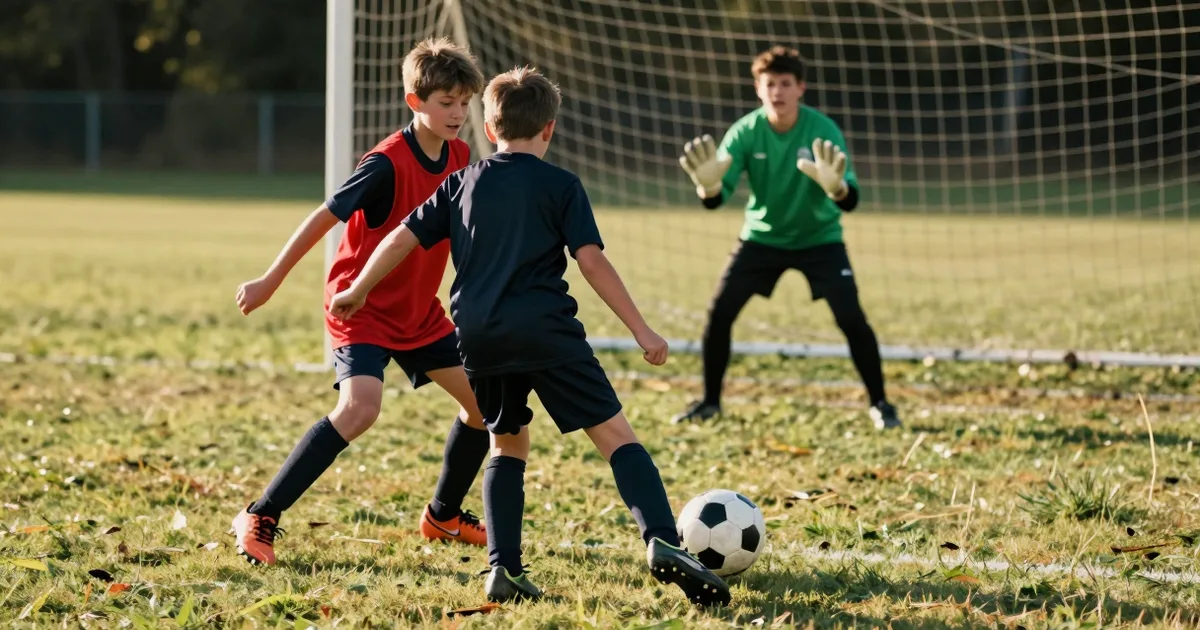
Three matches, no goal: the issue isn't talent
You're a U11 assistant coach, and after three winless matches you sit at the kitchen table on Sunday with the match report in hand: ten shots on goal, none in. In training everything looks normal, the kids run, they play, they shoot. In matches they can't pull it off, and you're wondering: bad luck, bad form, weak strikers?
Probably none of those. A goal drought in youth football has almost nothing to do with talent. It's a question of repetition, pressure, and training architecture. And that can be turned around in two to three weeks if you put five focused minutes per session on finishing, instead of letting it run as a "we'll get there eventually" element.
This article walks through the five most common causes of goal droughts in U11 squads, three drills of five minutes each that target those causes directly, and a concrete three-week plan you'll see results from in the next match.
Five causes that are almost always behind it
Before you change training content, identify which problem actually applies to your team. Usually it's one of the following points, often two of them combined.
Cause 1: Too few shots on goal per session
In a U11 match a striker realistically gets two to five shots on goal. If they only add five to ten more in training, that's at most fifteen shots per week. Not enough to build routine. Backed by data at developmental level too: in the Premier League 2 (English U23 league) winning teams average 14.22 shots and 6.86 on target per match, losing teams 11.22 / 4.18 (p < 0.001). Shots on target are the single strongest predictor of winning in that study. Pro strikers fire three-digit numbers per week — at every age, volume is the first lever.
Shots on target per match: losing vs winning teams
Premier League 2 (U23): winning teams take 64 % more shots on target per match (p < 0.001). Shots on target are the single strongest predictor of winning.
Winning in Premier League 2: a statistical model of technical performance indicators (2026).
Cause 2: Shots without pressure
When the striker calmly receives, takes three steps toward goal, and shoots at an empty net, what they're practicing is warm-up. In matches a defender shows up, the keeper is positioned, the ball half-bounces. Shots without a defender and without time pressure carry almost nothing into the match situation.
Cause 3: Wrong distance
Most goals in U11 matches drop from the six-yard area, not from the edge of the box at 16 metres. If your training only practices shots from 16 metres on an empty net, you're training a situation that barely happens in matches. Short distance, little reaction time, fast finish, that's the reality.
Cause 4: Shot from a stand
In training: receive, turn, aim, shoot. In matches: ball comes, the striker is on the move, and they have half a second to finish. Players who only shoot from a stand can't shoot on the move. Different motion, different foot position, different gaze.
Cause 5: Finishing at the end of training
If your session flow is "warm-up, technique, small-sided game, finishing", your team is shooting in the last ten minutes when legs are heavy, focus is gone, and everyone just wants the scrimmage. Finishing belongs in the first thirty minutes, fresh and alert. That changes everything.
If your team additionally loses the ball regularly in 1-on-1s in front of goal, more shooting won't fix that. You first need solid dribbling drills for U9 to U11 before more finishing volume pays off.
Drill 1: 1 vs goalkeeper in five-minute frequency
Drill 1: Frequency finishing
Two lines in front of the goal, alternating take, two steps, finish, then over to the other line.
Setup. One goal with a goalkeeper. Two lines in front of the goal, one on the left, one on the right, each seven to eight metres from goal. A ball stash at each line. One player from each line in alternation: take the ball, two steps, finish on goal, immediately move to the other line. The next starts as soon as the ball is in the goal or wide.
Goal. Thirty shots per player in five minutes. No aiming, no thinking. Ball, step, shot. Volume is the core here, not accuracy.
Coaching cue. Every tenth shot, briefly stop and give one cue: "Heads up, look at the goal, not the ground." No tactical corrections, no discussion. Frequency and gaze only.
Why it works. Cause 1 (volume). In five minutes each player banks the shot count they'd otherwise get in two weeks.
Drill 2: 4-goal mini-game in five minutes
Drill 2: 4-goal Funino with shooting zone
3 vs 3 on 12 × 18 m, four mini-goals in the corners — goal only counts if the shot comes from inside the 6-metre zone.
Setup. A field twelve by eighteen metres. Four mini-goals, two per team to defend, in the four corners. Three vs three. Mark a six-metre shooting zone in front of every goal. Goals only count if the shot comes from the shooting zone. No goalkeeper.
Goal. As many goals as possible in five minutes. Swap teams after each round so everyone attacks and defends.
Coaching cue. "Look which goal is open, head there." Don't sprint into the central goal, decide. The drill is Horst Wein's Funino (3 vs 3 with four mini-goals), recommended by the DFB as the standard format for G- and F-Jugend since the 2024 reform (Booklet 09/2024). The 6-metre shooting zone comes straight from Wein: "A goal only counts if the scorer is inside the shooting zone at the moment of the shot." The drill trains two things at once: pressure (defenders are there) and distance (six metres, not sixteen).
Time-pressure variation. Memmert (2011) suggests for finishing-focused small-sided games: "A shot has to happen within 20 seconds." Once your team flows, add the rule: if 20 seconds pass without a shot, the ball turns over.
Why it works. Causes 2 and 3 combined. Players shoot from a realistic distance under defender pressure. That's the match situation missing from classic finishing training.
Drill 3: Finishing on the move in five minutes
Drill 3: Finishing on the move
Low cross-pass from the half-space, the runner finishes directly — without stopping the ball.
Setup. One goal with a goalkeeper. A wide position (left half-space) with a ball stash. From the centre circle a player runs toward goal. The wide player plays a low cross-pass into the box. The runner finishes directly on the move, without stopping the ball. Next player immediately.
Goal. Ten to fifteen shots per player in five minutes. Swap the wide position after each round so the passer learns tempo too.
Coaching cue. "Movement first, then the shot." Players who stop the ball are slow and give the defender time. The shot has to happen on the run, with the first touch on goal. UEFA Technical Observer Mićo Martić put it short and unambiguous in the 2026 U19 Futsal report: "One-touch finishing is a must." The same logic applies to outdoor youth football: one touch fewer means a faster shot.
Why it works. Cause 4 (shooting on the move). This direct finish is the most common goal situation in matches and the rarest in training. Five minutes for three weeks is enough to flip that.
The 3-week plan: what you do now
The drills only work if you put them consistently into the training flow. Here's the concrete plan for the next three weeks.
Training architecture. Place the drills in the first thirty minutes, after the warm-up and before the main scrimmage. Legs are fresh, focus is still there, that makes every shot more effective. End of training is scrimmage, not technique — and the DFB coaching manual for Bambini through D-Jugend is explicit on that: at least 50 % of training time should be finishing-form play in some variation. Two levers combined: focused drills up front, plenty of scrimmage time at the back.
60-minute training with finishing block up front
Warm-up, finishing drills in the first 30 minutes, then the scrimmage — drawn proportional to time.
Distribution follows the DFB coaching manual for Bambini through D-Jugend (at least 50 % scrimmage).
Week-by-week distribution.
Three weeks, each with a clear focus. By the next league match you should see the difference in shot situations.
Week 1: Volume
Drill 1 (frequency) every session. Goal: every player hits their 30 shots per session. Visible payoff already after four days.
Week 2: + Pressure
Drill 1 continues, plus Drill 2 (4-goal Funino with shooting zone) in the second session. First match-realistic shooting under defender pressure.
Week 3: + Movement
All three drills in rotation. First session: Drill 1 + 3. Second session: Drill 2. Direct finishes are now in the repertoire.
What to measure. Track shots on goal and goals after every match. After three weeks, compare with the three matches before. If shot count rises but goals don't, you still have a volume or distance problem. If both rise, the plan worked.
If your next tournament is in the upcoming weeks, you can prep the schedule and team line-up in parallel, instead of improvising the day before.
Set up your next tournament nowFree and no sign-upSources
- Winning in Premier League 2: a statistical model of technical performance indicators (2026). Shots and shots on target per match for winning vs losing U23 teams (14.22 / 6.86 vs 11.22 / 4.18); shots on target as the single strongest predictor of winning.
- Wein, H.: Game Intelligence in Soccer. Funino rules including the 6-metre shooting zone: "A goal only counts if the scorer is inside the shooting zone at the moment of the shot."
- DFB: Competition formats in children's football, edition 09/2024. Recommends Funino (3 vs 3 with four mini-goals) as the standard format for G- and F-Jugend.
- DFB: Coaching tips for Bambini, F-, E- and D-Jugend (Münchener Fußballschule, DFB coaching manual). "At least 50 % of training time through D-Jugend should always be scrimmage (in different variations)."
- Memmert, D. (2011): Teaching game ability. Suggests for finishing-focused small-sided games: "A shot has to happen within 20 seconds."
- UEFA Technical Report (March 2026), The Technician. Mićo Martić on the U19 Futsal EURO: "One-touch finishing is a must" — applies analogously to outdoor youth football.