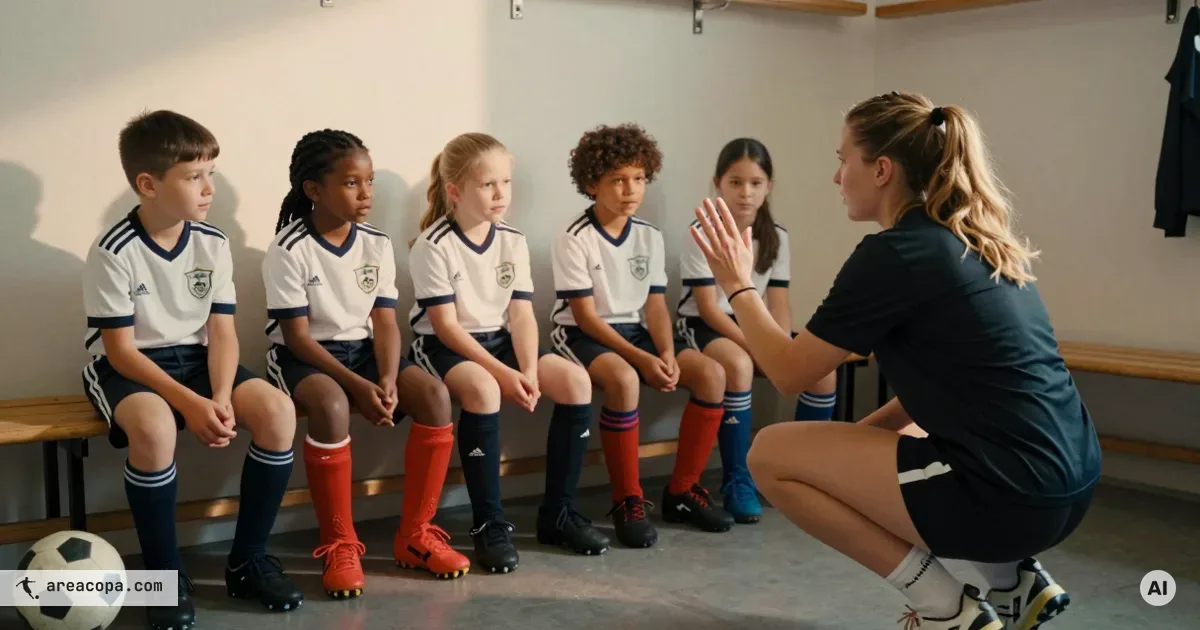
Five minutes before kick-off, ten excited children in the locker room, and you don't know what to say. In youth football, or soccer as it's known in North America, those last minutes set the tone for everything that follows. You start: "Right, today it counts. Give everything, stay focused." The children nod. Thirty seconds later they run out, and you think: did anyone actually hear that?
Probably not. Not because the children weren't paying attention, but because you said the wrong thing.
Why "Give Everything" Backfires with U10
Phrases like "concentration", "give everything" or "we want to win" are not motivation, they're noise. Children aged eight to ten don't process abstract instructions the same way teenagers or adults do. They can't switch "concentration" on because they don't yet have the tools to do so.
Worse: sentences like "we can't afford to lose today" or "the opposition is strong, you'll really have to work" create pressure that shows up directly in the game. Tense passes, timid challenges, panicked glances at the sideline.
The reflex often comes from your own experience as an athlete. As a teenager or adult, those phrases may have worked. At U10, at the first tournament of the year, they don't.
What Children Really Need Before Kick-Off
U10 children arrive at a tournament with mixed feelings: anticipation, excitement, perhaps a touch of fear. What they need to take from that mix is not motivation, they're already motivated. What they need is the feeling that it's okay to be exactly as they are.
Three basic needs come first before kick-off:
These are the three needs you address in your talk: Confidence (trust in oneself), Connection (belonging), Competence (ability).
Security
'You are prepared. You know what you're doing.' Corresponds to Confidence in the 4Cs model, trust in your own abilities.
Belonging
'We are a team. This is your place.' Corresponds to Connection, the quality of the relationship with the coach and teammates.
Permission to play
'Today you get to play football. That's all.' Corresponds to Competence-Permission, being allowed to show what you can do, without pressure to produce a result.
Character, the fourth C, develops over the season, not in the last two minutes before kick-off, it belongs in everyday training, not in the locker room talk.
One sentence that hits all three: "You've been training for weeks. You know your positions. Today it's about playing football together, and that's fun."
No result. No expectation. No pressure. Successful sporting careers start with enjoyment, social connection, and permission to play, not with pressure to produce results. Fixing children on outcomes too early risks stress, anxiety, and drop-out. "Today you get to play football" is not soft pedagogy; it is the more robust long-term decision as a coach.
The Template: 2 Minutes, Three Points
A good locker room talk for U10 lasts two minutes at most. Not because you don't have time, but because more time adds nothing. After two minutes attention is gone, regardless of how well you speak. The DFB coaching guide for Bambini through D-Youth makes the point clearly: "On the touchline the coach behaves calmly and with restraint. Motivation yes, but no..." The same applies in the locker room: short, calm, concrete.
The 2-Minute Template
Look back, task, prompt, ritual, shown proportionally by seconds. Nothing more is needed.
Maximum 70 seconds of content, the rest of the 'two minutes' is buffer for quiet transitions.
Three points are enough:
1. Look back (10–15 seconds) Something concrete from training or the last game. Not "we trained well", but: "Last time you switched play really quickly, let's do that again today."
2. Task (20–30 seconds) One single, concrete, age-appropriate task. Not "play well", but: "When you have the ball, look left and right before you pass." This is autonomy-supportive coaching: letting the player perceive something or make a decision rather than prescribing a result. Coaches who do this give children control over their game, and that works measurably better than "give everything".
3. Prompt (5–10 seconds) No result, no pressure, a short signal: "Now go and do what you can. I'm looking forward to it."
Done. Then the ritual, then out.
Ready-to-Use Phrases for Two Situations
Before the First Game of the Tournament
"You've trained, you know each other. The opposition have trained too, they're nervous too. Your task for the first two minutes: go into the challenges, even if you're not sure you'll win them. That'll get your rhythm going. And remember: excitement is fine — I know the feeling myself."
Brief pause.
"On three, everyone together."
After a Loss in the Group Stage
"That game's gone, it doesn't count anymore. You fought. One thing for the next game: we're losing too many balls in midfield because we play forward too fast. Next game: secure the ball first, then look up. That's all that changes."
Brief pause, eye contact.
"Same question: are you up for it? Good. Let's go."
No long dwelling. No drama. No comparison with the opposition.
What You Leave Out
Language Cheat Sheet for the Locker Room
What you say, what can optionally go in, and what stays at home. Print the left column, avoid the right.
Say
- Concrete look back: "Last time you switched play quickly"
- One task: "Secure the ball first, then play forward"
- Prompt: "Do what you can. I am looking forward to it."
Optional
- Normalise excitement: "That means this matters to you"
- Reframing: excitement as information rather than threat
- Clear closing ritual: hands in, team chant, out
Leave out
- Tactical instructions, system changes, press triggers
- Result goals: "We must win"
- Comparisons with the opposition ("they are good/bad")
- "Do you want to win?" as a motivating question
Distinction follows autonomy-supportive coaching (MCC 2026) and the 5Cs behaviour logic (Ashdown 2026).
Some things sound reasonable but do more harm than good:
Tactical instructions in the locker room: system changes, positional rotations, press triggers, these belong in training, not in the last two minutes before kick-off. What the children can't do now, they won't be able to do in two minutes either.
Result goals: "We must win", "This is the game that counts", "A draw isn't enough." Anything that puts the result front and centre creates fear of failure.
Comparisons with the opposition: "They're strong, you'll need to be careful" is toxic. "They're beatable, you're better" is a lie if you don't actually know. Neither helps.
The motivating question: "Do you want to win?" Everyone says yes, nobody knows why. Better to ask a concrete question: "What's your task for the first two minutes?"
And one psychological detail about excitement: trying to calm it down ("relax") works measurably worse than reframing it ("excitement means this matters to you"). Framing excitement as information rather than as a threat, that is the concrete lever. In the 5Cs model this ability is called Control: an observable behaviour that coaches can actively support.
The Closing Ritual
A short ritual at the end of the talk is more important than the content of the talk itself. It marks the transition from talking to playing, a clear boundary that children pick up on immediately.
The simplest ritual needs no preparation at all:
Everyone stacks their hands in the middle. You say: "On three." The group counts: "One, two, three, team!" Then out.
That takes 15 seconds. And it works at the first tournament just as well as at the thirtieth, because it needs no words you have to think up. The children know it, they carry it out, and then they run.
If you want to develop your own ritual with your team, build it in training, not on tournament day. Introducing a new ritual under competitive conditions is almost always messy.
Going into the Tournament Prepared
The locker room talk is a small part of tournament preparation. What comes before it decides just as much how calm and ready your children are when they sit down in the locker room: a structured warm-up, clear positions, communicated playing time. The complete roadmap from four weeks before the tournament to the journey home is in the article Preparing a Youth Team for a Tournament. And to keep the unrest from coming in from outside in the first place, handling difficult parents helps with the parent evening and conflict scripts.
Set up my next tournamentFree and no sign-upSources
- Newman, J. et al. (2026): Winning Beyond the Game — Findings from the Million Coaches Challenge Implementation Study. American Institutes for Research. Autonomy-supportive coaching (offering choices, promoting decision-making, taking the player's perspective seriously) is linked to higher perceived self-control in young athletes (Fawver et al. 2020; Riley et al. 2017).
- Côté, J. & Gilbert, W. (2009) and Müjdeci, İ. et al. (2026): Coaching effectiveness in competitive youth contact sports and martial arts. Frontiers in Psychology 16. 4Cs model (Competence, Confidence, Connection, Character) as an empirically validated framework for youth sport coaching effectiveness.
- Ashdown, B. et al. (2026): Observable mental-toughness behaviours in youth football. European Journal of Physical Education and Sport Science. 5Cs construct (Confidence, Control, Concentration, Commitment, Communication); arousal regulation as an observable Control skill.
- Andronikos, G. et al. (2026): A Qualitative Investigation of Successful Junior-to-Senior Transitions in Elite Athletes. Athens Journal of Sports 13(1). Elite athletes cite enjoyment, social contact, and permission to play as reasons for starting sport; early result pressure correlates with stress, anxiety, and drop-out (Rees et al. 2016).
- DFB: Tips for Bambini, F-, E- and D-Youth (Munich Football School, DFB Coaching Guide). "On the touchline the coach behaves calmly and with restraint. Motivation yes, but no..." — and "no long explanations".
Read next
- Motivational climate: winning or developing?: why the climate in training decides development.