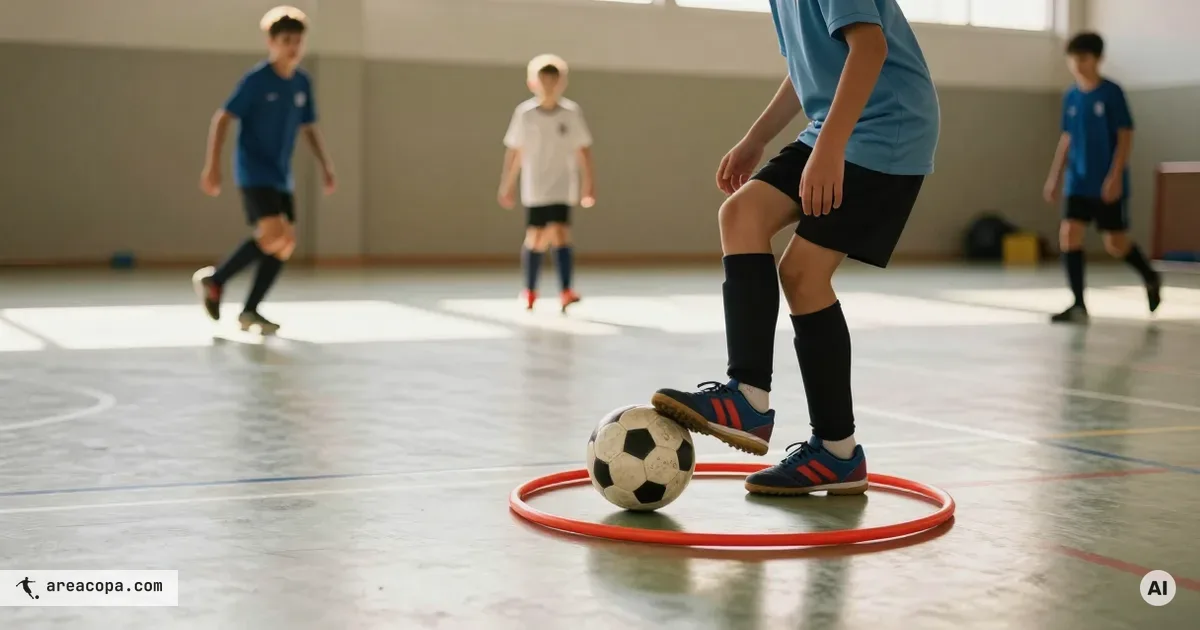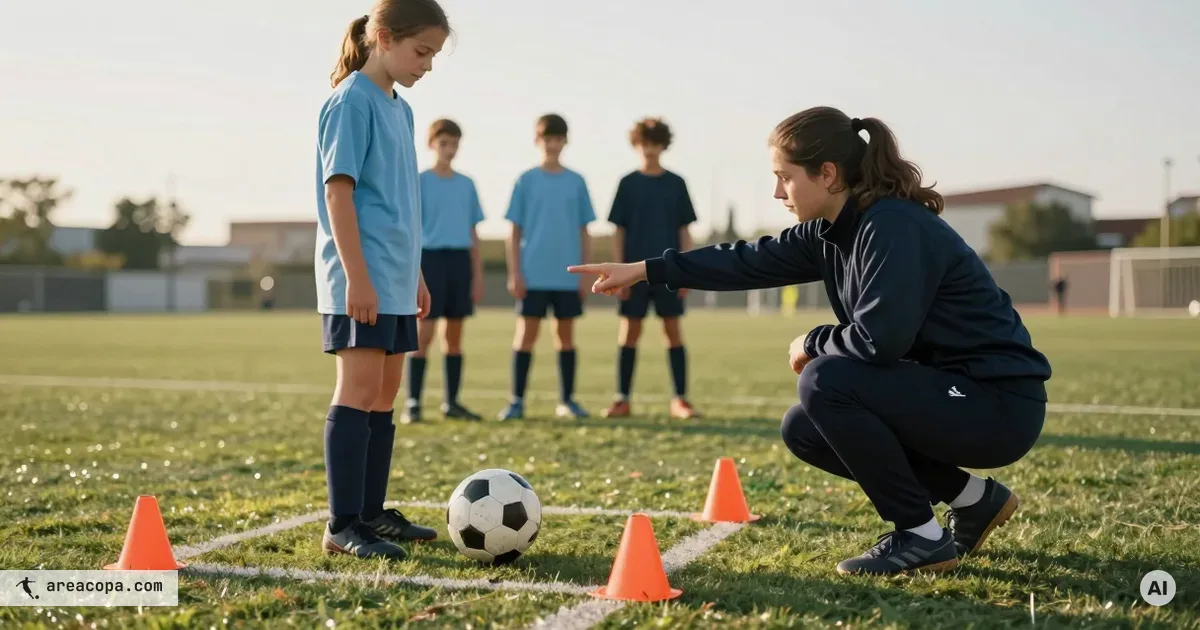
It is Tuesday evening, the drill is running, and it is too easy. Your players pass the ball around, nobody loses it, nobody has to think. Speed of play is the one thing this drill is not asking for. So you make it harder. Every coach in youth soccer, or football as the rest of the world calls the same game, arrives at that moment sooner or later.
And how do you make it harder? You tack two more minutes onto it. You push it to the end of the session, when everyone is already cooked. You ask for more repetitions, more tempo, more running.
That is the one dial out of six you should leave alone with children. It is called load pressure, and it means nothing other than physical fatigue.
This article does not hand you new drills. It hands you the six axes along which you can set the difficulty of every drill you already have. And it shows you on two concrete forms what that looks like in practice.
Speed of play is not sprint speed
Speed of play describes how quickly a player reads a situation, decides and executes the right technique before an opponent can intervene. The pressure is built into the definition of technique itself. A movement only becomes soccer technique once it holds up under time, space and opponent pressure.
That is more than a turn of phrase. Technique without pressure is not soccer technique, it is a movement. And that is why a player can cover 30 metres in 4.0 seconds and still need two touches too many in every phase of the game.
How much physical speed is trainable at all during the youth years is a question of its own. The answer is more sobering than most people expect, and it sits in speed training for youth football. Here we are dealing with the other half: with what happens between perception and execution.
That is exactly where the chain breaks for most players. Every coach knows the picture. In the drill the player controls the pass cleanly and plays it on accurately. In the match, with an opponent on his back, the same pass suddenly turns clumsy. Same movement, same player, a different outcome. The foot has not changed. The pressure has.
The six pressure conditions
Six kinds of pressure can act on a movement. They are not drills, and they are not a coaching method. They are dials.
| Dial | What it demands | How you turn it up | Example in the game |
|---|---|---|---|
| Time pressure | The technique has to be executed faster, before the opponent closes in. | Second limits, shorter distances, a tighter pitch, defenders starting closer. | The pass has to be gone before the holding midfielder shuts the lane. |
| Precision pressure | The execution has to be more accurate. | Smaller targets, narrower goals, target zones instead of target players. | The ball through the channel instead of just anywhere forward. |
| Successive pressure | Several tasks one after another, with no break in between. | Build action chains: receive, dribble, switch, finish. | Win the ball, switch the play, run into the box, convert the cross. |
| Simultaneous pressure | Several tasks at the same time. | Two balls, a shouted call on top of the ball carrying, two signal givers to watch. | Carry the ball, track the defender, call a team-mate, weight the pass. |
| Variability pressure | The conditions change and the player has to re-adjust. | Change a rule mid-drill, water the pitch, cut the grass shorter, switch the tactical brief. | The opponent goes from a low block to a high press. |
| Load pressure | The technique has to hold under physical and mental fatigue. | Drill at the end of the session, more repetitions, a pre-load. | The closing minutes, when the legs go heavy. |
A note on the count, because it will otherwise blow up in your face in some coaches' discussion: it is not six everywhere. Depending on the source you will find five to seven pressure conditions. Sometimes successive and simultaneous pressure are folded into a single complexity pressure, sometimes further levels are added, and the names change. How they are sliced is a matter of taste, the dials behind them are not. Once you can tell them apart, you recognise them again, whatever label is stuck on them.
English-language coaching has a name for the mechanism underneath all of this. Shaping the task, the environment and the player so that a different solution becomes necessary is what sport scientists call the constraints-led approach. The six dials are its practical end: a finite, named list you walk through on a Tuesday evening, not a theory you have to interpret first.
Time and variability lead in soccer
Six dials are six options, and that is an overload to start with. The good news: for soccer they are not weighted equally. Two lead the way, time pressure and variability pressure, and both can be turned without any effort at all.
With time pressure that is intuitive. The game has got faster over the decades, so the basic techniques have to be finished earlier. The moment the opponent starts to close in, the clock is running out.
Variability pressure is the underrated one of the two. It means that the conditions in a match change constantly and the player has to adjust to them. The opponent sits deep in the first half and presses high after the break. The pitch was dry at kick-off, and after the rain the ball suddenly skids through.
This is where the most practical recommendation of the lot hides, and it costs nothing: change the surface. Train on grass today, on artificial turf next week, indoors in winter, on sand in summer. Every surface gives the ball a different speed and the foot a different grip. If you have no second pitch, water the one you have or let the grass grow longer. No equipment, no set-up, not one extra minute. You are changing the condition under which you are training anyway.
The simplest version of it is a rule change in the middle of a running drill. After five minutes you reverse the passing direction. After another five, back-passes are banned. The drill stays the same, the head has to sort itself out again every time.
Why fatigue is the wrong dial to turn first
Load pressure means that a player is under high physical and mental strain and still has to solve coordinatively demanding tasks. The closing stage of a match is the showcase: the legs are heavy, the deficit weighs, and the ball still has to be controlled cleanly.
It is a genuine demand, and in the professional game it cannot be wished away. For children and teenagers something else applies, and the recommendation is unambiguous: in coordination work, load pressure stays out until the basics are in place. In practice that means: until around under-14.
The reason is not consideration, it is logic. Fatigue lowers decision quality instead of demanding it. A tired player does not solve the task better, he solves it slower and less accurately, and he learns exactly the wrong pattern while doing so. The other five dials make the drill harder without switching the brain off. Load pressure makes it harder by switching the brain off.
And yet it is the dial almost everyone reaches for first. It is the only one you can operate without thinking.
The touch limit is a fitness ladder in disguise
There is one progression every coach knows and takes for a decision progression. It goes like this: allow three touches first, then two, then one. Sounds like time pressure. It is time pressure too, but not only.
In 2025 everything that has been measured on touch restrictions in small-sided games was pulled together for the first time. The findings are uncomfortable, and there are three of them.
First: touch limits raise the number of passes per player. So far the good news. But they raise the number of unsuccessful passes at the same time. Under a one-touch limit, errors and turnovers go up with them. The player is on the ball more often and loses it more often.
Second: the under-9 to under-13 age groups measurably cannot cope with a one-touch limit. For them two touches are the floor, that is from under-9 right through to under-13. One-touch play belongs in the older age groups.
Third, and this is the point that matters here: touch limits drive heart rate, lactate and sprint distance covered upwards. Physically, restricting touches is therefore a load progression.
Which makes the ladder from three touches to two to one not the decision progression everyone takes it for. To a good extent it is a fitness ladder with a decision label stuck on it. It grabs precisely the dial you are supposed to leave alone with children, and pretends to be a different one.
That does not mean touch limits are banned. It means you have to know what you are doing with them. From under-14 upwards they are a legitimate tool. In the under-11s and under-13s two touches are the floor, and anyone who wants to go harder reaches for one of the other five dials.
The six dials on one basic drill
Take a drill you already know. Two starting cones, a small square in between, a player runs in, calls for the pass and takes it forward in one movement.
Basic form: the ball-control square
Two starting cones facing each other, a 3 by 3 metre square in between. The player runs in, calls for the pass and takes it forward in one movement.
Based on a German FA session for under-11s.
The form comes from a German FA session for the under-10 and under-11 age group. In the basic form not a single dial is above zero. No opponent, no limit, no time pressure. And this is how you make it harder without changing the drill:
- Time pressure: the player has to be out of the square within two seconds of his first touch. Or a second player starts at the same moment from the opposite cone, and the two have to avoid each other inside the square.
- Precision pressure: the player does not take the ball just anywhere, he takes it into a marked lane one metre wide. Miss it and you start again.
- Successive pressure: a second task follows immediately behind the square, with no break. Receive, carry, beat a man, finish. Four actions in one chain.
- Simultaneous pressure: the passer calls out a colour or a number at the moment of the pass, and that decides the direction of the take. The player has to control the ball and read a signal at the same time.
- Variability pressure: the pass comes in low, then bouncing, from the left, then from the right, and the player does not know beforehand which one is coming.
- Load pressure: before the reception the player runs an intensive lap. This is exactly the dial you do not touch with under-10s and under-11s.
Five progressions that cost nothing. And one you save yourself.
The six dials in the rondo
The rondo is the most played small-sided form in youth soccer, and most coaches turn exactly two dials in it: smaller pitch, fewer touches. That is time pressure and, as we have just seen, a good chunk of load pressure. Four axes stay unused.
Basic form: rondo 4v2
Four players on the outside of a rectangle, two defenders pressing inside. The form every player knows.
This is what all six look like on that one form:
- Time pressure: shrink the pitch. 10 by 10 metres becomes 8 by 8. The defenders arrive sooner, the decision has to fall earlier.
- Precision pressure: the pass only counts if it reaches the team-mate on the correct foot, or if it goes between two cones.
- Successive pressure: after five completed passes the team switches immediately into a second rondo next to it, without a break.
- Simultaneous pressure: a second ball comes into play. Now the outside players have to keep two balls in view at once.
- Variability pressure: every two minutes one rule changes. First only right-footed passes, then only along the ground, then every third pass has to go across the diagonal.
- Load pressure: the rondo runs at the end of the session, after the final game. Again the dial you deliberately leave alone.
More variations of this basic form are in the rondo variations for the warm-up. And if you only have half a hall, the same principle works in a tight space: football training in a small space.
Diagnose before you progress
Six dials are worth little as long as you operate them by feel. The real benefit appears when you think backwards from the error.
| What you see from the touchline | The dial that is missing |
|---|---|
| The technique holds in the drill and falls apart in the match. | Time pressure. The drill was too slow. |
| The passes arrive, but always a metre too long. | Precision pressure. |
| After the first action the player stands and watches. | Successive pressure. He has never trained a chain. |
| The player solves the task but sees nothing else while doing it. | Simultaneous pressure. |
| The moment the opponent does something unexpected, nothing works any more. | Variability pressure. |
| In the last ten minutes everything collapses. | Load pressure. But only from under-14. |
This table is the actual reason the model is worth having. It turns a vague observation ("they play too slowly") into a concrete adjustment. And it heads off the most common mistake of all: making a drill that has a precision problem more tiring.
Which dial belongs to which age group
In youth soccer all six pressures act more weakly than in the professional game, and they grow with the level of play. That is exactly why they belong in youth training: not because children already master them, but because that is where they first meet them.
Under-7 to under-9. Time pressure and variability pressure, wrapped up as play. For this age the brief is clear: the drills stay a game, without pressure and with plenty of fun. What is meant there is the pressure to perform, not the methodical pressure of the six dials. Even so, it means this: many simple drills beat a few complex ones. No touch limit, no load pressure.
Under-10 to under-13. Precision and simultaneous pressure come in. Late primary-school age is particularly good for reaction ability and for coordination under time pressure. Still no one-touch limit, two touches are the floor. Still no load pressure.
Under-14 and older. Successive pressure in longer chains, touch limits as a legitimate tool, and now load pressure may join in as well. It keeps rising all the way to the professional game, where it cannot be wished away.
The three mistakes that undo the effect
Turning every dial up at once. If you tighten time, precision and simultaneous pressure in the same drill, the execution collapses. The player does not learn to act faster, he learns to panic. One dial per progression step is enough.
Raising the pressure before the movement is there. A technique passes through a rough form, then a refined form, and only at the end variable availability. Only in that last phase can a movement be called up reliably under pressure. Open the time-pressure dial while the rough form is still wobbling and you cement the error.
Making the drill harder without knowing why. This is the mistake that contains all the others. It happens because "harder" has only one meaning for most people: more tiring. With six names for six dials, it has six.
Download the six-dial card
The six dials, the diagnosis table and the age limits, compact as a printable PDF. Plus an empty drill planner: one row per drill, one dial per step, and a column for the question of whether it worked.
The Six-Dial CardSpeed of play: set the difficulty of every drill on purposeDownload PDFYour plan for the next four weeks
You do not need a new drill collection. You need a different question before every drill.
Week 1: name it. Look at your three standard drills and write down which dial is above zero in each. For most coaches the answer comes out the same: time pressure and load pressure, and nothing else.
Week 2: diagnose. Take one single question into the match with you. Which of the six dials is my team failing on? The table above gives you the error pattern.
Week 3: turn one dial. Exactly one. Same drill, same time, one axis up. Then watch whether the error pattern moves.
Week 4: leave the load dial alone on purpose. The drill goes at the start of the session, not at the end. If your players play better afterwards instead of worse, the argument held.
The most honest test of speed of play in the end is a small club tournament. All six pressures act there at once, and nobody announces in advance which one is up next. With AreaCopa the fixture list for it is ready in a few minutes.
Create my tournament for freeFree and no sign-up