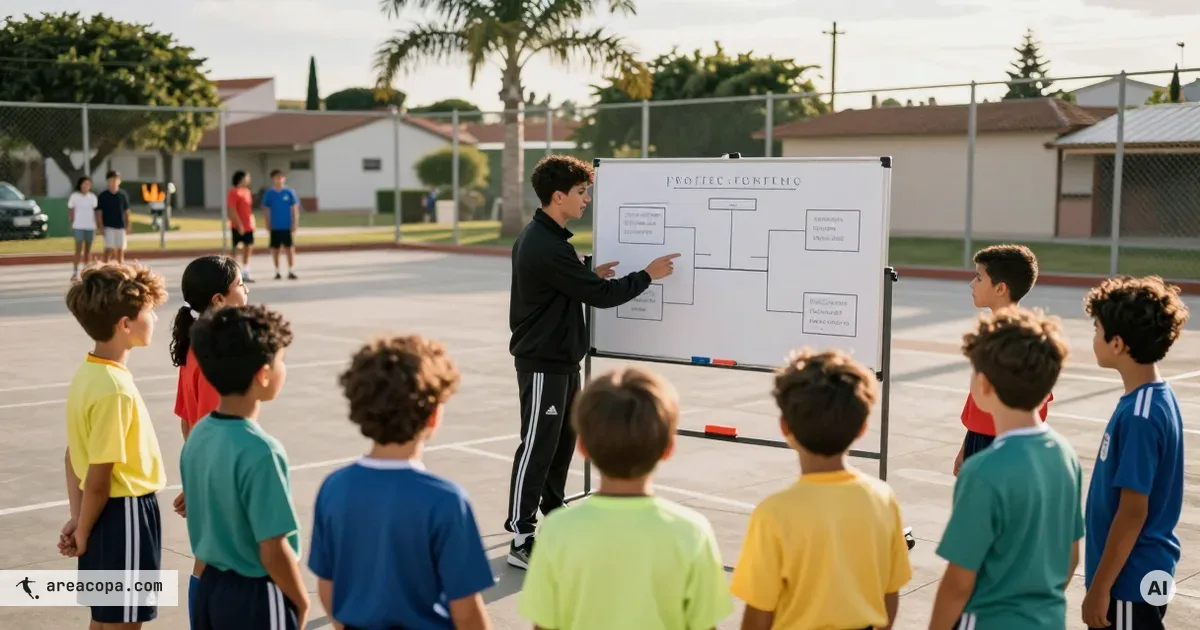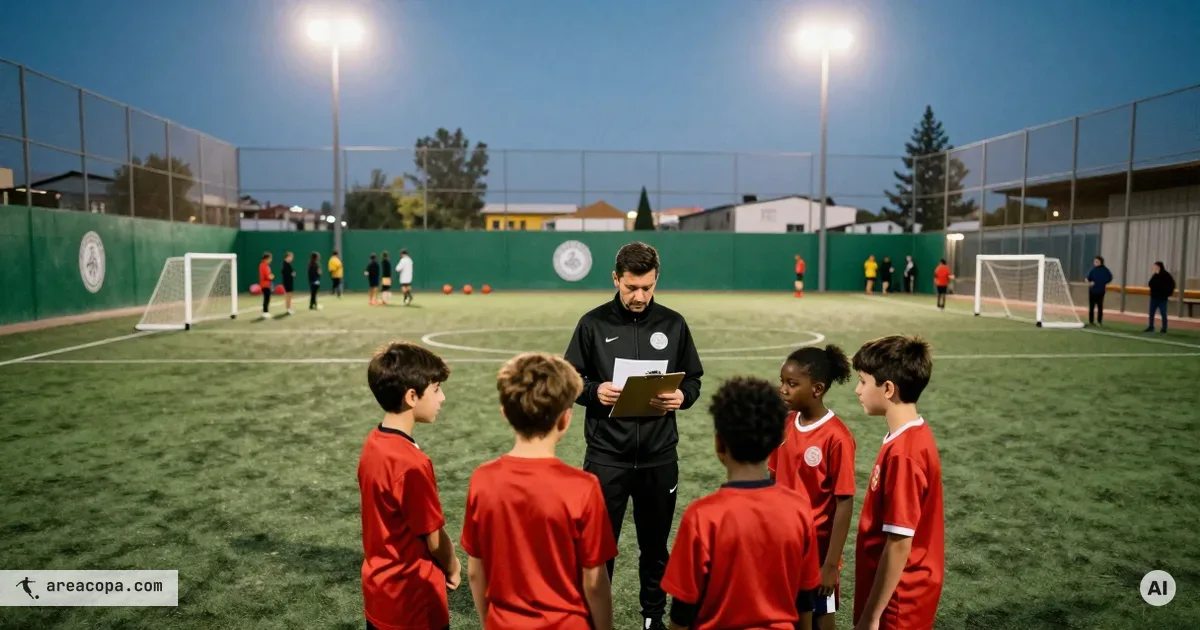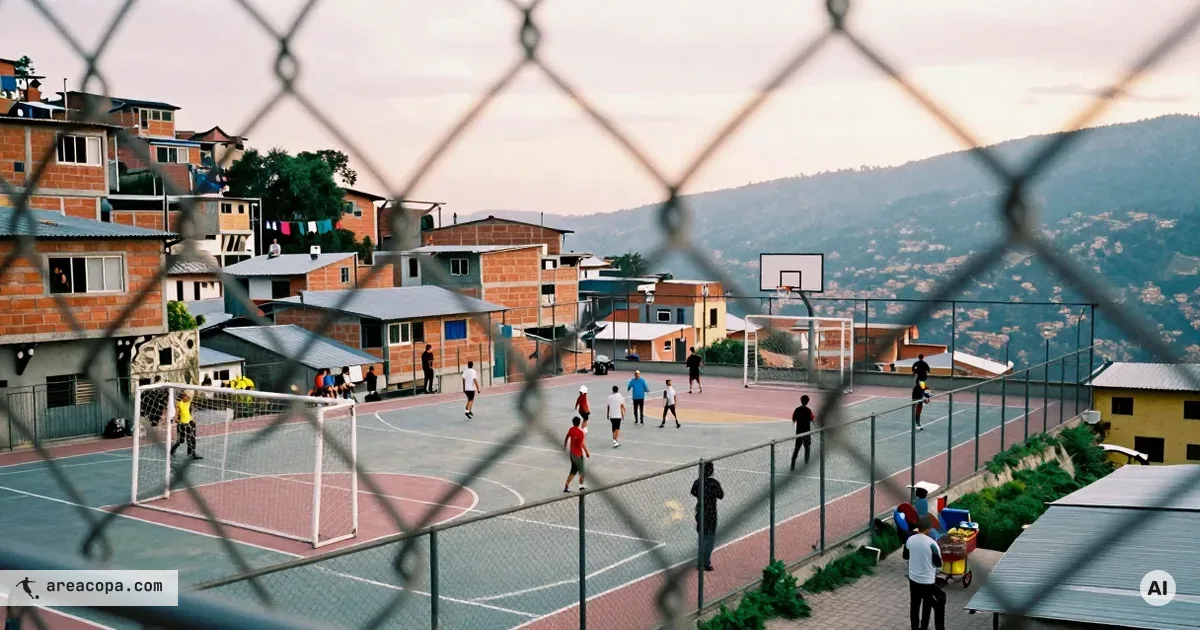
It is Saturday, 9 in the morning. Four teams arrive at the sports hall, each with eight to ten players, everyone wanting to be home before parents have to cook lunch. You have a three-hour hall slot and one pitch. That is exactly what the Campeonato Relámpago is for: a one-day football tournament, or soccer tournament as it's called in North America, that fits from first whistle to trophy ceremony into a single slot. The term comes from Latin America, but the concept works in any club house, school hall, or neighbourhood pitch.
This article presents three schedule templates: morning (3 hours), afternoon (5 hours), and full day (around 8 hours), each with exact kick-off times and a matching match format. There is also a dedicated section for the school and neighbourhood case, where teams are drawn on match day and parents referee. Anyone looking for the bigger planning picture and wanting to organise a football tournament will find the complete 12-week checklist in the main guide. Anyone wanting to go deeper into kick-off times, buffer times, and escalation levels will find that in the kick-off times article. This article is the schedule reference for exactly one day and four to twelve teams. Anyone with more than one day who wants to run the tournament in the World Cup format with a group stage and knockout will find it in the World Cup format article.
What a Campeonato Relámpago or one-day tournament is
A Torneo Relámpago is a tournament played on a single day or at most over three consecutive days, a few teams, a format that can be completed within hours. In practice "one day" is the norm; the weekend Relámpago appears almost only at charity or season-opening events.
The two main paths are pure Eliminación directa (little time, odd number of teams) and zonal group stage plus Eliminación (six or more teams). With four to six teams a short round-robin without a knockout phase also works, in which case the table leader wins. The pitch is almost always Fútbol 5 (in Chile synonymous with Baby Fútbol on a 26×16-metre surface), less often Fútbol 7 or Fútbol 11. Match time per game ranges between 2 times 10 minutes (school, children) and 2 times 15 minutes (adults, Argentine standard).
What distinguishes the Relámpago from the Cuadrangular: the Cuadrangular has exactly four teams by definition; the Relámpago scales flexibly between four and twelve. What distinguishes it from a classic club tournament: it ends on the same day it begins. Full stop. Anyone who wants to play over several weeks with a running table instead of a single day should set up their own soccer league instead.
The three schedule templates at a glance
Three schedule templates for your Campeonato Relámpago
Morning, afternoon, or full day: the three standard slot sizes with matching team count, match format, and total playing time.
The table immediately shows why the slot size is the first decision. With three hours you cannot accommodate eight teams: the maths does not add up. With eight hours and only six teams, the format is underused. The second decision is choosing the format path within the slot: pure knockout is faster; round-robin or zones-plus-knockout gives each team more playing time.
Which template fits your slot?
Three decision anchors along the time-budget axis.
You have a morning
Three hours, one pitch, four to six teams are coming: pure knockout with 4 teams or short round-robin with 6 teams. Fully done before lunch, no second referee needed.
You have an afternoon
Five hours, two pitches, six to eight teams are coming: group stage in two groups plus semi-finals plus final. Every team plays two to five matches, and there is a proper trophy ceremony at the end.
You have the whole day
Around eight hours, two pitches, ten to twelve teams are coming: two groups of five or three groups of four plus semi-finals plus final. Full club-tournament experience in one match day.
Morning Relámpago: 3 hours with 4 to 6 teams
Three-hour slot, one pitch, four or six teams. This is the simplest of all Relámpago setups and the most common in Chilean schools or neighbourhood pitches on a Saturday morning. Two format paths are available.
Path A: pure knockout with four teams. Identical to variant C of a Cuadrangular. Two semi-finals (40-minute slot each including break) and a final. Three matches in total, every team plays at least one, the winner plays two. A third-place match is optional.
Path B: short round-robin with six teams. Six teams produce 15 matches (formula N×(N-1)/2). Too many for three hours on one pitch. Therefore: two groups of three, each plays internally (3 matches per group = 6 matches), group winners play the final. Seven matches in total, every team plays at least two, the finalist three.
Morning Relámpago: knockout bracket with 4 teams
Semi-finals, final, optional third-place match. Three to four games in three hours on one pitch.
Match time 2 times 10 minutes plus 5 minutes break, one slot of 40 minutes per match. Bracket component analogous to the Cuadrangular spoke.
Morning Relámpago: schedule on one pitch
Three hours gross including set-up and take-down, four teams in pure knockout.
Match time 2 times 10 minutes, slot 40 minutes per match including break and referee changeover.
This slot size is the only one that works without a second referee: one person can whistle all four matches — the two semi-finals, the third-place match and the final — because there is enough of a break in between. That makes the morning Relámpago the default choice for schools, kindergartens, and neighbourhood clubs that cannot or do not want to book an association referee.
Afternoon Relámpago: 5 hours with 6 to 8 teams
Five-hour slot, two pitches, six to eight teams. This is the most common setup for club tournaments and cross-class school cups. The standard format choice: two groups of four in the group stage, then cross semi-finals (first in Group A vs second in Group B and vice versa), then the final.
| Phase | Matches | Match time | Duration |
|---|---|---|---|
| Group stage Group A | 6 matches | 2×12 min plus 3 min break | ~2.7 hours on one pitch |
| Group stage Group B | 6 matches | 2×12 min plus 3 min break | on the second pitch, parallel to A |
| Semi-final 1 | 1 match | 2×12 min plus 3 min break | 27 minutes |
| Semi-final 2 | 1 match | 2×12 min plus 3 min break | 27 minutes |
| Final | 1 match | 2×15 min plus 5 min break | 35 minutes |
With one pitch you get 12 group-stage matches plus 3 knockout matches: 14 of them last 27 minutes, the final 35, roughly 6.9 hours in total. Too much for the 5-hour slot. Therefore two pitches are mandatory, or match time must be cut to 2×10 minutes. With eight teams the one-pitch option does not exist; with six teams it still works.
Anyone who does not want to calculate the group-stage table by hand can use a schedule generator and share a public live link with all participants. The mathematics of the zonal group stage is identical to the round-robin algorithm: N×(N-1)/2 matches per group of four gives 6, with semi-finals and final a total of 15.
Full-Day Relámpago: around 8 hours with 10 to 12 teams
Around eight hours, two pitches, ten to twelve teams. This is the club-tournament variant on a Saturday or Sunday. Without a lunch break it is not possible: players, parents, and referees need at least one hour of reset between the group stage and the knockout phase.
Format path with ten teams: two groups of five, each plays ten matches (formula 5×4/2), making twenty group-stage matches. On two parallel pitches this takes 4.5 hours including breaks. Then comes the knockout round. The top two teams from each group meet: two semi-finals, a final, optional third-place match. That is three to four knockout matches of 35 minutes each, so with the semi-finals in parallel on two pitches around two hours. With lunch break and Premiación you arrive at around eight and a half hours gross.
Format path with twelve teams: three groups of four with six matches each (18 group-stage matches in total). From each group the first-place team advances plus the best second-place team (four teams in the semi-finals). Advantage: fewer group-stage matches than with ten teams, and the day fits into around eight hours. Disadvantage: the "best second-place team" must be determined via goal difference or head-to-head, which is error-prone at the referee table under stress during a real tournament.
Full-Day Relámpago: schedule on two pitches
Ten teams in two groups of five plus knockout round, around eight and a half hours including the lunch break.
Group-stage match time 2 times 12 minutes plus 3 min break, knockout 2 times 15 minutes plus 5 min break. The lunch hour is at the same time the buffer.
In the full-day format the lunch break is not a convenience but a buffer-time reserve. If the group stage overruns by 20 minutes due to injury or a walkover, that eats into the lunch break without the final being put at risk. More on buffer times and escalation levels in the kick-off times article, which goes through this systematically.
Special case: one-day tournament at a school or in the neighbourhood
The three templates above assume a club tournament: teams register weeks in advance, bring their line-up, pay an Inscripción, the club provides association referees. At schools and in neighbourhoods it works differently. Three sub-setups cover the most common pain points.
Sorteo de equipos on match day
In schools where children play across classes, or in neighbourhoods where players register individually, there are no ready-made teams on match day: they are drawn on the spot. Three common methods:
- Capitanes Pick. Two pre-named captains per team take turns selecting players from the pool. Fast and transparent, but socially delicate: whoever is picked last knows it. More suitable for adults or older teenagers.
- Pot Sorteo. All registrations go into a container; a neutral person draws in turn. Optionally in multiple pots to balance positions (one pot per position, or one pot per skill level). Anonymous, neutral, good for children. The first Campeonato Relámpago of the Red Infanto Juvenil Maipú in 2008 explicitly used this method.
- Class-year mix. Each class provides two players per team; teams are mixed across class years. Promotes cross-class contact and automatically balances skill levels. The classic school approach.
Important in every variant: the Sorteo happens before the first match, is recorded in writing, and a list is posted visibly for all teams to see. Otherwise, during the first break, whispers will start about who was unfairly drawn against whom.
Parents and teachers as referees
Association referees cost between 30 and 80 euros per match (or 10,000 to 30,000 Chilean pesos). At a one-day tournament with 15 matches these costs add up to a four-figure sum. School Relámpagos therefore do without association referees and use parents or teachers as match officials. For this to work, a 15-minute briefing before the tournament starts is needed, covering five points:
- Stopwatch. Who has it, who starts it, how is added time communicated.
- Card rules. What sanctions apply (yellow, red, time penalty), who records them on the Planilla, what happens on a double yellow.
- Walkover protocol. When is a match considered a no-show (rule of thumb: 10 minutes after kick-off time without appearing), result 3:0 for the opponent.
- Injury pause. How long to wait (rule of thumb: 5 minutes, then substitute or abandon), who decides.
- Final-score handover. Who enters the final score at the table, who updates the table, who writes an injury report if needed.
The briefing takes 15 minutes; the one-day tournament saves three to four hours of referee fees as a result.
Cuota solidaria instead of an entry fee
At a club tournament, teams pay an Inscripción (in Chile 30,000 to 150,000 CLP per team, depending on the league). At a school Relámpago or neighbourhood tournament this is rarely the case. Instead, the Cuota runs as a donation or material contribution. Three models:
- Cash donation for a social cause. School library, animal shelter, local social project. The Cuadrangular Solidario of Santa María del Páramo on 28 December 2024 ran as a toy collection for the DANA victims in Lloc Nou and Sedaví. Each team brought a toy, which was distributed to those in need after the tournament.
- Material contribution. Each team brings something: a ball, a crate of water, a pack of plasters for the first-aid kit. No one pays cash; everyone contributes.
- Sponsorship from local businesses. Trophies from the bakery, medals from the local butcher, refreshments from the cafeteria. In exchange, a logo on the bracket poster and a mention in the Premiación.
Anyone who keeps the club as the organiser but switches the format to donation mode often ends up with more participants than with a classic Inscripción: the family-budget threshold disappears.
One-day tournament in 11-a-side format (adaptation)
Anyone wanting to run a one-day tournament in Fútbol 11 (full-size pitch, 11 vs 11, 2 times 30 or 2 times 45 minutes) rather than Fútbol 5 keeps the decision tree but multiplies times and slot requirements by around 1.5 to 2.
| Template | Fútbol 5 | Fútbol 11 |
|---|---|---|
| Morning (4 teams pure knockout) | 3 hours, 1 pitch, 2×10 min | 5 hours, 1 pitch, 2×30 min, without a third-place match |
| Afternoon (8 teams groups+knockout) | 5 hours, 2 pitches, 2×12 min | ~10.5 hours on two pitches, no longer fits in one day |
| Full day (10 to 12 teams) | around 8 hours, 2 pitches, 2×15 min | no longer fits in one day |
The last two rows show the hard limit: eight teams' 15 matches of 2×30 minutes break the ten-hour mark even on two pitches, and twelve 11-a-side teams in one day simply do not work. You need a weekend format, a third pitch, or you cut match time to 2×20 minutes (which is more of a full-size indoor tournament than an 11-a-side match). Anyone wanting a 12-team club tournament in 11-a-side format should look at the schedule spoke for 5/7/10 teams or plan a weekend.
Planning a one-day tournament with AreaCopa
Managing three schedule templates for your one-day soccer tournament on a scrap of paper while calculating group-stage table maths with goal-difference tiebreakers at the same time is a source of errors under stress on match day. Anyone who does not want to enter the schedule, live scoring, and table by hand can use a tool like AreaCopa and skip the spreadsheet.
Specifically, you set up your one-day tournament in four steps: choose the slot size (morning, afternoon, full day), enter the number of teams, set match time and breaks, confirm the tiebreaker order. The system generates the schedule automatically and keeps the table in real time as results are entered. Anyone wanting to show the schedule and table to the audience shares a public link that updates itself.
One-day tournament – Campeonato Relámpago checklistPull a morning, afternoon or full-day tournament through in one dayDownload PDF Create my one-day tournamentFree and no sign-upConclusion: which template for which occasion
Anyone who reaches the end of this article still unsure which schedule template fits their next tournament can sort the decision with three questions. First: how much slot do I have? Three hours = morning, five hours = afternoon, around eight hours = full day. Second: how many teams are coming? Four to six = morning or afternoon, six to eight = afternoon, ten to twelve = full day. Third: is it a club, school, or neighbourhood tournament? If club: standard templates and association referees. If school or neighbourhood: Sorteo on match day, parents as referees, and Cuota solidaria instead of Inscripción.
You can set up the schedule for your next Campeonato Relámpago in two minutes, regardless of the template you choose. That saves you the spreadsheet, the table maths at the referee table, and the mental mapping of tiebreakers during match day.