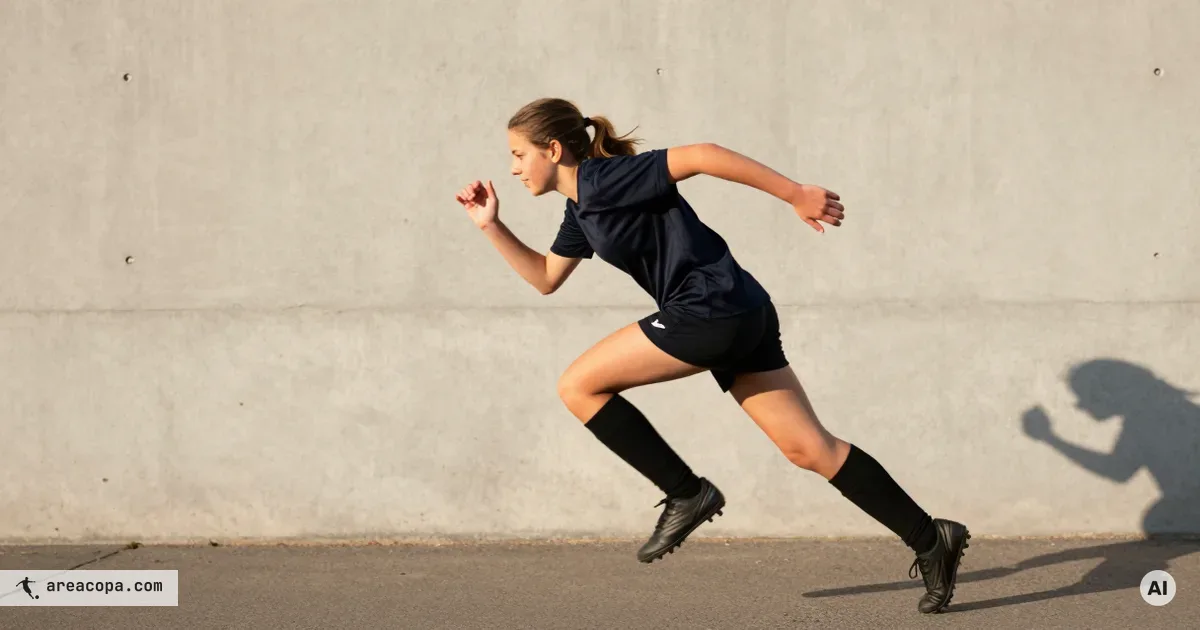
Most youth teams jog two laps around the pitch before a match and call it conditioning. Speed does not come from that. Getting faster in football, or soccer as it is known in North America, does not need longer laps, it needs better running technique. That is exactly what running drills are for: a set of technique exercises that train each part of the running stride on its own. This guide shows you which building blocks count, which ten drills suit U11 to U18, and how a forest run builds base endurance alongside them.
Why soccer players sprint differently
A sprint in soccer has little in common with a 100-meter dash. In a match you rarely cover long distances in one go. Instead come many short, sharp bursts in every direction, with stops, turns and pauses in between. Moving like that demands a different technique than steady continuous running: short, fast steps, a low center of gravity at the start and explosive acceleration. The first ten meters are decisive, because most duels for the ball are settled over that distance.
That leads to a simple consequence for your training. Whoever only runs laps may improve base endurance, but will not get quicker off the mark. Worse still: repeating sprints in the same form and speed cements the existing pace instead of raising it. The body stores movement patterns, and a constantly identical pattern becomes a barrier. This is exactly where running drills come in. They break the stride into its parts, make each movement clean, and then reassemble it into an economical, fast running style.
Three running myths in soccer
What coaches believe about running training, and what actually makes players faster.
Myth: More laps around the pitch make the team faster.
What really counts: Laps improve base endurance but not acceleration. Speed comes from clean technique and short, explosive sprints.
Myth: Whoever sprints a lot automatically gets faster.
What really counts: Always identical sprints only cement the existing pace. Only technique and targeted stimuli push the speed ceiling up.
Myth: To get quicker off the mark, you mainly have to make the steps faster.
What really counts: Over the first few meters it is the force that goes into the ground with each contact that decides, not the step count. Shot putters beat class sprinters over 30 meters without a single sprint session.
What are running drills?
Running drills are a series of running and jumping exercises that each highlight and exaggerate one specific phase of the stride. Instead of simply running off, you train the knee lift, the foot strike, the push-off phase or the heel recovery on their own. Through this isolation, the body learns the correct movement until it runs automatically.
The benefit works on three levels. First, technique: a clean running style is more economical, you lose less energy per step. Second, coordination: the exercises demand precise interplay of arms, torso and legs, which lays the movement foundation especially in youth. Third, injury protection: whoever lands and pushes off in a controlled way loads the knee, ankle and Achilles tendon less one-sidedly. Most coaches build running drills into the warm-up, but they also work as a dedicated technique block in the main session.
The 7 building blocks of clean running technique

Clean running technique can be broken down into seven building blocks. They are the map for every correction on the sideline: as soon as you know which block is off, you also know which exercise helps.
The 7 building blocks of clean running technique
Split into stance and swing phase: each block sits where it acts in the stride.
Stance phase
Foot on the ground, body above it
- Torso posture: stay upright, do not sink into a sitting posture
- Arm action: loose from the shoulder, elbow roughly at a right angle
- Hip extension: fully extend the hip in the push-off phase
- Foot strike: land flat under the center of gravity
Swing phase
Leg swinging through the air
- Knee lift: drive the knee actively forward and up
- Heel recovery: heel toward the glute, short lever
Stride and frequency: set the steps short and fast instead of long and pounding
Own illustration based on common running-technique models.
- Arm action. The arms swing loosely from the shoulder, the elbow stays roughly at a right angle. They set the rhythm and stabilize the upper body. Tense or cross-swinging arms slow the forward drive.
- Torso posture. The upper body stays upright, the head above the torso. With a weak core, the runner sinks into a sitting posture and tips forward, which costs pace and knee lift.
- Knee lift. The swing leg drives the knee actively forward and up. Too low a knee lift shortens the stride and worsens the foot strike.
- Hip extension. In the push-off phase the hip extends fully. A powerful hip extension lengthens the stride and is the real engine of the forward drive.
- Heel recovery. In the rear swing phase the heel comes close to the glute. This shortens the leg's lever and makes the stride faster.
- Foot strike. The foot lands flat under the center of gravity, first over the midfoot, at high speed over the ball of the foot. A hard heel strike far in front of the body acts like a brake and loads the joints.
- Stride length and frequency. The interplay of length and rhythm of the steps sets the pace. You train both in isolation before they merge in the sprint.
Stride length or frequency: what counts?
Behind every running speed sits a simple formula: pace is the product of stride length and stride frequency. Whoever wants to get faster has to turn one of the two screws, ideally both. Stride length depends above all on strength and hip extension: the more powerful the push-off, the farther each step carries. You build exactly this push-off power with focused jump-power training, the strength side to running technique. Frequency depends on fast ground contacts and a clean, short swing. The second complement is sensory: with neuroathletics you train perception, eyes and balance, so technique and pace stay stable even under sensory pressure.
For acceleration, though, the weighting is different from what most coaches assume. When you accelerate, the foot stays on the ground comparatively long, and that is exactly why what decides there is the force you press into the ground in that time, not the number of steps. Track and field delivers the most striking example: shot putters and weightlifters who never do a single sprint session beat class sprinters over 30 meters. Acceleration is a strength problem first. Technique makes that strength usable, it does not replace it. Why piling on more sprints still won't make your team faster, and what actually moves the needle, is covered in speed training for youth football.
Stride length is not something you can simply decide on either. Whoever deliberately reaches out further plants the foot in front of the center of gravity and brakes himself with every step. Length comes from behind, out of the push-off, not from reaching out in front. Frequency, on the other hand, you work on with stride-outs and deliberately small, fast steps that the players first exaggerate and then carry over into normal pace.
Acceleration and top speed are two different jobs
A sprint falls into two phases that barely resemble each other. While accelerating, the body leans forward, the steps are short, and the foot stays on the ground comparatively long. That long contact time is why strength rules here: there is enough time to press a lot of force into the ground. At top speed the body straightens up, the steps get long, and the foot has no more than a blink of ground contact. Now what counts is how short and how hard that contact turns out.
Two different training goals follow from that. For acceleration you train strength and the low, forward-leaning start. For top speed you train short ground contacts: fast ankle work, jumping forms, a clean landing under the body. The guideline value is a ground contact under 170 milliseconds. Players who reach that are not only faster — they also have more room left to grow.
This is also the real reason running drills exist at all. Movements under 200 milliseconds can no longer be corrected by the nervous system while they are happening. In a full sprint, every instruction arrives too late. What the body does out there has to be locked in beforehand. That is exactly why you break the running stride into its parts in the warm-up instead of shouting corrections into the sprint from the sideline.
The most important running drills
These ten drills form a complete toolbox. You do not have to run them all in one session: three to five per training are enough, but clean. Each drill runs over a distance of about 15 to 20 meters, after which you walk back easily.
| Drill | Focus | Coaching cue |
|---|---|---|
| Ankling (fast feet) | Foot strike, frequency | Tiny, fast steps on the ball of the foot, knee almost straight |
| High knees (A-skips) | Knee lift | Knee actively at hip height, upper body stays upright |
| Heel flicks (butt kicks) | Rear swing phase | Heel loosely toward the glute, do not reach out in front |
| Stork hold (knee balance) | Knee lift, balance | Hold the high knee, stabilize briefly, then continue |
| Power skips | Hip extension, push-off | Push off emphatically upward, arms swing along actively |
| Bounding | Push-off power, stride length | Wide, sweeping bounds, long flight phase |
| Side gallop | Hip opening, lateral burst | Hips to the side, do not cross the legs |
| Stride-outs at high cadence | Frequency | Short, fast steps, build pace over the distance |
| Resisted runs | Push-off power, stride length | Keep resistance light, extend hip fully, then run free |
| Standing start (first 10 m) | Acceleration | Low start, short sharp steps, explosive first steps |
Building running drills in: when, how often, how long
The natural place for running drills is the warm-up. After an easy jog-in and some mobilization come three to five drills, each once or twice over the short distance. That brings the players up to temperature and trains technique at the same time. Plan two such sessions per week, 8 to 12 minutes each. For what a complete warm-up without equipment looks like, see these warm-up exercises for the U11.
Quality matters more than duration. Six focused, technically clean repetitions bring more than twenty sloppy ones in which the movement falls apart. As soon as the technique breaks down, the repetition is worthless or even harmful, because the wrong pattern gets ingrained. Better take a short break and start fresh. Daily running drills are not necessary: the body needs recovery between stimuli to lock in the new movement patterns. Increase the frequency first, then the complexity of the exercises and only last the pace.
One point goes wrong almost every time: coordination belongs at the start of the session, never at the end. A tired player can no longer steer a fine movement, he only copies its rough shape. Running drills in the cool-down after a hard session are therefore wasted time — at worst they ingrain the sloppy pattern. So keep the individual drills short, 20 to 30 seconds are enough, and put them where the heads are still fresh.
Age-appropriate from U11 to U18
Running drills are not one size fits all. Before U11, tag and running games come first: the children should run, jump and move in varied ways, without you fine-tuning individual technique details. Conscious, isolated technique training only becomes useful once children can control a movement deliberately, so from around U11 to U12. From then on the demand rises with each age group.
Running drills from U11 to U18
Focus, typical drills and intensity per age stage.
- Focus
- learn the movement cleanly, lots of praise
- Typical drills
- ankling, high knees, heel flicks
- Intensity and volume
- low, short distances
- Focus
- chain drills, more pace
- Typical drills
- combinations, stride-outs
- Intensity and volume
- medium, first jumping forms
- Focus
- acceleration and pace under pressure
- Typical drills
- burst over 10 m, bounding, resisted runs
- Intensity and volume
- high, small jumping doses
Own illustration. Before U11, varied running and tag games come first.
The stretch between 13 and 15 deserves a note of its own. In the growth spurt, the body's levers shift faster than the nervous system can readjust. Movements that used to sit cleanly suddenly look wooden, and it is exactly the fine, precise sequences that suffer first — what coaches know as adolescent awkwardness. That is not laziness and not a step backwards, it is a normal phase. For you it means: here you do not rebuild technique, here you hold it. Whoever laid a solid movement foundation beforehand gets through with a dip. Whoever did not loses the most in these two years.
Endurance runs and forest runs with the team
As much as acceleration is the focus, it does not work entirely without endurance. A certain aerobic base helps the players recover faster between sprints and stay focused over 60 or 90 minutes. The right place for it is not the cinder track but the forest. Soft forest ground cushions every step and protects joints and tendons, while hard asphalt transfers the full impact load onto knees and back with every strike. Changing the surface also prevents one-sided overload.
Intensity is decisive. A base run goes in the aerobic zone, at around 75 to 80 percent of maximum heart rate. The simple rule of thumb: whoever can still hold a conversation alongside is running right. Whoever is gasping is running too fast. For the team, 20 to 40 minutes at an easy pace work well, depending on age and season phase. In pre-season you lay the foundation, during the season an easy run for recovery after an intense match is enough.
The often underrated side effect: a shared forest run bonds the team. Away from tactics and performance pressure, the players talk to each other, groups mix, the coach is part of the group instead of a commander. Whoever enriches the run with a small loop over roots and hills also trains sure-footedness and coordination along the way. That turns the obligatory lap into a date the team looks forward to.
Running in the heat: tips for hot days
Especially in pre-season, running training often falls in the hottest time of year. With a few simple rules it stays safe and useful nonetheless. For the complete heat playbook for training and match day, from how much to drink to a heat emergency, see the guide football in the heat.
- Time of day: Put the session in the early morning or the evening, and avoid the midday heat entirely.
- Route: Choose a shaded loop, the forest is the first choice here too. Water nearby helps for cooling down.
- Pace down: In the heat, intensity belongs throttled back. Move intense bursts and sprint intervals to cooler days and shorten the volume.
- Drinking: Plan fixed drink breaks every 15 to 20 minutes, with every player bringing their own bottle. Diluted apple juice or an electrolyte drink replaces the lost salt.
- Clothing: A light, airy jersey, plus a bright cap against the sun. Do not forget sunscreen on the neck and arms.
- Acclimatization: The body needs a few days to get used to the heat. Take the first hot sessions deliberately carefully.
Running drills PDF to download
The 10 drills with coaching cues, the build-in plan, the age ladder from U11 to U18 and a 6-week forest-run tracker as a printable PDF for your pocket.
Running Drills for Soccer PlayersDrill cards and forest-run planDownload PDFYour running-drills plan for the season
Put the building blocks together into a simple rhythm. In pre-season you lay the aerobic foundation with two easy forest runs per week and introduce the basic running drills in parallel. During the season the focus shifts to technique in the warm-up and short bursts in the main session, complemented by a recovery run after hard matches. That way each phase gets its fitting stimulus without overloading the team.
6-week plan for pre-season
From the easy forest run to the sharp burst. First technique and frequency, then pace.
Own illustration. The badge shows the starting week of each phase.
If you like it concrete, print the ten drills with their coaching cues as a card set and take them onto the pitch. A simple forest-run plan for pre-season fits alongside it, staggering frequency, duration and pace over the weeks. Together they turn theory into a training system you can work through week by week.
And once pre-season is set and the team is fit, all that is missing is the real test against real opponents. A pre-season tournament is the ideal chance to see the new burst under competitive conditions. For how to prepare the team all-round for it, see the complete tournament plan.
Plan my pre-season tournamentFree and no sign-up