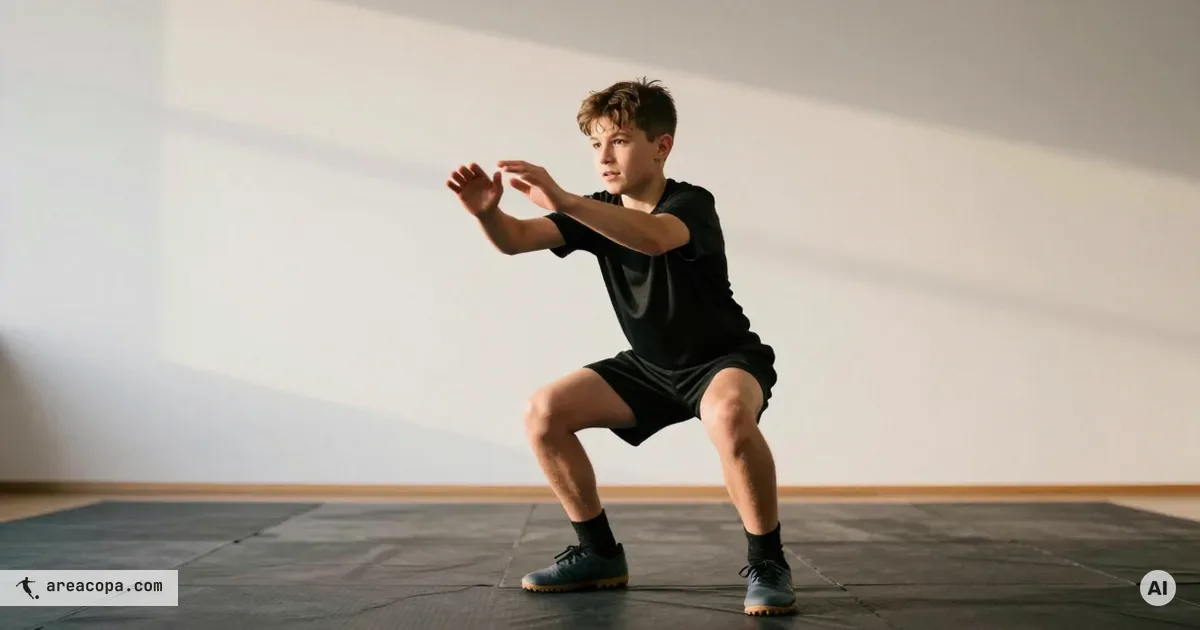
Most youth football teams, soccer as it is known in North America, train speed by running laps and strength not at all. Yet matches are rarely decided by the long distances. It is the first two steps to the ball, the take-off in an aerial duel and the burst from a standing start. All of that is jump power: the ability to put a lot of force into the ground in the shortest time. This guide shows you how to build it systematically, which drills suit which age, what the contrast method delivers and what a 6-week plan looks like that fits into normal training without extra time.
Why jump power decides football matches
Look at how goals actually fall. Jumps precede about 16 percent of goal situations, linear sprints as much as 45 percent and changes of direction another 6 percent. All three movements share one thing: they demand explosive force from the legs, not endurance. The striker who is a step earlier on the ball, the centre-back who heads the cross clear, the winger who pulls away in a one-on-one: they all use jump power, even if only one of them visibly jumps. The most visible jumper of all is the goalkeeper, whose explosiveness you can build with targeted goalkeeper training even without a dedicated GK coach. The same explosiveness decides who is first on the ball after a turnover: it is the physical base for counter-pressing and for fast transition play.
A football match is made of many short, maximal actions with breaks in between. A player sprints only about eleven times per match on average, mostly over 10 to 20 metres. These bursts are not won by whoever can run longest, but by whoever picks up speed fastest. This is exactly where leg strength training comes in: more force per ground contact means a shorter, more forceful first step, a higher jump and a cleaner deceleration before the change of direction.
The good news: jump power is trainable, faster than many think, and it needs barely any kit. An open patch, a few cones and low hurdles are enough to start. If you train running technique and the first step alongside it, you combine this ideally with the drills from our running ABC for footballers. One builds the technique of the stride, the other the force behind it.
What "explosive" really means
"Explosive" sounds like a buzzword, but it has a clear meaning. Maximal strength is how much a muscle can move at all, no matter how long it takes. Speed strength or explosive strength is how much of that you call up in a tiny window of time. In the jump and the burst you only have fractions of a second of ground contact. Whoever puts more force into the ground in that time jumps higher and accelerates faster. Experts call this the rate of force development: not how strong you are, but how fast you are strong.
The engine behind it is the stretch-shortening cycle. Before you jump, you briefly bend the knees. This stretches the muscle and stores energy like a tensioned rubber band. If you take off straight out of that movement, the muscle releases that energy on top of its own contraction. That is exactly the difference between a jump from a deep static stand and a jump with momentum: the momentum uses the stored energy.
Plyometrics is nothing other than the training that targets this cycle: short, forceful jumps with as little ground contact as possible. The body learns to push off again the instant it lands, instead of braking the movement. That is the bridge between raw strength and speed on the pitch.
Plyometrics: the base for every age (U11 to U18)
Plyometric training can be used sensibly from around age 11 to 12, once children can consciously control a jump and landing movement. The most important rule: quality over quantity. Six clean jumps do more than twenty sloppy ones, and they protect the joints. A sensible session is made of about 80 jumps, spread across three to four drills with two to three sets, twice a week with at least 48 hours of rest in between.
Always start with the landing, not the take-off. Whoever lands soft, quiet and stable, with slightly bent knees over the balls of the feet and the knees over the toes, has mastered half the drill. A loud, stiff landing is the clearest warning sign. Let players first drop from a low height and come to a clean stop before you even think about jump height.
After that you stagger by age and ability. The overview shows what gets added at each stage:
Jump power by age group
What gets added at each stage
- Drills
- Pogo and squat jumps, side jumps
- Landing
- two-footed
- Load
- no load, no drop jumps
- Drills
- plus hurdle hops and box jumps
- Landing
- two-footed
- Load
- no load, low heights
- Drills
- plus single-leg hops and drop jumps
- Landing
- single-leg allowed
- Load
- light load, contrast method
Own illustration. Staggered by age and training status.
Taking off and landing on two feet is mandatory in the younger stages. Light added load only comes in at U15 to U18, once the landing technique is solid and the strength work is in place.
The drill catalogue: eight jumps for the pitch
Pick three to four drills per session and reach about 80 jumps that way. Increase the number of repetitions first, then height or distance. All figures are per player.
| Drill | How to | Dosage | From age |
|---|---|---|---|
| Pogo jumps (straight-leg) | Two-footed, legs straight, very short ground contacts | 2 to 3 × 8 | U11 |
| Squat jumps | Deep into the squat, explosive up, soft landing | 2 to 3 × 6 | U11 |
| Side jumps over a line | Two-footed fast back and forth, both sides | 2 to 3 × 10 per side | U11 |
| Standing long jump | Two-footed far forward, come to a clean stop | 2 to 3 × 5 | U11 |
| Low hurdle hops | Over 4 to 6 mini hurdles, short contacts | 3 × 5 rounds | U13 |
| Box jumps | Onto a low box, explosive up, soft landing | 2 to 3 × 6 | U13 |
| Single-leg hops | Off one leg, land on both | 2 × 5 per leg | U15 |
| Drop jumps | Down off a low box, straight back up | 2 to 3 × 5 | U15 |
One note on that: with the low hurdle hops every round means 4 to 6 ground contacts, so this single drill alone comes to 60 to 90 jumps. On the day you schedule it, put at most one or two small drills alongside it, otherwise you blow the frame of about 80 jumps per session.
One effective trick: jumps in several directions. In a match you rarely jump and turn straight ahead. So build in lateral and diagonal jumps and train both turning directions equally. It is exactly this versatility that sets soccer-relevant plyometrics apart from dull up-and-down hopping.
What research shows about jump training
The evidence for jump training in football points pleasingly in one direction: it works. Reviews across many studies with players of every age and both sexes show gains in jump height, sprint time, changes of direction, maximal strength and even shooting speed. A systematic review focused on young male footballers up to age 23 found, across all included studies, better numbers for sprint, jump and agility.
What is interesting is what does not work: one-sided training. Whoever drills only jumps or only changes of direction often transfers it poorly to real agility in the game. A mixed, neuromuscularly demanding programme of jumps, changes of direction and stability work beats drilling single building blocks to death. In practice that means: combine, instead of repeating a single drill form into the ground.
On patience an honest look pays off. A study with adolescent female players brought more jump height and shooting distance with just one session per week. But only after 14 weeks, not after 7. With two sessions per week it goes faster; first effects often show after about six weeks.
No explosiveness without strength
Plyometrics does not make you stronger, it makes you fast-strong. That is a difference. If the base strength is missing, there is little there to call up quickly. So every serious jump-power build-up includes a minimum of strength training for the legs and the trunk. The stronger the base, the more every plyometric drill adds on top.
In childhood and youth, strength training does not mean heavy barbells. In the pre-puberty phase, strength improves mainly through the nervous system, not through muscle growth: the body learns to recruit more muscle fibres at once. Bodyweight exercises, partner drills and stabilising forms for trunk and legs are plenty for that. A truly stable single-leg stance is the base for every clean landing, and a focused balance training over eight weeks builds exactly that. Whoever also trains single-leg balance takes the next step with neuroathletics: it trains the eyes, balance and body awareness as the sensory counterpart to jump power. A high base strength also links directly to fewer injuries, so load-based strength training is doubly useful.
From puberty, around U15, strength training can get more concrete, with clean technique and slowly rising load. Two short sessions per week are enough. What matters is the right order across the season: lay the strength base first, then set explosiveness on top. When that strength work actually starts to bite depends on the growth spurt, though, not on the birth date: before it the return stays close to zero, as our guide to speed training in youth football shows.
The contrast method (PAP): worth the effort?
The contrast method, also called complex training, is the most advanced stage. The principle: you pair a heavy strength exercise with an explosive movement in the same movement pattern, for example a heavy squat directly followed by a maximal jump. The heavy exercise activates the nervous system so strongly that the following jump turns out briefly more forceful. Experts call this effect post-activation potentiation, PAP for short. Put simply, the jump afterwards feels feather-light, as if you were yanking up a bucket you thought was brimful but which is half empty.
Here is how it looks in practice, for mature players with strength-training experience from U15 or in the adult game:
- Load range: 75 to 90 percent of maximal strength on the heavy exercise.
- Repetitions: only 1 to 5 per set, low total volume with 2 to 4 sets.
- Pairing: biomechanically similar, such as squat plus extension jump or deadlift plus standing long jump.
- Rest between heavy exercise and jump: 3 to 12 minutes, the stronger the player, the longer.
- Block length: 4 to 6 weeks show clear effects, some benefit up to 8 to 12 weeks.
These rest times are exactly the catch. Whoever has to wait several minutes between heavy load and jump rarely fits in enough clean rounds in normal team training. On top of that: the effect is highly individual and works mainly in already strong players, barely in untrained ones. For an average amateur or youth team the effort is therefore rarely justified.
Your 6-week plan for more jump power
You do not need a separate training session for jump power. The simplest route is to fold the jumps into the warm-up, twice a week for about 10 to 15 minutes. For what a good no-equipment warm-up looks like, see our U11 warm-up. That replaces the usual lap running and costs you no extra training time. All that matters is the order across the weeks: firm up the technique first, then raise the volume, finally sharpen the speed.
6-week plan for more jump power
First landing, then volume, then speed. Twice a week in the warm-up.
Own illustration. The badge shows the start week of each phase. Stagger volume and intensity by age.
Keep to the age limits. U11 to U14 stay on bodyweight throughout all phases and land two-footed. U15 to U18 may add single-leg jumps from week 3 and light added load or first drop jumps from week 5. Track your progress simply: note the standing long jump distance or the vertical jump height of each player at the start and the end. You meet these same values at a player tryout too, where they reveal more about physical maturity than about talent. After six weeks you see in black and white whether the plan works.
Whoever brings running technique and jump power together has the complete burst machine: the running ABC for footballers delivers the technique of the stride, this plan the force behind it. And once the team is more explosive after pre-season, all that is missing is the live test against real opponents. A pre-season tournament shows whether the new burst holds up under match pressure too.
Plan my pre-season tournamentFree and no sign-upDownload the program (PDF)
The full jump-power program as a printable PDF: the ground rules, the drill catalogue with dosage and age clearance, the 6-week plan and a table to measure each player's progress before and after.
Jump power & explosiveness for footballersPlyometric program for U11 to U18Download PDF