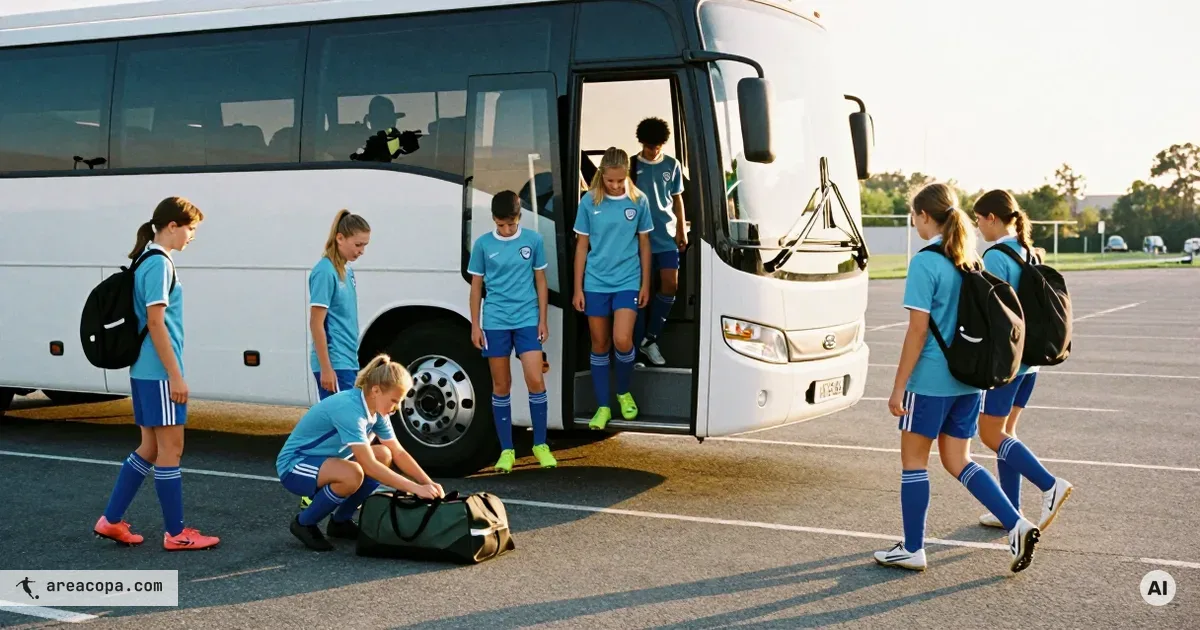
The season is ending, parents have been asking about dates for weeks, and you've agreed to organise the end-of-season trip for your under-11s. A youth football team, or soccer team as it's known in North America, on the road for a few days: three days, eighteen kids, two assistant coaches, a bus, accommodation that is not yet booked, and a consent form you have never written.
End-of-season trips look from the outside like extended away fixtures. They are not. You are continuously responsible for underage children for two nights and three days: enforcing quiet hours, managing medications, keeping parents informed, and making the right call within minutes in an emergency. At the same time, the trip should be the kids' highlight of the year.
This checklist walks you through the planning in the right order: format first, then the timeline, budget, accommodation, duty of care, parent communication and programme. At the end you get a departure-day tick list so nothing gets forgotten.
End-of-season Trip – Checklist3-day trip planning templateDownload PDF1. First: one night or three days?
Before you book anything, you need an answer to this question. It determines budget, lead time, supervision ratio and programme.
| Criterion | 1-night trip (Fri–Sat) | 3-day trip (Thu–Sat or Fri–Sun) |
|---|---|---|
| Lead time | 2–3 months | 6 months |
| Budget per child | about 30–50 % of a 3-day trip | full calculation |
| Supervision shifts | 1 night, one supervisor rotation | 2 nights, fixed rotation schedule |
| Programme density | 1 session plus team-building evening | double training sessions, small tournament possible |
| Consent form | short form sufficient | detailed version including medication plan |
| Age suitability | under-9s and under-11s ideal | under-13s and under-15s from second trip, under-17s and under-18s strongly recommended |
The pragmatic decision guide: if this is your first trip as a coaching team, plan a single overnight in a group house no more than an hour by bus. You can get someone back within an hour in an emergency, parents can travel if needed, and you gain experience without the full risk of a three-day trip. If your coaching team is seasoned and knows the kids well, three days deliver a significantly greater team-building gain.
2. The timeline: when you need to do what
Plan backwards from departure day. The four deadlines to mark on your calendar:
Four deadlines until departure
Backwards from departure day: club approval, bookings, parent meeting, emergency folder.
6 months out
- Secure club approval (board, youth coordinator)
- Lock in a date and cross-check it with the league fixture list (youth teams often play into June)
- Sketch a rough per-child budget
- Narrow down the destination (region, maximum travel time)
3 months out
- Book accommodation with a binding reservation (group houses and youth hostels fill up fast at end of season)
- Book the bus (see the Transport section)
- Schedule and send invitations for the parent meeting
- Finalise the coaching team (who is coming, who is the main contact)
- Check the club's insurance coverage
4 weeks out
- Hold the parent meeting
- Hand out consent forms with a return deadline (at least 2 weeks before departure)
- Lock the participant list, keep a waitlist for replacements
- Plan the on-site programme in detail
- Collect emergency contacts and medication information
1 week out
- Compile the emergency folder (see its own section)
- Verify all payments have cleared
- Do a weather check and send the final packing list to parents
- Set up the phone chain and communication rules with parents
- Confirm roles within the coaching team one more time (who does what)
3. Budget: what a 3-day trip realistically costs
The budget has five line items:
- Transport (chartered bus with driver: day rate plus driver overnight allowance)
- Accommodation (full board in a group house or youth hostel, per child per night)
- On-site programme (entry to climbing wall, swimming pool, mini-golf, pitch hire for a friendly)
- Own provisions (snacks on the journey, occasional extras outside the meal plan)
- Contingency (approximately 10–15 % for the unexpected)
The trip is classically funded from a mix of parent contributions, the club fund (many clubs offer a fixed subsidy per youth trip) and sponsorship. Many teams also run a kid-led fundraiser: collecting deposit bottles, a cake sale at a home match, a club maintenance day. This lowers the parent contribution and brings the team together before the trip.
4. Accommodation and transport
Accommodation: what actually matters
Youth hostels and group houses are the two standard options. Three points to clarify before booking:
- Multi-bed rooms or dormitory? Multi-bed rooms (4 to 6 beds) are better. In a dormitory you are guaranteed conflicts at night and less sleep.
- Separate coach rooms? Yes, and ideally on the same floor as the kids. That way you hear if something happens at night.
- Sanitary facilities (showers per floor, boys and girls separated)
Transport: chartered bus, not parent car-pool
A chartered bus with a professional driver is the clear recommendation despite the higher cost. Reasons:
- Insurance: the bus company's professional liability covers the journey. In a parent car-pool the private driver is personally liable if anything happens.
- Driving-hour rules: professional drivers know the rest regulations. Parents driving on Friday evening after a full working day are not comparable.
- Supervision: on the bus you have all the kids together, you can count them, make announcements and distribute materials. Across three cars you lose the group.
Book the bus including the return journey with a fixed time. Keeping it flexible means poor planning on departure day.
5. Duty of care: the part that keeps you up at night
Duty of care is the topic volunteers worry about most, and the one most articles cover the least. The legal foundation in Germany sits in §832 BGB: whoever assumes supervision of minors is liable for damage caused by those in their care if supervision is breached.
In the daily reality of an end-of-season trip, this comes down to three things.
Supervision ratio
As a rule of thumb: at least two supervisors, and a maximum of eight children per supervisor for ages 10 to 14. With 18 children, three supervisors is a solid setup. For younger age groups (under-9s, under-11s) aim for 1:6; with older groups (under-15s, under-17s) you can go to 1:10 if the group is settled.
Important: there must always be at least two adult supervisors present. Even if you need to nip out briefly, one stays with the group.
Quiet hours and room checks
- A fixed quiet hour (e.g. 10:30 pm for under-11s and under-13s, later for older age groups)
- Room checks around 11:30 pm, then quiet
- Coach rooms on the same corridor, door not locked
Alcohol, smoking, sneaking out
Clear rules before the trip (at the parent meeting and at the pre-trip briefing with the kids): alcohol and smoking are prohibited. A breach triggers a predefined procedure agreed with parents in advance (phone call, in extreme cases early collection). For phones, screen-time blocks are more workable than a total ban.
6. Parent communication: do it right once, no stress again
The parent meeting is the most important event before the trip. Not a coffee morning, a session to clear up every open question before it becomes a problem.
Agenda for the parent meeting (60 to 75 minutes)
- Date, route, accommodation (10 min)
- On-site programme (10 min)
- Costs, payment terms, deadlines (10 min)
- Duty of care and rules (10 min)
- Health: medication, allergies, dietary needs (10 min)
- Phones, screen time, reachability (5 min)
- Emergency chain (5 min)
- Questions (10 min)
The consent form
What must be in it:
- Consent to the trip itself (signature from both guardians)
- Medication list with dosage and times
- Allergies and special dietary needs
- Swimming ability (if a pool visit is on the programme)
- Photo and video consent for team photos
- Emergency contacts: two phone numbers guaranteed to be reachable during the trip
- Authorised pick-up persons (in case a child has to be collected early)
- Health insurance details and a copy of the insurance card
Parent WhatsApp group
Set up a parent group, but make the rule explicit: one update per day, not seven. For example a short message with two group photos after dinner each evening. Individual questions go through direct messages. Otherwise by the end of day one you have fifty unread messages and you're doing nothing but typing.
7. On-site programme: training, team-building, free time
A tried-and-tested framework for a Thu–Sat trip:
- Day 1 (Thu): Arrival, room allocation, relaxed evening session with small-sided games (max. 60 min), shared dinner, campfire or board games.
- Day 2 (Fri): Breakfast, morning training (technical, 75 min), lunch, afternoon team-building (treasure hunt, climbing, leisure park), dinner, team evening (film, games).
- Day 3 (Sat): Breakfast, final training or friendly match (see next section), lunch, journey home.
Important: don't overload the training volume. At most two sessions per day is enough, and the second should be match-oriented rather than fitness-focused. The outline above already schedules one session a day; you only add the second if the group feels like it. End-of-season trips are meant to be fun, not feel like a professional training camp.
Team-building ideas that don't cost much:
- Treasure hunt in the nearby woods or village (prepared by the assistant coaches)
- Campfire circle with a question round ("What was your season highlight?")
- Small team tournament in creative formats (football tennis, 3+1 vs 3+1 in a small space)
- Closing ceremony on the last evening with a personal recognition for every child, not just the top scorer
8. Extras: mini-tournament or friendly match on location
If the accommodation is near a local club, a friendly or small mini-tournament against a local youth soccer team is a great option. It's valuable on the pitch (different opponent, different style of play) and a genuine highlight of the trip.
What you need:
- Contact at a local club (write 2 to 3 months before the trip)
- Pitch booking (often possible via the host club)
- Match format agreed (one full game or three to four short game formats over 90 minutes)
- Referee (one of the assistant coaches is sufficient for a friendly)
If you're planning a mini-tournament with two or three local teams, you'll need a fixture list, a standings table and results management that works on the pitch without a laptop. A digital tool like AreaCopa takes care of that: add teams, auto-generate the fixture list, enter results on your phone. The standings update in real time and parents can follow along live.
Set up our mini-tournament on location for free in two minutesFree and no sign-upFor a detailed checklist on tournament organisation, see also the football tournament checklist guide.
9. The emergency folder: what goes in the envelope
A physical folder (not just a Google Doc) travels in the bus on departure day. Contents:
- Participant list with name, date of birth, address
- Per child: two emergency phone numbers (at least one reachable 24/7)
- Per child: medication schedule with dosage and times
- Per child: allergies and special notes
- Copies of health insurance cards
- Addresses and phone numbers: nearest GP, nearest hospital, poison control hotline
- Contact details for the accommodation (landline, on-site contact person)
- Contact details for the bus company
- Emergency protocol: who informs whom in what order (parents, youth coordinator, club board)
The folder stays within reach of the lead supervisor; a copy (without sensitive health data) is held by the youth coordinator at home. That way, in a worst case, someone who knows the situation is always reachable.
10. The departure-day tick list
Your head is full on departure day. Tick through this list before leaving:
- Participant list complete (cross-checked against consent forms)
- All consent forms signed and in the folder
- Emergency folder in the bus
- Medication for all children collected and labelled
- First-aid kit and cool packs present
- Cash float for emergencies (approx. 100 to 200 euros)
- Accommodation contact details in your phone and as a paper copy
- Bus driver's number in your phone
- Final head count before departure: all children, all bags, all supervisors
- Parent WhatsApp group: departure message scheduled
- Weather forecast for all three days checked and communicated
- Charging cable and power bank for coaches
Order before departure: count, load, count again, depart. Not the other way round.
Conclusion: from the first time to routine
The first end-of-season trip feels like a small affair of state. By the second, much of it becomes routine: the consent form templates, the contacts at the bus company, the standard agenda for the parent meeting. What stays is the attention for this particular group, this particular trip, these particular children.
The trip will be a highlight of the coaching year. For you, for the coaching team, for the kids. Plan thoroughly, stay calm on departure day, and hold a short debrief with the assistant coaches afterwards so the next trip gets even better.
Download the checklist
The 3-day trip as a printable planning template: format decision, deadlines, budget, supervision, parent communication and the departure-day tick list.
End-of-season Trip – Checklist3-day trip planning templateDownload PDFSources
- BGB § 832 Liability of the supervisor. Legal basis for civil-law supervisory duty for persons assuming supervisory responsibility over minors contractually or by law.
- DFB: Jugendordnung, Issue 08, version 16.07.2024. Club-law requirements for youth activities, insurance standards for club members through the sports insurance schemes of the state sports federations.
- DGUV: Vorschrift 1 — Principles of Prevention. Supervisory duties on club trips; minimum standard for the supervisor-to-child ratio (max. 8 to 10 children per adult supervisor for ages 10 to 14).