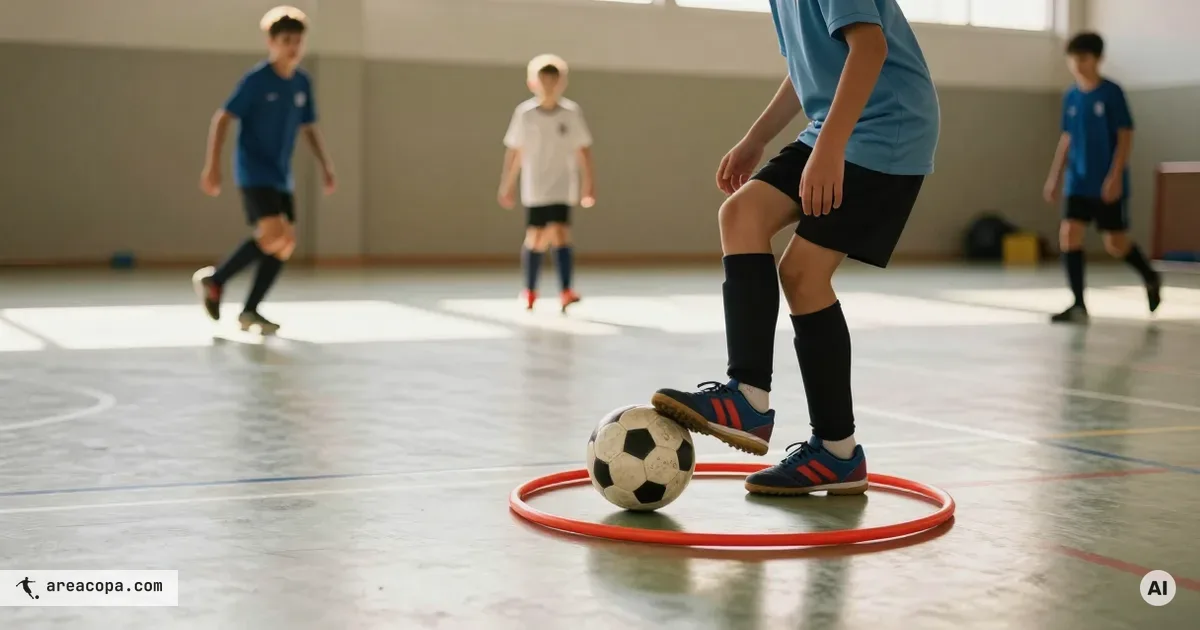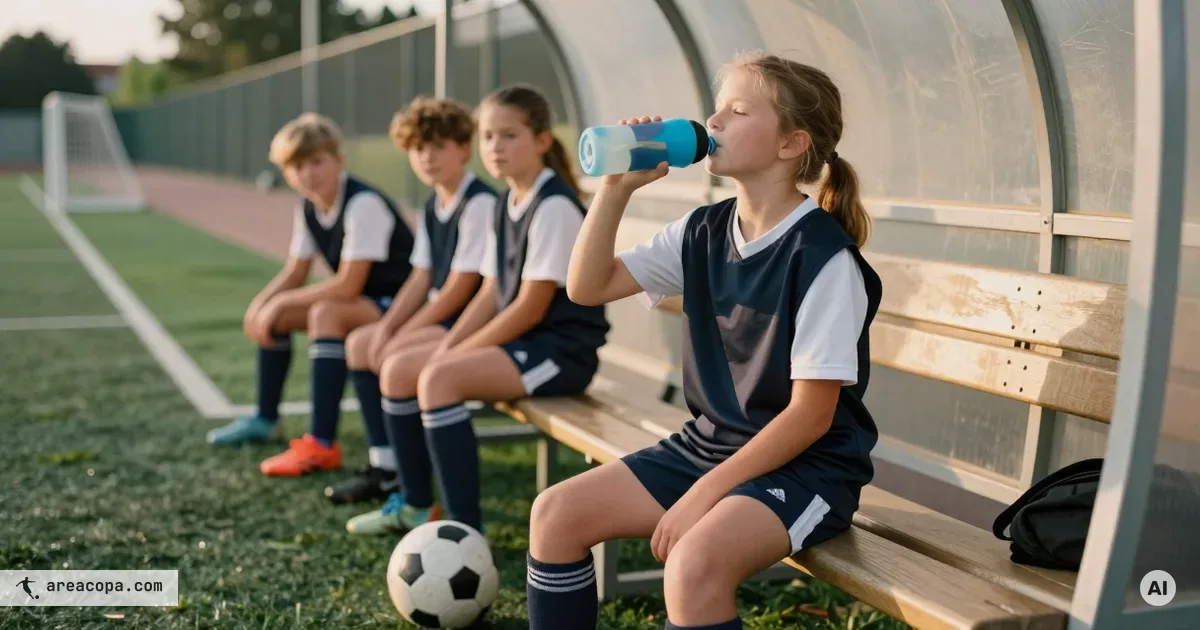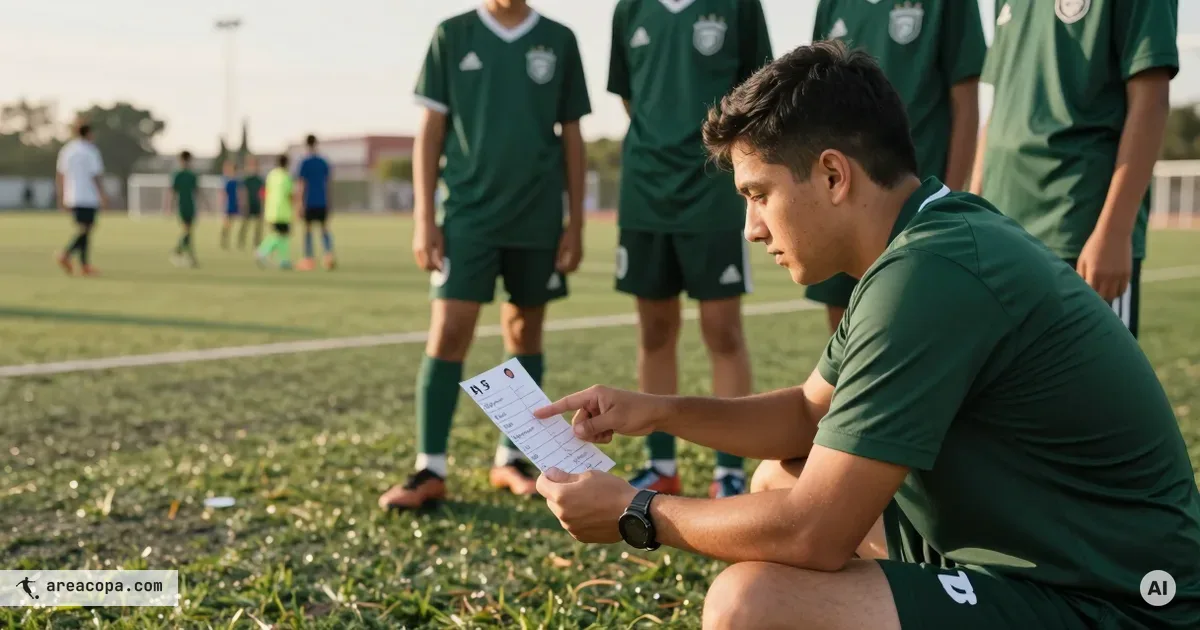
You are standing at the bus stop after the match, three parents waiting. One walks over: "My son played 14 minutes today. Last week it was 18. The others were on for 50. How exactly do you decide?" Every youth football coach, or youth soccer coach if you are in North America, knows this moment. You take a deep breath and realize you don't have a clean answer. You have a feeling, but no system. And that is exactly the problem.
The so-called "50% rule" has been circulating in coach WhatsApp groups, parents' evenings and club boards for years. It sounds like a DFB statute but isn't one: the figure comes from North America (AYSO, US Soccer). The DFB itself names a different target for children's football, "at least 75% playing time per child where possible", and some regional associations recommend figures of their own. It remains one of the most important lines in youth soccer, because the DFB training philosophy notes that many children stop playing from U12/U13 on.
This article clears up the myth and gives you what you actually need: four models for four age brackets, seven hard-case scenarios from club life with concrete recommendations, three printable templates (substitution card, parents' evening script, club-wide policy) and a parents' FAQ block. Written for U7 to U19 coaches, club boards looking for a youth-department line, and parents who want to know the other side's arguments.
This article is about minutes per player. How long the match itself lasts at each age is in the overview of youth football match length by age group.
What the rule books actually say
Three layers of sources define what counts as "fair playing time." Two German, one international.
Layer 1: DFB Children's Football reform (binding since the 2024/25 season). The DFB booklet Children's Football Competition Formats (status 5 March 2026) regulates the age brackets U6/U7, U8/U9 and U10/U11. The recommendations have been binding since the 2024/2025 season. Two phrasings are central here. First, from the FAQ Children's Football (May 2022): "Integrated into the formats is a rotation principle with fixed player substitutions, to enable all children to get playing time." Second, from the booklet on the Four-Goals game: "The prescribed player rotation produces fair playing times for everyone." In practice this means in the mini-bracket (G and F): substitution after every scored goal or, if no goal is scored, after 2 minutes at the latest. The coach is not a coach, but a game leader.
Layer 2: DFB targets and regional associations. The DFB Youth Charter (status 21 August 2026) sets the match duration (§ 8) and the formats, but gives no playing-time share per player. The figures come from the DFB's children's football booklet and from regional associations. Five sources name a number or a fixed rotation rule; all are targets or recommendations, with no penalty for a breach:
| Association | What it says | Document | Character |
|---|---|---|---|
| DFB, children's football | "At least 75% playing time per child, where possible!" | Competition Formats in Children's Football (status 03/2026), rules | Target ("where possible"), rotation binding |
| Saxony (SFV) | At least one third of the total match duration, use all players | Small-pitch provisions from 1 July 2026, U12 to U19 | Recommendation; U10/U11 6-a-side: duty to play |
| Lower Saxony (NFV) | "Minimum playing time of 75% recommended" | Framework guidelines U12/U13 6+1 v 6+1, season 2026/27 | Recommendation in a pilot model |
| Baden (BadFV) | "Strongly recommended to give all players the same playing time" | Information sheet U12/U13 from season 2026/27 | Recommendation |
| Upper Bavaria district (BFV) | No percentage, but "No player plays through" | Implementation of mini football 2025/26, 7-a-side | Rotation mandatory |
The DFB says the same in second place: its training philosophy (Trainingsphilosophie Deutschland) states "All children should receive at least 75 percent playing time and none should have to stay at home." I find no percentage for playing time per player in the DFB Youth Charter itself. I read the DFB and nine regional associations; what applies to you is in your association's implementation rules.
Layer 3: International federation standards. This is where the 50 percent comes from. American Youth Soccer Organization (AYSO) requires in its "Everyone Plays" philosophy that every player plays at least half of every match. US Soccer Player Development Initiatives (2017) recommends 50 percent as a floor for its small-sided formats up to U12. Football NSW (New South Wales) requires the clubs of its Girls' Youth Leagues to have a game-time policy and a record of playing time in the Girls' Youth Club Standards & Benchmarking Framework 2025-26, but names no percentage.
What remains for the German coach? In the mini-bracket the DFB gives a hard rotation rule and a 75 percent target. Rotation is also prescribed in U10/U11; from U12/U13 you distribute the minutes freely. The "50% rule" is an import from North America and sits below the DFB target. My reasoning for using 50 percent as a floor anyway: 75 percent only works out arithmetically with few children on a pitch, in 9-a-side up to 12 players (9 of 12), in 11-a-side up to 14 (11 of 14). In 9-a-side it is 64 percent with 14 children and 56 percent with 16. The DFB figure suits children's football with side pitches, the 50 percent suits regular competition from U12/U13. That is my assessment, not an association's rule. Anyone pushing it through at club level can cite the DFB's 75 percent target and the club's own policy, not a statute.
Bucket 1: U7 to U9, mandatory rotation
The U6/U7 and U8/U9 age groups are the simplest bracket for playing-time distribution because the DFB has practically decided the question. The DFB Youth Charter prescribes three formats: 2-versus-2 and 3-versus-3 in U6/U7; 3-versus-3, 4-versus-4 and 5-versus-5 in U8/U9. Matches are played at game afternoons and festivals: in U6/U7 up to seven rounds of at most 5 minutes (2-versus-2) or 7 minutes (3-versus-3), in U8/U9 up to seven rounds of at most 10 minutes or six rounds of 10 to 12 minutes.
Rotation is firmly anchored in the rule book. Quote from the booklet: "Goals may only be scored from the halfway line onward. After every scored goal both teams substitute one player according to a predetermined sequence." If no goal is scored, the rotation happens after 2 minutes at the latest. The goalkeeper (where present, optional from 5-versus-5) is not part of the field rotation and changes after every round.
What this means for you as a coach:
- You are primarily a game leader, not a coach. The booklet is unambiguous here: "Decisions during the match should be made by the children themselves as much as possible. Coaches/supervisors act as joint game leaders and intervene only when necessary."
- Parents stay at least 3 metres from the mini-pitch and do not enter the big pitch. The Youth Charter makes this binding for U6 to U9, and for U10/U11 only if the regional association decides so. Not enforcing it produces exactly the conflict the reform aims to avoid.
- The substitution sequence is set before the round. Not on the fly. A substitution sheet with player names in fixed order is enough. With this you have a clean lineup in 30 seconds even when three parents are talking to you at once.
- Important for your math: the DFB caps the number of rotation players (2-versus-2 at most one, 3-versus-3 at most two, 4-versus-4 at most three, 5-versus-5 at most four). With a full squad each child is on the pitch about 56 to 67 percent of the time (5 of 9, 4 of 7, 3 of 5, 2 of 3). "Everyone plays every time" is therefore not quite true, and the booklet's 75 percent is a target you reach with side pitches: "From 2 rotation players per team, set up a further pitch if possible," says the booklet.
A detail often missed in practice: the 3-versus-3 recommendation for U8/U9 exists specifically to give each child more ball contacts. The DFB FAQ clearly recommends concentrating on 3-versus-3 in U8/U9, because the smaller the groups, the more ball contacts the children get. 5-versus-5 remains a permitted format.
Related reading: our comprehensive guide Funino and the DFB Children's Football Reform: Game Formats for the 2026 Season explains the 2-versus-2, 3-versus-3 and Four-Goals formats with diagrams and provides a game festival schedule for 12 to 30 children. And when the playing-time question turns into a sideline conflict, handling difficult parents gives you the scripts for that conversation.
Bucket 2: U10 to U13, strict 50 percent as minimum
U10/U11 is still part of the binding children's football with a fixed substitution scheme: in league play (4 by 15 minutes) the rotation players come from side pitches, at festivals rotation happens after 3 minutes. Depending on the regional federation, play is 7-a-side, 6-a-side or 5-a-side. You distribute the minutes freely only from U12/U13, and there your regional association decides how many substitutions you have.
The DFB Youth Charter sets 2 by 30 minutes for U12/U13 and recommends 7-a-side, 8-a-side or 9-a-side. Most associations play 9-a-side, some 7-a-side. On the number of substitutions the DFB Youth Charter says nothing; the associations write it differently:
- Bavaria: up to five players may be substituted; substituted players may only return at district and county level.
- Württemberg: unlimited in U12/U13 and U10/U11, five players in the other youth matches; no substituting back in association-level A and B teams.
- Saxony: U12/U13 (7-a-side) up to seven substitutes, substituted players may come back on.
This is where playing time becomes a coach's question. The DFB Youth Charter prescribes no playing time per player here. This is where the 50 percent floor comes in as my recommendation. Recommendation: 50 percent as an absolute minimum per player, measured across the match (not across the season).
The math problem for large squads. In 9-a-side, eight outfield positions plus goalkeeper are filled, nine players on the pitch at any moment. At 2 by 30 minutes this produces 540 total player-minutes per match (9 players times 60 minutes). For a 14-player squad that comes out to around 39 minutes of playing time per player when everyone plays equally. For a 16-player squad it drops to 33.75 minutes. For an 18-player squad (rare but it happens) to 30 minutes.
50 percent of 60 minutes is 30 minutes. That still works out for a 16-player squad (a 33.75-minute average leaves just under four minutes of room above the threshold). For an 18-player squad it gets tight: a 30-minute average sits exactly on the 30-minute threshold — even the smallest deviation pushes individual players below it. Consequence: coaches with large squads must either rotate match days (some players sit out completely, but play more next match) or define the 50 percent rule across the season rather than the single match.
These averages only hold with unlimited substitutions. With five substitutions the picture changes, because then only 9 plus 5, so 14 children, play at all, and more players in the squad mean spectators. Anyone who wants to give every child at least 50 percent with five substitutions has exactly one option: all five substitutions at halftime. If a player is substituted after t minutes, the one going off plays t and the one coming on plays 60 minus t minutes; both reach 30 only when t equals 30. After just 25 minutes one drops to 25 minutes, that is 42 percent.
Substitution plan for 9-a-side, 14 players, five substitutions:
| Time | Action | Minutes per player |
|---|---|---|
| Kick-off | Starting lineup: 9 players, 5 on the bench | |
| Halftime | 5 starters off, the 5 bench players on | |
| Result | 4 players play through, 5 play the first half, 5 the second | 4 by 60, 10 by 30 |
Sum: 4 by 60 plus 10 by 30 makes 540, the math works out. Everyone has at least 30 minutes, that is 50 percent. But four children play the whole match. Fairness comes over time: you change every match day which four play through, and log it in the tracker. The Tools section below contains a substitution card to print.
What you should not do in this bracket: distribute playing time as a reward for good practice. The temptation is strong ("whoever worked hard this week plays 50 minutes"), but it produces a two-tier team. The children who need to build confidence in this phase are often exactly the weaker ones; if they lose playing time, they stop. In the U10 to U13 phase, the 50 percent rule is a protective mechanism for the team, not an incentive tool.
Related reading: Transition to 9-a-side: U12/U13 Lineups, Offside Rule, Formations covers the formation-specific question of who plays which position in this age group and what the halftime coaching routine looks like.
Bucket 3: U14 and U15, 50 percent minimum with a performance-based starting lineup
The U14/U15 age group plays 2 by 35 minutes. From here most associations play on the big pitch; the DFB Youth Charter also allows smaller pitches and requires a squad size of at least seven and at most eleven. With league table, promotion and relegation, parents, players and the board suddenly notice results differently. The temptation to name the best 11 and ride them grows exponentially.
The hybrid model. My proposal, not an association standard, is a two-part model that combines the 50 percent floor with competitive reality:
- Starting lineup: named by current practice and match form. Whoever was strong in the week starts.
- Minimum playing time: every squad player receives 50 percent of the playing time, so at 70 minutes that means at least 35 minutes. Even the weakest player in the squad.
- Substitutions: one block at halftime, because with five permitted substitutions that is the only way to give everyone 35 minutes.
This hybrid logic serves three needs at once. It respects that players with better practice performance deserve more playing time (incentive), it protects the weaker players from drop-out (retention), and it leaves the starting lineup and the choice of the five who change at halftime with the coach (competition).
What breaks if you ignore the hybrid model:
- If you select only on performance, the bench players lose interest after 3 to 5 matches. In my impression drop-out rates in U13/U14 are particularly high, because this is also where the NLZ scouting selection phase runs in parallel and parents see a club change as an alternative.
- If you select only on 50 percent, the team loses matches it could have won, and the board asks about the coaching license. This tension is real and has to be discussed before the season at the board and in the team council.
The math: in 11-a-side there are 770 player-minutes (11 by 70). With 16 players that is 48.1 minutes, with 18 it is 42.8, and the 35 minutes would only be used up at 22 players. This average only helps if you may substitute without limit. In Bavaria, Hesse, Württemberg and the Aachen district it is five substitutions; substituting back is not allowed everywhere.
Substitution plan for 11-a-side, 16 players, 2 by 35 minutes, five substitutions:
| Time | Action | Minutes per player |
|---|---|---|
| Kick-off | Starting lineup: 11 players by performance, 5 on the bench | |
| Halftime | 5 starters off, the 5 bench players on | |
| Result | 6 players play through, 5 the first half, 5 the second | 6 by 70, 10 by 35 |
Sum: 6 by 70 plus 10 by 35 makes 770. Everyone reaches the 35 minutes. But with five substitutions at most 16 children play, and you have used all the substitutions at the break. A closing-minutes rule, where you line up by performance again for the last ten minutes, does not work without taking the 35 minutes away from a bench player. You make the decision beforehand: at the starting lineup and in choosing which five change at the break.
The weakest player. Here lies the uncomfortable truth that is rarely spoken: in U13/U14 every squad has 1 to 2 players who cannot hold the team's level. Anyone honest with themselves knows these players can cost the team points in tight matches. The question is: do you still send them on for 35 minutes, or do you protect the result?
The clear answer: yes, you send them on. Three arguments. First, team morale. Players who notice the coach rides "his favorites" lose trust independent of their own position. Second, development. A player who never plays does not improve. Third, the season balance. A coach who rotates in U13/U14 has a broader player group in U15/U16 than one who sifted. The drop-out effect in the team is measurable.
Related reading: Counter-pressing for U13/U14: Klopp Principles for the Youth Game shows a training methodology in which weaker players are valued in specific defensive roles instead of being seen as "all-rounders with less ability."
Bucket 4: U16 to U19, competitive mode with minimum playing time against drop-out
The U16/U17 and U18/U19 age groups play competitive soccer. The B-Junioren (U16/U17) play 2 by 40, the A-Junioren (U18/U19) 2 by 45 minutes, without reform adjustments, without protective regulation. Anyone who got this far has held out against the drop-out rate, and it is high: the DFB training philosophy notes that many young players stop playing from D-Junioren age (U12/U13) on. Why late developers in particular get lost here, and what talent actually is, is covered in our guide to talent development. A U16-to-U19 coach who distributes playing time without a plan accelerates this effect.
The honest position: the DFB Youth Charter names no playing time per player for this age group, and Saxony recommends at least one third of the match duration here: just over 26 minutes in U16/U17 (80 divided by 3), 30 in U18/U19. The team plays for promotion, relegation, NLZ scouting, Junior Bundesliga or U-national-team levels. In my view a rigid minimum playing time per match is not practical in this age group because a single mandatory substitution scheme would give up several key situations per match.
What works: minimum playing time averaged across the season. My rule of thumb: every squad player who trains regularly comes to a season average of at least 20 to 30 minutes of playing time per match. With 30 season matches that produces 600 to 900 minutes per season per player. Anyone below either does not belong in the squad or you lose them. Both are coaching decisions you have to make before the season.
Four-tier model for the U16-to-U19 squad:
- Starters (8 to 11): play most of every match. No minimum playing time discussion.
- Rotation players (4 to 6): play depending on form and opponent, averaging 30 to 45 minutes per match.
- Squad fillers (2 to 4): play at least 20 minutes per match, often as substitutes in the second half. This group is drop-out vulnerable, every minute counts.
- Build-up talents (1 to 2): play irregularly, but then also 90 minutes in the reserve team or scouting appearances. Clear communication about what the plan is.
The mid-season conversation. Something rarely done in German clubs but standard in England and Spain: a 1:1 conversation with every squad player at mid-season about playing time. You show him his statistics (minutes per match, trend, position in the hierarchy), explain what you expect and ask what he expects. For the squad fillers and talents this is the most important measure against drop-out because the players understand where they stand. Anyone who leaves the weakest player on the bench for half a season without a conversation should not be surprised when he stops coming to practice.
Hard cases: when the rule meets reality
The abstract rule is the easy half. The hard half is the cases that do not appear in the DFB Youth Charter and that every coach hits sooner or later. Seven cases with concrete recommendations:
Hard case 1: cup final or promotion decider
Question: "Does the 50 percent rule apply in the most important match of the season too?"
My suggestion: None of the rule books I read covers this, so it is your decision as a club. Up to U11 yes, because the rotation is prescribed anyway. In U12 to U15 in the group stage yes; in knockout rounds from the semi-final you pick the starting lineup by performance and still substitute a block at halftime. From U15+ pure competitive mode applies.
Reasoning: The cup exception only works if it is communicated before the tournament. Anyone who deviates spontaneously from the 50 percent mode in the semi-final loses the trust of the players who suddenly find themselves on the bench. At the season-opening parents' evening, explain: "In cup knockouts we lineup more for performance. You know that when the time comes."
Hard case 2: too-large squad (16+ players for 11-a-side)
Question: "With 18 players in the squad I cannot fit 50 percent for everyone, the math doesn't work."
Recommendation: Check your substitution limit first. With five substitutions at most 14 children in 9-a-side and at most 16 in 11-a-side play; the others do not get on, however you calculate. That leaves match-day rotation (14 or 16 play per match, the group rotates at the next match) or a second team. The sat-out players get a training game or an appearance in the other team.
Reasoning: With unlimited substitutions the math looks kinder: 18 players in 9-a-side come out at exactly 30 minutes, the threshold, and in 11-a-side at 42.8 minutes against 35. But no match ever splits minutes exactly along the average. Match-day rotation is more honest and transparent than "everyone a little but some not really." In children's football it is ruled out anyway: the Aachen district (FVM) calls pausing a player for entire rounds inadmissible.
Hard case 3: the weakest player "loses" the match when he's on
Question: "Player X is clearly the weakest in the squad. During his 35 minutes of playing time we often concede decisive goals. Can I let him play less?"
Recommendation: No, with a condition. The recommendation stays at 50 percent, but you choose the phases more wisely. Don't bring him on in the decisive closing phase but in the quieter first half or directly after halftime. And: work with him in practice on a specific defensive role that gives him security (e.g. "force the striker with the ball onto the weaker foot, then close down").
Reasoning: Anyone who keeps the weakest player below 50 percent loses him as a player. Worse: the team notices. Players in the middle of the hierarchy also lose trust because they see the rule is full of holes. In my impression, drop-out is noticeably higher in teams with "favorite" coaches than in teams with a transparent rotation policy.
Hard case 4: coach's son or board's daughter gets favored
Question: "The coach is also the father of Player Y. Y plays every match for 60 minutes, others come on for 30. Is that okay?"
Recommendation: No, but the solution is organizational, not personal. Three mechanisms:
- Publish playing-time tracker on the club website. A table with minutes per player per match, visible to all parents. When the data are public, behavior usually corrects itself.
- Co-coach decides on coach's son lineup. Clear four-eyes principle.
- Club-wide playing-time policy with concrete minimum playing time per age group (template in the Tools section below).
Reasoning: Coach's-son problems are the most frequent complaint in youth departments. Solving them only "humanly" (conversation, appeal) usually fails. Structural solutions work.
Hard case 5: unexcused absence from practice
Question: "Player Z was unexcused at practice this week. Does he still get 50 percent playing time?"
Recommendation: From U13 clear coupling works. Whoever misses practice unexcused in the week before the match starts on the bench and comes on after 20 minutes. Excused absence (illness, school) starts normally. In the mini-bracket the rule does not apply because the DFB rotation takes over.
Reasoning: Playing time as a discipline tool works if the rule was communicated in advance and applied consistently. Anyone who does it only "case by case" loses credibility. The rule must be discussed before the season in the team council and explained at the parents' evening.
Hard case 6: friendly, cup, league, do different rules apply?
Question: "In friendlies and practice matches I substitute freely, in cup I don't, in league it's 50 percent. Is that too complicated?"
Recommendation: Three clear rules, by format:
- Friendly / practice match: everyone plays roughly equal time, often in unfamiliar positions to test.
- League: 50 percent rule as a minimum (from U13), in U13/U14 with hybrid model.
- Cup group stage: like league.
- Cup knockout (from semi-final): in U13 to U15 first half by performance, mandatory substitution after halftime. In U15+ pure competitive mode.
Reasoning: Differentiated rules are not too complicated when they are communicated once at the parents' evening. A one-page handout is enough.
Hard case 7: player wants to stop coming because he plays too little
Question: "Player W has played only 20 minutes in the last 4 matches. His parents wrote to me that he wants to quit. What do I do?"
Recommendation: Four-step plan within one week.
- Check the data. How many minutes did W actually play? Pull out the playing-time tracker.
- Immediate conversation. In person, not by WhatsApp. Invite parents and player on a practice day.
- Honest assessment. Where do you see W in the squad? What does W have to do to get more playing time? What do you as the coach have to change?
- Concrete commitment. "You'll get at least 30 minutes per match in the next 4 matches if you come to practice normally." Hold and review.
Reasoning: The DFB training philosophy calls drop-out at the grassroots too high. Anyone who prevents a drop-out through an honest conversation has saved a player for next season. Anyone who just sits it out loses him and sees him at the rival club in two years.
Tools: substitution card, parents' evening script, club policy
The theory is one thing. In real coach life you need templates that you print, stick to the bench or send around by email. Three templates have proven themselves:
Template 1: substitution card for match day (A5). A single-page grid with player names in the first column and quarter slots (0 to 15, 15 to 30, 30 to 45, 45 to 60 minutes) in the further columns. You check off before the match who is on the pitch for which quarter. With this card you have a clean rotation in 60 seconds that you can show the board if asked. Bonus: at season end you add up the checks per player and see who actually played how much. Format: A5 landscape, one match per card, 16 rows for the squad.
Template 2: parents' evening script (A4). Copyable speaking text for the first parents' evening of the season, focus on playing-time distribution. Five to ten minutes, structured into: 1) What the DFB rule books say, 2) Which line we follow as a team, 3) How we handle hard cases (cup, illness, internal coaching issues), 4) How parents can give feedback, 5) Where the club policy hangs. The script isn't what you read out word for word but the argument structure you walk along.
Template 3: club-wide playing-time policy (A4). A one-page policy that the club board can adopt and publish on the club website. Contents: which minimum playing time per age group applies, how hard cases are handled, who decides (coach, co-coach, youth officer), how complaints escalate. A written policy looks like bureaucracy at first, but it has a tangible effect: parents complain less because they know the rules, and coaches have backing when they make uncomfortable decisions.
Anyone wanting to reduce the planning load of their own season uses a tool like AreaCopa for the playing-time statistics per match and player, instead of maintaining an Excel spreadsheet that nobody updates after three matches.
For parents: 6 questions you ask, and honest answers
If you arrived at this section as a parent because you googled "why did my child only play 15 minutes": welcome. This block summarises the most important answers scattered across the article above by age group. If an answer doesn't satisfy you, talk to your child's coach. If the coach isn't willing to talk, escalate to the youth officer. Both paths work better than WhatsApp recriminations or parents'-group drama.
1. Why does my child play less than others? In children's football (U7 to U11) this should hardly happen because the rotation is fixed. From U12/U13 the coach distributes the minutes. Reasons can be: current practice performance, discipline (unexcused absences), position in a large squad, or an honest assessment of current match form. Ask for the data. A coach who takes the job seriously can tell you how many minutes your child played in the last three matches.
2. Is the 50 percent rule in the statute? No, not as a binding rule. What is binding: the rotation principle for children's football U6 to U11 (DFB reform, since 2024/25 season). For children's football the DFB names "at least 75% playing time per child where possible" as a target, Saxony recommends one third of the match duration, and Lower Saxony 75 percent in U12/U13. The 50 percent comes from AYSO and US Soccer. Parents demanding "the rule" should know they are citing a recommendation, not a law.
3. My child is clearly one of the weaker players. Is it realistic to expect 50 percent? Yes, with empathy for the coach. In U13/U14 and above every squad has players who hold the level less well. Still, the recommendation in this article is to give 50 percent minimum playing time. If the coach doesn't do that, it is a legitimate conflict question. If the coach does it and your child still plays less, ask: is it the position, the day form, the practice performance? There's often a concrete reason.
4. Is the coach allowed to favor his own son? Structurally no, in practice it happens. Three solutions: 1) demand a club-wide playing-time policy (see Tools block above), 2) have playing-time statistics published on the club website, 3) involve the co-coach in the lineup. Direct confrontation with the coach is rarely successful, structural solutions are.
5. What do I do if my child wants to quit? Three steps. First, ask your child whether it's really the sport that is fun and only the team is the problem, or whether it's the sport itself. Second, talk to the coach in person with the concrete playing-time commitment question for the next matches. Third, consider a club change as an option. In some clubs the playing-time culture fits your child better than in others. Drop-out from sport completely is the worst option because you lose not just soccer but also the social effects (exercise, team, structure).
6. In the cup my child suddenly didn't play at all. Is that okay? Tough question. None of the rule books regulates this, so it is the club's decision. My suggestion for U13/U14 is that in knockout rounds from the semi-final the first half is selected more by performance, with a block substituted at halftime. "Didn't play at all" shouldn't happen though. Ask the coach whether the cup rule was communicated in advance. If yes, it is honest competitive practice. If no, it is a communication failure that belongs in conversation.
If you still have an open question after this block, go to your child's coach after practice or the match. A 5-minute conversation after a match is far more effective than a 2000-character WhatsApp.
Next step: plan the season, distribute playing time fairly
If you read this article to the end, you now have three things: one less myth (the 50 percent rule is not a DFB statute; the DFB's own target is 75 percent in children's football), four concrete models for your age bracket, and seven hard cases with recommendations. The most important thing is not pulling the rule through mechanically but making playing-time distribution transparent and consistent.
Three immediate measures for the next match day:
- Print the substitution card and stick it to the coaching bench. Player name times quarter slot, with check marks before the match. Add up after the match.
- Set up a playing-time tracker for the season. A simple table, player times match day, minutes per match day. If after 5 matches you notice a player is below 50 percent, correct course in the next 2 matches.
- Communicate the cup rule. At the next parents' evening or by email: what applies in the league match does not apply 1:1 in knockout play. Clarifying the rule in advance prevents semi-final arguments.
Anyone regularly organising club tournaments knows the problem from a different angle: with 12 teams in 10-minute matches, fair playing time is particularly visible because every team has to rotate every match. Here a schedule tool helps that already incorporates the substitution slots into the plan rather than improvising them on match day.
Plan my tournament with fair playing-time distributionFree and no sign-upDownload the workbook
The 5 sections above as a printable PDF workbook: substitution card for match day, season tracker setup, parents' evening script for the playing-time block, hard-case plan for before the season, and a club-wide playing-time policy for board and youth officer.
Fair Playing Time – WorkbookSubstitution card, tracker, parents evening, hard cases, club policyDownload PDFSources and further reading
DFB rule books:
- Deutscher Fußball-Bund (status: 21 August 2026). Jugendordnung (Youth Charter), § 8 (match duration), § 8a and Annex IV (provisions for children's football). Source for match duration, rotation and formats of U6 to U11.
- Deutscher Fußball-Bund (status: 5 March 2026). Wettbewerbsformen im Kinderfußball (Children's Football Competition Formats). Source for the rotation sequence, the number of rotation players and the target "at least 75% playing time per child where possible".
- Deutscher Fußball-Bund (status: 31.05.2022). FAQ Kinderfußball (Children's Football). Source for the "rotation principle with fixed player substitutions" and the recommendation of 3-versus-3 in U8/U9.
- Deutscher Fußball-Bund. Trainingsphilosophie Deutschland (German Training Philosophy), chapter Spieltag (match day). Source for "at least 75 percent playing time" and the observation that many children stop from D-Junioren age on.
Regional associations:
- Sächsischer Fußball-Verband (from 1.7.2026). Bestimmungen für Fußballspiele auf verkleinerten Spielfeldern (provisions for matches on reduced pitches). Source for the recommended minimum playing time of one third of the match duration and the substitutes.
- Niedersächsischer Fußballverband (season 2026/27). NFV-Rahmenrichtlinien für die D-Jugend (6+1 gegen 6+1). Source for "minimum playing time of 75% recommended".
- Badischer Fußballverband (from season 2026/27). Informationsblatt D-Jugend (information sheet U12/U13). Source for "strongly recommended to give all players the same playing time".
- Bayerischer Fußball-Verband (status: 16.07.2026). Jugendordnung, § 8 and § 20. Source for the five substitutions and substituting back at district and county level.
- Württembergischer Fußballverband (season 2026/27). Durchführungsbestimmungen Jugendfußball. Source for the unlimited substitutions in U10 to U13 (item 22).
- Bezirk Oberbayern (season 2025/26). Umsetzung Minifußball. Source for "No player plays through" in 7-a-side.
International federation standards:
- American Youth Soccer Organization (AYSO) Six Philosophies: every player plays at least 50 percent of every game.
- US Soccer Player Development Initiatives, 2017: 50 percent recommendation for the small-sided formats up to U12.
Related articles on AreaCopa:
- Funino and the DFB Children's Football Reform: Game Formats for the 2026 Season: binding reform formats explained.
- Transition to 9-a-side: U12/U13 Lineups: formations for the transition phase.
- Counter-pressing for U13/U14: training methodology that values weaker players.
- Futsal for Football Coaches: the Practical Guide: use the indoor season productively.
- The 5 Biggest Tournament Planning Mistakes: what can go wrong with the schedule.
- Youth Football Coaching Trends 2026: current trends in methodology and coaching.
Read next
- Motivational climate: winning or developing?: why the climate in training decides development.