You're watching a Bundesliga match, the commentator says "classic counter-pressing", and you wonder: what should my players actually be doing if I want to teach them this? Counter-pressing is one of the buzzwords of modern football, or soccer as it's known in North America, that gets repeated far more often than it gets explained. You may never have played at a higher level yourself. You've been coaching your U13 or U14 for two years, and the term "counter-pressing" keeps coming up without anyone ever explaining it in two sentences.
This article gives you exactly that: a definition in one sentence, the essentials of Klopp's and Alonso's pressing models, an honest assessment of what actually transfers to U13/U14, and three drills you can use to build it step by step.
What counter-pressing is (in one sentence)
Counter-pressing is the immediate pressure phase right after a turnover, in which the team that has just lost the ball tries to win it back within seconds, instead of dropping back into shape.
Three words in this definition matter. Immediate means within the first seconds after the turnover, not after 20 seconds of regrouping. Pressure means actively closing down the ball-carrier and his next passing options, not waiting. Win it back means the goal is regaining possession, not just delaying. A team that only delays is doing classic pressing or harassing; counter-pressing goes further.
As Horst Wein puts it from a game-intelligence perspective: "Success in the game often depends on the speed of the transition", and the well-prepared player reaches "a correct decision in less than a second". Exactly this gap of seconds after a turnover is the training target.
Quick terminology: "pressing" in general is any active form of defending. "High pressing" is pressing in the opponent's half. "Counter-pressing" is the specific phase right after your own team loses the ball. The three terms are not synonyms, even though they are often used as if they were.
Why it works: the open window after a turnover
Right after a turnover, the opposing team is briefly disorganised. The players who were just defending are all looking in one direction and are still oriented forward. The player who has just won the ball has only had it for half a second, is looking at the ball, and has not yet identified passing options. His teammates are in defensive positions, not receiving positions.
This short window, often 3 to 6 seconds, is the highest-probability moment to win the ball back. A team that attacks during this window either gets the ball or forces a bad pass, which puts the opponent under pressure again. A team that doesn't attack during this window wastes the chance and ends up defending in its own half against an organised opponent.
The numbers bear this out: in Premier League 2, the English U23 league, winning teams concede an average of 4.02 shots on target per match while losing teams concede 6.43. That is a 60 per cent difference. Teams that press early and in coordination concede fewer dangerous actions. This is no coincidence; it is statistically measurable at developmental level.
Shots on target conceded per match: winning vs losing teams
Premier League 2 (U23): losing teams concede 60 % more shots on target (p < 0.001). Defensive aggression, early pressing after a turnover, is measurably linked to winning at developmental level.
Winning in Premier League 2: a statistical model of technical performance indicators (2026).
Exactly this seconds-of-advantage is the entire reason counter-pressing exists. Without it, it would just be pointless chasing.
Klopp and Alonso: two pressing schools compared
Klopp and Alonso represent two different interpretations of the same basic idea. Both press after a turnover, but in different ways.
Klopp model. High intensity, forward-oriented, uncompromising. The famous "6-second rule" says that after losing the ball, the team should spend 6 seconds at full energy trying to win it back. If that fails, the team drops back and reorganises. The Klopp style is built on speed, physical presence, and high risk: many players push forward, the space behind briefly thins out.
Alonso model. More controlled, man-oriented with a spatial component. At Bayer Leverkusen the team also presses after a turnover, but with clearer assignments: every player has a direct opponent, but also a zone he must not leave. The pressing is less breathless than Klopp's, but more stable in rest defence. The style relies on reading the game and discipline, not pure energy.
What the two have in common. Both models recognise the open window after a turnover and exploit it. Both train their players to start immediately after losing the ball, not after a coach's call. Both work with clear triggers: situations in which the team collectively attacks.
What separates the two is more a question of risk and energy than concept. Klopp is the maximum version, Alonso the controlled version. For your U13/U14 the Alonso model is the better reference, because it asks for less fitness and gets by with clearer rules. The explosiveness for closing down fast you build, whichever model you pick, with jump-power training.
What actually transfers to U13 and U14
U13/U14 reality check
What transfers from pro pressing, what works only with limits, and what you can drop.
Works
- Build the pressing reflex, go to the ball immediately after a turnover
- Three simple triggers; more confuses
- Team reaction: one player presses, two follow
With limits
- Short pressing phases with rest in between
- One single pressing pattern, repeated until automatic
- High pressing only in selected game situations
Doesn't work
- 90 minutes of high pressing, not even the Bundesliga sustains that
- Complex synchronised shifting movements
- Pressing across the whole pitch with multiple lines
Realistic reading based on Klopp and Alonso models, cross-checked with DFB coaching education.
This is the most important section of the article: what works, and what doesn't.
What works. Three building blocks transfer, and they're enough for a whole season of training content.
- Build the reflex: after losing the ball I go to the ball IMMEDIATELY, not back. That is a movement and mentality habit that twelve to fourteen year olds can learn very well.
- Recognise triggers: three simple cues a player can still process under pressure. More than three confuses.
- Team reaction: when one player presses, two follow. If no one follows, the first player is alone and the opponent plays around him.
What doesn't work. Honest version too.
- A high pressing line over 90 minutes. Pros can't sustain it; your U14 certainly can't. Realistic is short pressing phases with rest phases in between.
- Complex shifting movements. Klopp's or Alonso's pressing triggers assume the team shifts in sync. At U13/U14 it is already a success when three players spot the right direction at the same time, let alone eleven.
- Pressing across the whole pitch. The pressing line can be high, mid, or low. At youth level one single pressing pattern, repeated until it is second nature, is plenty.
Important safety note: pressing without rest defence behind it is suicide. A team that presses high while the opponent plays a long ball over the pressing line ends up in a 1-vs-1 with the centre-back. If your centre-back can't handle that, the opponent has a big chance. Before you train pressing, the topic of rest defence in youth football should at least be in place at a basic level.
Three pressing triggers your players need to learn
Three game situations in which the team presses collectively. Without triggers everyone runs uncoordinated and the press falls apart after three seconds.
Bad pass
The receiver needs two touches to control the ball. Exactly in that phase the next player jumps in. Half-volleyed passes and passes into the wrong run are the most common triggers.
Back to goal
A player who receives with his back to his own goal can't play forward. He must pass back or turn. Both take time, in that time the next defender steps up.
Touchline
The sideline acts like an extra defender and removes one passing direction. On the line the opponent only has three directions instead of four, that is where the team presses hardest.
Triggers are the situations in which the team is allowed to press collectively. Without triggers, every player runs in uncoordinated bursts, and the press falls apart after three seconds. Three simple triggers are enough for U13/U14, more confuses.
Trigger 1: bad pass. A pass arrives too high, too soft, into the wrong run, or only half-controlled. The receiving player needs two touches to bring the ball under control. Exactly in this phase the next player jumps in. Example: a centre-back plays a half-volleyed pass to the holding midfielder, who can't take it cleanly and has to stop the ball first. The team's striker reads it and steps out immediately.
Trigger 2: opponent receives with his back to goal. A player who receives the ball with his back to his own goal can't play forward. He has two options: pass back or turn. Both take time. In that time the next defender can step up and force the player to clear long or play backward.
Trigger 3: opponent forced to the touchline. The sideline acts as an extra defender, because it removes one passing direction. When an opponent has the ball on the line, he has only three directions instead of four. Exactly there the team presses hardest, because winning the ball there immediately enables a counter.
These three triggers have to be repeated in training until your players still recognise them under pressure. When someone spots a trigger and attacks without the coach calling, training is succeeding.
The three drills that follow are all small-sided games or game-realistic drills. Counter-pressing is best learnt in situations that force counter-pressing. Small-sided games, game-based learning, and conditioned games reliably improve tactical understanding and decision-making in youth soccer more than isolated technique drills, this is especially true for the type of reflex this article targets.
Drill 1: 3-second rondo (build the pressing reflex)
Drill 1: 3-second rondo
5 vs 2 in an 8×8 square. After a turnover the outside players have 3 seconds to win the ball back.
The first drill builds the reflex. After losing the ball, go to the ball without instruction.
Setup. 8 by 8 metre square, 5 vs 2 rondo. Five players around the outside of the square, two inside as pressers. One ball.
Flow. Outside players pass among themselves, inside players try to win the ball. As soon as the inside players win it, they dribble out of the square. The outside players have 3 seconds to win the ball back; after that the phase ends and a new round starts.
Coaching cues.
- Start the moment the ball is lost, no thinking first
- Several outside players attack in parallel, not one after another
- Cover passing lanes, not just close down the player on the ball
Variation. Stretch the 3 seconds to 5, or restrict the inside players after winning to dribble through one specific gate, not any direction. Makes recovery harder and trains the running line during the press.
If this rondo turns up regularly in training, the reflex sits within a few weeks. More rondo variations as a warm-up format are in the article on rondo warm-up drills for U12.
Drill 2: 4-vs-4 with pressing duty (apply the triggers)
Drill 2: 4-vs-4 with pressing duty
25×18 m, four mini-goals. After a turnover the player who lost the ball calls the trigger, the team attacks collectively.
The second drill connects the reflex with trigger recognition.
Setup. Pitch 25 by 18 metres, four mini-goals in the corners (Funino-style). 4 vs 4. One ball. The 4-vs-4 format is not arbitrary: in 4v4 game intelligence shows up particularly clearly because every player comes into decision situations frequently. One of the core criteria is "transition, anticipate ball recovery and offer an attacking option", exactly the counter-pressing reflex this drill trains.
Flow. Normal game on four goals. Pressing rule: after every turnover the player who lost the ball must shout one of the three triggers out loud (for example "bad pass!", "back to goal!", "line!"). Teammates confirm the trigger by joining the press immediately. If the trigger isn't called, the other team gets a free kick.
Coaching cues.
- Call the trigger loud enough that everyone hears
- Joining the press doesn't mean all at once: one to the ball, one to the next passing option, one holds the space behind them
- If the press fails, fall back into team shape immediately, don't keep chasing
Variation. Replace four goals with two goals on the short ends; then "line!" becomes the most common trigger. Or: pressing only allowed in the opponent's half, in your own half the team must defend in shape.
This drill simulates the move from theory to application. Players who can confidently call triggers in this drill can do it in real matches too.
Drill 3: transition after turnover on two goals (match-realistic)
Drill 3: transition after turnover
30×20 m, big goal with keeper vs mini-goal. 6 vs 6, asymmetric pressing rule in the opponent's half.
The third drill is the most match-realistic.
Setup. Pitch 30 by 20 metres, one full-size goal with goalkeeper on one short end, one small goal on the other. 6 vs 6 including goalkeepers (i.e. 5 outfield players plus goalkeeper per team, or 6 outfield without goalkeeper on the small-goal side).
Flow. Both teams play towards the opposing goal. Special rule: when the team defending the big goal loses the ball in the opposing half, it has 6 seconds to win it back. If it succeeds, the game continues normally. If not, the players fall back into team shape.
Coaching cues.
- 6 seconds press, then drop, keep both phases clearly distinct
- Pressing in the opponent's half means: two players attack, three secure the space behind
- After winning the ball, finish quickly up front, that is the bonus
Variation. Extend the pressing zone to the halfway line, or have both teams press, which makes the tempo extreme. For the first few sessions a one-sided pressing rule is plenty, otherwise the kids are overwhelmed within five minutes.
Time-pressure variation for advanced players. For finishing-focused small-sided games the rule applies: "a shot must occur within 20 seconds." Combined with pressing this becomes a tight chain: 6 seconds pressing → on winning the ball, 20 seconds to a finish → otherwise turnover. Simulates the full chain "ball won → counter → finish" under realistic time pressure.
What happens after the press matters as much as the press itself. A ball won in the opponent's half is the best setup for a counter, and the topic of transition play in youth football ties directly into this drill.
60-minute training plan: building the press in one session
60-minute pressing training plan
Warm-up → 3-second rondo → quick theory → 4v4 with triggers → big game form. Drawn proportional to time.
Order follows the learning logic: reflex → triggers → match-realistic application.
How the three drills flow together in a single training session.
Minute 0 to 10: warm-up with immediate-press habit
- Running ABC with the ball, then shadow pressing in pairs (player A dribbles, player B tries to attack constantly, switch every 60 seconds)
- Purpose: physical activation plus the mental reflex of "don't wait"
Minute 10 to 25: 3-second rondo (drill 1)
- Three to four rounds of 3 minutes, with 1 minute of rest in between
- Coaching: one cue per round ("go immediately!" or "cover passing lanes!"), no more
Minute 25 to 28: water break and brief theory
- One minute on the three triggers: bad pass, back to goal, line
- Maximum 90 seconds talking, then continue
Minute 28 to 45: 4-vs-4 with pressing duty (drill 2)
- Three to four rounds of 4 minutes
- Teams rotate between rounds so all players experience both roles
Minute 45 to 60: transition after turnover on two goals (drill 3)
- One large game form, 15 minutes straight
- Don't whistle in, let the press evolve, give one cue at the end
What you do as a coach during these 60 minutes.
- Set up the equipment on the sideline before training begins, otherwise you lose 15 minutes at the start
- One cue per block, not twelve
- Leave the final game form open: don't blow the whistle, just reflect briefly at the end
Four typical mistakes in pressing coaching
The four mistakes here are the most common at clubs trying to train pressing for the first time. Knowing them avoids the biggest pitfalls.
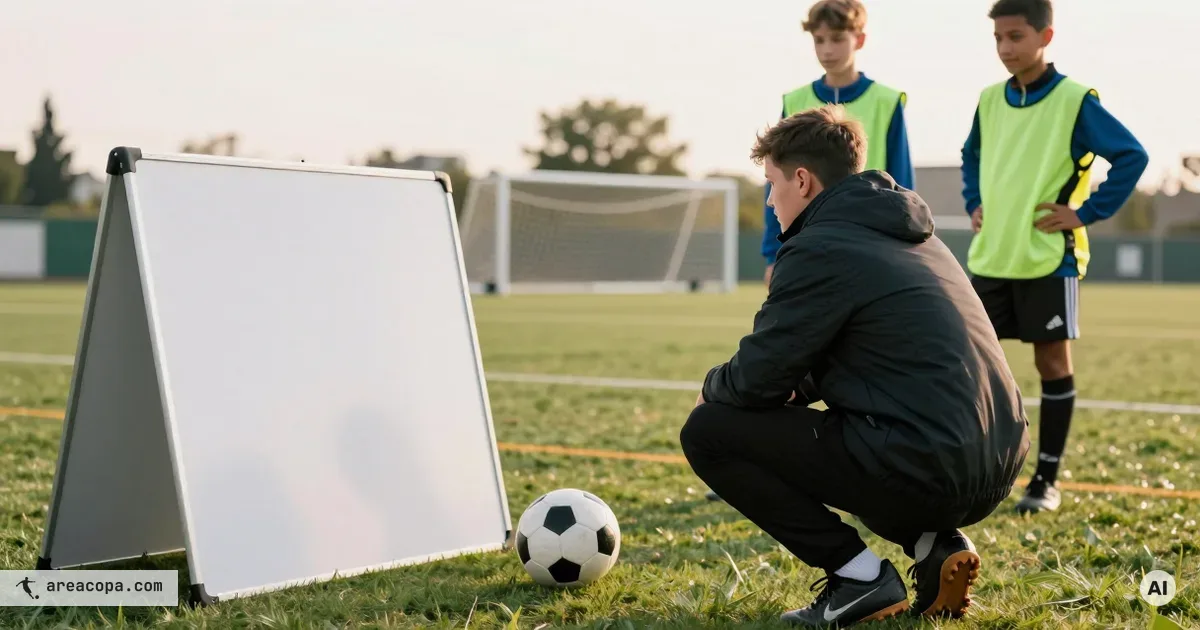
Mistake 1: pressing only explained, never trained. The coach lectures for 20 minutes at the whiteboard about Klopp and pressing lines, then the kids play a normal scrimmage. Pressing is learned through repetition, not through theory. Theory at most 5 minutes per session, the rest is drill.
Mistake 2: pressing without triggers ("just always press high"). The coach yells "press!" and everyone runs forward without coordination. The opponent plays one pass around them, and three seconds later the team is 30 metres too high and concedes a goal. Triggers aren't optional, they are half the concept.
Mistake 3: pressing without rest defence behind it. When four players push forward, three behind them have to cover. A coach who skips that turns every failed press into a big chance for the opponent. Rest defence is the foundation that lets the press be brave.
Mistake 4: pressing expectations without building the fitness. Pressing is exhausting. A team that doesn't push to the limit in drills 1 and 2 can't pull it off in matches. Training intensity must match match intensity, otherwise it stays theoretical. At U13/U14, short and intense phases with clear breaks are enough, but the phases really do have to be intense.
From the practice pitch to the match: testing pressing in a real season
What sits in training needs match practice to lock in. Pressing in a drill is one thing, pressing against an unknown opponent under match pressure is another. A player who confidently calls a trigger in a drill often looks at the coach in a real match because they don't yet trust their own reading. That trust only grows through many minutes in real games. How to distribute those minutes across a U13/U14 squad without a rigid 50 per cent lineup, but with minimum playing time for every squad player, is the hybrid model laid out in fair playing time in youth football for 11-a-side.
Short tournaments and warm-up matches are the ideal format. Several short matches against different opponents force the players to recognise triggers afresh each time, instead of settling on a single pattern. Anyone who wants to minimise the planning effort for their own warm-up tournament uses a tool like AreaCopa and skips the spreadsheets for fixtures and tables. The team plays, you watch, the press shows itself. A step-by-step template for the whole organisation is in the football tournament checklist.
Plan our next warm-up tournamentFree and no sign-upSources
- Wein, H. (2022): Game Intelligence in Soccer — Coaching the Child-Centred Way, 6th edition, Meyer & Meyer Verlag. "Success in the game often depends on the speed of the transition"; specific transition games as a training method.
- Ricciardi, A. et al. (2026): Game intelligence in youth football — observation framework in 4v4. Federal Institute of Sport Magglingen + Swiss FA. The observation criterion "transition — anticipate ball recovery and offer an attacking option" as a validated criterion in the 4v4 format.
- Piri, N. et al. (2026): Game-based learning strategies to enhance tactical awareness in youth football. Health, Sport, Rehabilitation 12(3). Systematic review on the effectiveness of small-sided and conditioned games for tactical understanding and decision-making.
- Nguyen, N. H. & Tran, H. A. (2026): Research on criteria and a chain of observed behaviors applying defensive techniques. European Journal of Physical Education and Sport Science 13(3). Modern football as "continuous transitions between attack and defense"; synchronised pressing as a hallmark of high-performance teams (citing Clemente et al. 2020, Sarmento et al. 2018).
- Winning in Premier League 2: a statistical model of technical performance indicators (2026). Shots on target conceded per match: winning vs losing U23 teams 4.02 vs 6.43 (p < 0.001) — defensive suppression as a strong predictor of winning.
- Memmert, D. (2011): Vermittlung von Spielfähigkeit. Recommends a 20-second rule for finishing-focused small-sided games.