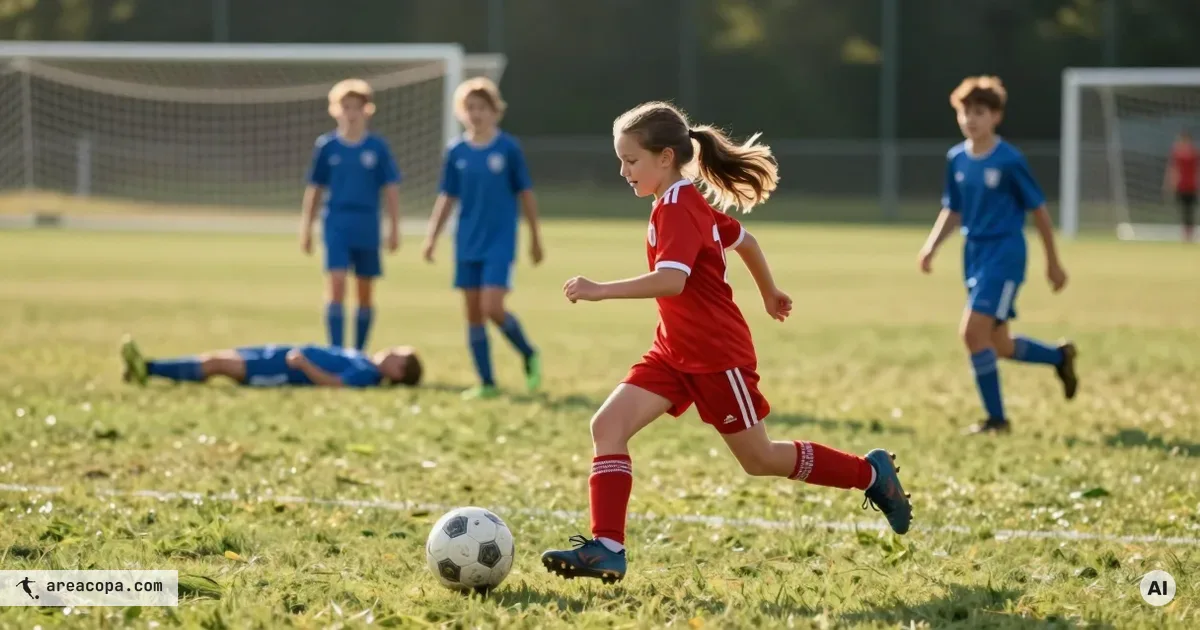
Ball won in midfield. Your six got a leg in, the ball rolls to the winger. This is youth football, or soccer as it's known in North America, and instead of looking forward straight away, she turns back, plays a square pass, the opponent closes in, second turnover. Exactly the same on the other side: own ball lost, nobody presses immediately, three opponent passes, counter-goal.
In both cases it is the first three seconds in which the game could have turned. These seconds are called the transition moment, and almost every youth team wastes them. Not because of tactical stupidity. But because nobody has told them what should happen in those three seconds.
The 3-Second Window Most Teams Miss
Transitioning means: the ball changes possession. Either you win it or you lose it. In youth football this happens many times per game. In a typical youth match both teams together lose the ball roughly five times per minute. Each time a short window opens in which the opponent is unorganised. Anyone with a clear action in those three seconds wins the moment. Anyone who hesitates loses it.
What counts after those seconds can be measured. Winning U18-U21 teams produce significantly more forward passes and more ball recoveries than teams that draw or lose. Exactly these two figures are created in the transition moment.
Professional football has long made this principle a religion: Jürgen Klopp called gegenpressing "the best playmaker in the world". For youth football the formula is the same; only the execution must be simpler. U10 to U15 do not need a tactics board, they need two clear reflexes.
What "Transition" Really Means: Two Phases, One Principle
There are only two situations in which a transition happens.
Phase A, winning the ball. Your team has won the ball. The opponents are still in an offensive shape, there is space between you and the opposing goal. The rule for Phase A is: first glance, first pass forward. Whoever wins the ball looks up in the first half-second, not at their own foot. And the first touch or pass goes into depth, not safely backwards. Playing it safe backwards kills the counter.
Phase B, losing the ball. Your team has lost the ball. The game can turn quickly here because at the moment of losing the ball you are usually advanced. The rule for Phase B is: the nearest player presses immediately, the others squeeze up. Don't run back. Pressure on the ball carrier, close off the passing lanes, and if you have not won the ball back within five seconds, reorganise. This phase is also called gegenpressing; a dedicated article covers how to train it with U13/U14 using three concrete drills.
Important for Phase B is that it does not start at the moment of losing the ball, but before. If your defensive cover is already in place before the ball is lost, you have the three seconds to apply pressure instead of having to chase. Both topics belong together.
Two reflexes, one principle: Use the three seconds before the opponent reorganises.
The 3-Second Transition Window
Every possession change opens a short window. Two clear reflexes determine whether your team uses the moment or loses it.
Own illustration based on Wein (2009) and Memmert & König (2011)
All three drills below work with the same reflexes. Game forms with a counter stimulus transfer tactical behaviour into the game better than isolated drill exercises, especially between the ages of 10 and 14. Exactly this age range is what this article covers.
Drill 1: 4v4 with 5-Second Counter Rule
This is your core drill for offensive transition.
Setup Drill 1: 4v4 with 5-Second Counter Rule
Pitch 25 by 30 m, two mini-goals per end line. After winning the ball 5 seconds to finish, otherwise turnover. Goal counts double.
Setup: Pitch 25 by 30 metres, two mini-goals on both end lines. Two teams of four players each. No goalkeepers.
Rule: After every possession win, the team has five seconds to produce a shot on goal. If they fail, possession turns over and it is a throw-in for the other side. Goals scored within the five seconds count double.
What you coach: On winning the ball, lift the head immediately. First pass into depth, not square or backwards. Whoever wins the ball does not stay with it but makes themselves available. The others sprint into open spaces. Exactly this explosive burst decides the transition, and you build it with jump-power training.
Variant for U10 to U12: Seven seconds instead of five, and the double-goal bonus remains the main motivation. At this age the key thing is that the concept of "quick forward" gets across at all. Technique before pace.
Drill 2: 3-Zone Game with Immediate Pressure on the Ball Loser
This is your core drill for defensive transition.
Setup Drill 2: 3-Zone Game with Pressure after Losing the Ball
Pitch 40 by 20 m, three equal zones. The ball loser presses within 3 seconds, the nearest player pushes across. Regaining possession within 5 seconds earns a bonus attack.
Setup: Pitch 40 by 20 metres, split into three equal zones. Two teams of five or six players each. Two small goals or two end zones as targets.
Rule: Normal game form, but with one additional rule: whoever loses the ball must press the ball carrier in the next three seconds. The nearest teammate pushes across and closes off a passing lane. If the team regains the ball within five seconds, they earn a bonus attack with a free run through the middle zone.
What you coach: Don't run back, react immediately. Body position when pressing: angled slightly sideways, not head-on, so the ball carrier cannot simply move past. And the zone behind is not left empty.
Variant for U13 to U15: Two consecutive turnovers triggers a tactical press-up pause for the whole team. It sounds ridiculous but has an effect: the group starts paying collective attention to not simply giving the ball away.
Drill 3: Rondo plus Counter Break
This is the drill that brings both phases together.
Setup Drill 3: Rondo plus Counter Break
4v2 rondo on roughly 10 by 10 m, two goals 15 m from the edge. After winning the ball the defenders have three passes to hit an outer goal.
Setup: A 4v2 rondo on roughly 10 by 10 metres. Two goals on the outside, 15 metres away each. The four ball possessors pass in a square; the two defenders try to win the ball.
Rule: As soon as the defenders win the ball, they have three passes to hit one of the two outer goals. The ball possessors must in those same three seconds press immediately and regain the ball or block the passing lane to goal.
What you coach: The moment of winning the ball is the starting point. That is where Phase A begins for one side and Phase B for the other. In this drill players experience both reflexes within a matter of seconds.
This drill works well as a ten-minute warm-up at the start of training. Anyone who already uses rondo variations can add this rule as a progression.
Cues: The Four Phrases Your Team Understands Immediately
Young players cannot process tactical theory while the game is running. What they understand are short cues that trigger a concrete behaviour. Four cues are enough. More is harmful: too many live instructions narrow players' focus, up to 45 percent miss open teammates because they are processing coaching instructions.
- "Head up!" (on winning the ball, before the ball is under control)
- "Forward!" (on the first pass or dribble)
- "Press now!" (on losing the ball, aimed at the nearest player)
- "Together!" (the others squeeze up and stay compact)
For U10 to U12, reduce this to the first two cues. They cannot process more in the moment. For U13 to U15 all four are usable, and you can start discussing with players in breaks why which cue comes when.
Important: the cues must come from you until the players start calling them themselves. That is the indicator that the principle has landed. When a striker shouts "Press now!" at a defensive midfielder, you have won.
From Training to Tournament
Transition play is not a drill you do once and tick off. It is a basic reflex that develops over weeks and either shows up or does not in the tournament or next league game. Two things help with the transfer:
First: count during a game how often your team plays the ball forward in the first three seconds after winning it. You will be surprised how low the number is at the start. That is your baseline. In four weeks it should be significantly higher.
Second: observe in the game what happens after a turnover. If two or more players react immediately, Phase B is working. If everyone runs back five metres before anyone presses, the reflex is still missing. For U10 and U11 there are two smaller games for this, the 1v1 with transition and the attacks with more and fewer players, both in the 7v7 drills.
If you want to test transition play at the next tournament, plan the schedule with 20 minutes between two games. That gives you time to briefly review the last few moments. A well-structured tournament makes exactly these short reviews possible. A complete template for planning is in the football tournament checklist.
Plan my tournament and test transition play in competitionFree and no sign-upSources
- Wein, H. (2009). Spielintelligenz im Fußball — kindgemäß trainieren (2nd ed.). Meyer & Meyer Verlag. — Observations on ball-loss frequency in youth and amateur football (approx. 5 turnovers per minute for both teams combined); five-stage development model for tactical learning.
- Memmert, D., & König, S. (2011). Vermittlung von Spielfähigkeit. In A. Güllich & M. Krüger (Eds.), Sport — Das Lehrbuch für das Sportstudium. Springer. — Basic tactics (incl. "exploiting gaps", "creating numerical superiority") as a cross-sport curriculum; finding: too many live instructions narrow the attentional focus (Memmert 2004b: 45% miss an open teammate).
- Howell, N., Groom, R., & Nicholls, S. B. (2026). Winning in Premier League 2: a statistical model of technical performance indicators. International Journal of Performance Analysis in Sport. — Analysis of 367 U18-U21 matches: winning teams produce significantly more forward passes and ball recoveries; interceptions are a positive predictor of match outcome.
- Piri, N., Ihsan, F., Makadada, F. A., Lolowang, D. M., & Sobko, I. (2026). Game-based learning strategies to enhance tactical awareness in youth football: a mixed-methods study. Health, Sport, Rehabilitation, 12(3), 26-34. — Systematic review: game forms with a counter stimulus consistently improve decision-making and tactical understanding; game-based learning most effective with 10-14-year-olds.