When even the professionals reach for the water bottle mid-half at the 2026 World Cup in the USA, the message is clear: heat is no fringe issue. FIFA introduced mandatory water breaks in every match there, and people argue fiercely over whether it makes sense. For you as the coach of a youth football team, or soccer as it is known in North America, the situation is simpler and more serious at once. Children overheat faster than adults, and there is no team doctor standing on the sideline of the local pitch.
This guide gives you the complete heat plan: temperature thresholds, drinking amounts, snacks, heat emergencies and a packing list. All with concrete numbers, so you know what to do on a hot match day.
At what temperature does football in heat become critical?
The DFB sports-medicine commission names clear limits you can orient yourself by:
| Condition | Action |
|---|---|
| from 30 °C | Caution: sun protection, extra water breaks, ease off the intensity |
| above 35 °C (or above 32 °C at humidity over 80 %) | Move to the evening hours or postpone |
| from 40 °C | No match, no training |
The second row is the important one: things turn critical at just 32 degrees when the air is humid. Your body cools itself by evaporating sweat. When the air is saturated with moisture, sweat evaporates poorly and the cooling fails. 32 degrees in muggy air is more of a strain than 35 degrees in dry air.
Children are not small adults here. Relative to their weight they have a larger body surface, take on heat from outside more quickly through it and warm up faster. At the same time they sweat less efficiently and sense thirst less reliably. In the heat they therefore depend more on you to set the breaks and the drinking. What applies strictly to your U9 applies to the A-juniors in milder form, but it still applies.
How taxing the heat really is cannot be read from air temperature alone. This is exactly where the WBGT heat index comes in, which combines heat, humidity, sun and wind into a single value. The professional associations steer by it: the players' union FIFPRO calls for mandatory water breaks from a WBGT of 26 degrees and a postponement from 28 degrees, while FIFA only draws its line at 32 degrees. Current studies even recommend lowering the football threshold from 32 to 29 to 31 degrees.
Hardly any amateur club owns a WBGT measuring device. In practice, a thermometer plus a glance at the humidity in the weather app is enough. Treat the DFB values as a recommendation, not a law, and when in doubt decide cautiously. Nobody remembers the match you rescheduled. The ambulance call, they do remember.
Water breaks and cooling breaks: what the World Cup shows
Cooling breaks were introduced at the 2014 World Cup in Brazil, back then only above a heat index of 32 degrees and enforced by a labour court. At the 2026 World Cup FIFA goes further: two three-minute water breaks per match, around the 22nd and 67th minute, in every match and regardless of the weather. Coaches like Tuchel and Deschamps object to the chopped-up rhythm, and part of the criticism is fair: the breaks also hold a lot of advertising money. But the medical core is sound; in genuine heat, planned breaks protect against cramps and circulatory problems.
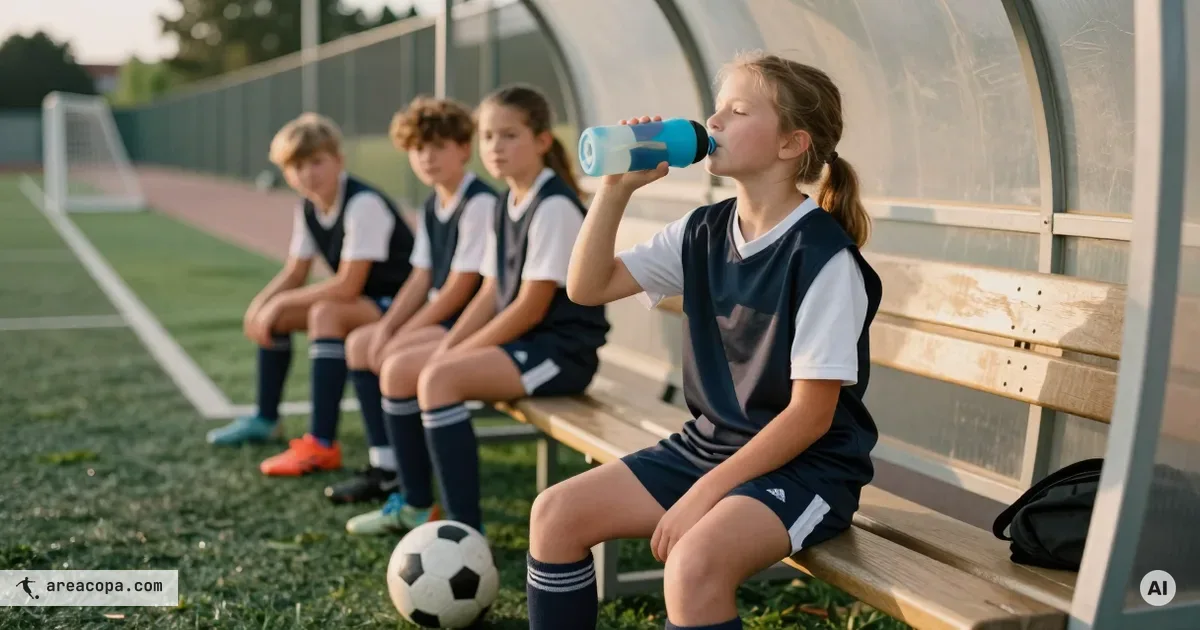
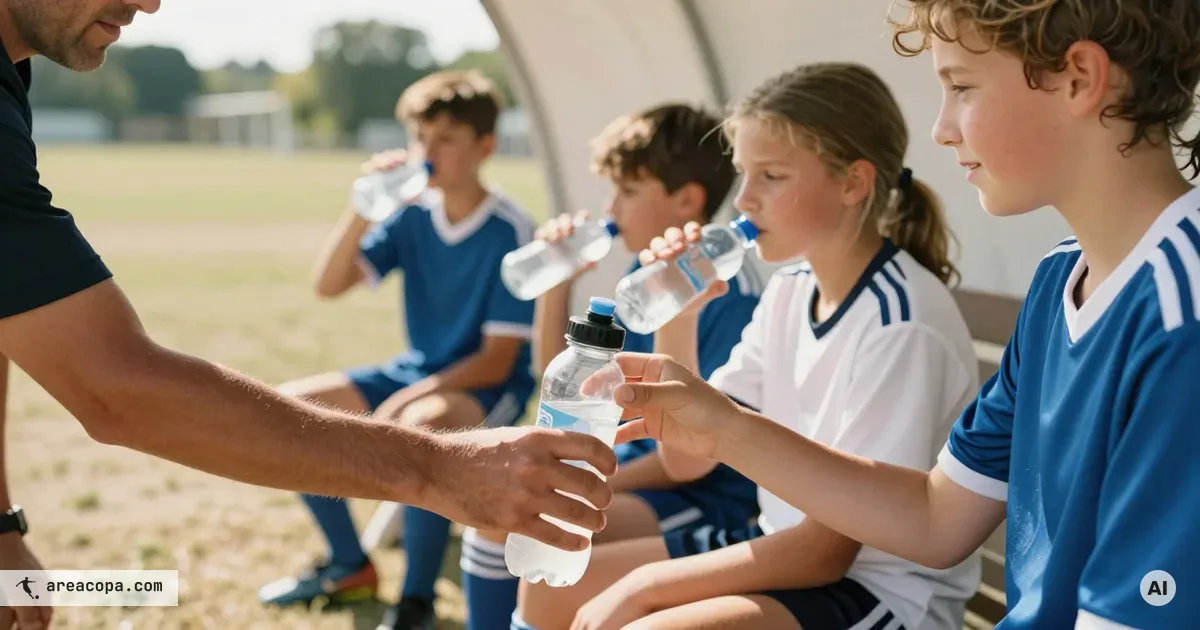
For your team that means, concretely: from around 28 to 30 degrees you build in extra water breaks, one to two per half during the match for two to three minutes. Send the children into the shade, set out several buckets of water and towels so they can lay cold compresses on the neck. In training you control the load yourself anyway, so schedule the breaks generously and ease off the pace.
An underrated lever is pre-cooling. Sit the children in the shade before kick-off, hand them a cool drink and put a wet towel on the neck, and they start with a lower body temperature. That reserve buys a few valuable minutes in the first half before the heat breaks through.
Adjust the content too: in strong heat, intensive sprint and endurance blocks go to the back, while technique, set pieces and coordination move to the front. That keeps the load low without cancelling the session. How to dose running and pace work in the heat is covered in the running drills for footballers.
At a tournament with many matches in one day, the load adds up. How to build water breaks and buffer times into a summer schedule is in our football tournament checklist.
Hydrating properly: before, during and after the match
Thirst is a late warning system. When a child feels thirsty, the body is already short on fluid. So your team drinks before, during and after the exertion by plan, not by feel:
| Timing | Juniors and adults | Children (per kg body weight) |
|---|---|---|
| Before (2 to 3 hours) | 500 to 750 ml | 5 to 7 ml/kg, 15 to 30 min before |
| During (every 15 to 20 min) | 150 to 250 ml (around 0.45 to 1.0 l/h) | about 10 to 13 ml/kg per hour |
| After | 1 to 1.5 l per kilogram lost | around 4 ml/kg per hour of exertion |
The amounts for children are best worked out once per player and shared with the parents. A 40-kilo child therefore needs around 200 to 280 millilitres before the match, a 50-kilo child 250 to 350.
Two details decide the effect. First the salt: with sweat it is mainly sodium that is lost. For exertion longer than an hour, about 0.5 to 0.7 grams of sodium per litre belong in the drink, which keeps the fluid in the body. Second the temperature: a slightly chilled drink, around 15 to 22 degrees, goes down better and cools from within. The lukewarm bottle that has sat in the kit bag since morning does neither.
How much your team actually loses you can find out with a simple scale: weigh the player shortly before and after a session, and the difference is the fluid loss. Half a kilo less means roughly half a litre that has to go back in. A second self-check is urine colour. Light like straw is good; dark like apple juice means too little was drunk, so adjust.
What to drink in the heat? Water, spritzer, electrolytes
For a normal training session in the heat, water is enough. When it gets longer or more intense, a light diluted juice is the better choice because it supplies carbohydrates and some potassium. The carbohydrate share should sit between three and eight percent. Above that, the sugar lies heavy in the stomach and slows you down instead of helping. Cola, iced tea and energy drinks are out, then; they are too sweet and supply no usable salt.
You do not have to buy expensive sports drinks. You can mix an effective electrolyte spritzer yourself:
Electrolyte spritzer (1 litre)
- 500 ml cloudy apple juice
- 500 ml mineral water
- 1 pinch of salt
- juice of half a lemon
- optionally a few ice cubes and fresh mint
Mix everything, stir well, serve chilled. The apple juice supplies carbohydrates and potassium, the salt tops up the sodium, the water the fluid. If you want it richer in potassium after the match, eat a banana with it; the classic did not earn its reputation for nothing.
What to eat on hot match days?
On hot days the appetite drops, but the energy demand stays. So go for small, water-rich portions instead of the hearty meal. Well suited are:
- Water-rich fruit and vegetables: watermelon, grapes, cucumber, oranges. They supply fluid and carbohydrates at once.
- Banana: the simplest source of potassium, easy to digest and quickly available.
- Salty snacks in moderation: a pretzel or a few salted rice cakes replace part of the sodium sweated out.
Timing counts: the last larger meal sits two to three hours before kick-off and is on the lighter side. Between two tournament matches, small bites plus drinking are enough. After the last match, carbohydrates and some protein refill the stores; a banana with bread and a spritzer already does that. Heavy, fatty or very sugary things before the exertion, on the other hand, lie in the stomach and make you sluggish.
Recognising a heat emergency and acting correctly
When the body's cooling fails, three heat illnesses loom. Heat collapse is a circulatory weakness, sunstroke an irritation from direct sun on the head. Most dangerous is heatstroke, in which the body temperature rises to life-threatening levels. Children and older helpers are especially at risk.
Watch for these warning signs in players, helpers and yourself too:
- headache, dizziness, nausea
- muscle cramps and extreme fatigue
- dark urine and suddenly stopped sweating
- hot, reddened skin, confusion or clouded consciousness
Prevention is easier than treatment: drink plenty and early, avoid the blazing midday sun, use shaded spots and do not push children to peak efforts in the heat. This section is no substitute for medical advice; in a real emergency the rescue service always decides.
The heat packing list for your team
Pack the heat gear separately from the normal match-day bag, then you will find what you need faster at the pitch:
Heat packing list: four categories
Drinking, cooling, sun protection and emergencies: pack them separately, reach them faster on match day.
Drinking
- Water canister with reserve for the whole team
- Cool box with ice or cool packs
- Electrolyte spritzer pre-mixed
- Enough cups or labelled water bottles
Cooling
- Several towels to wet down
- Ice bags or cool packs
- Spray bottle with water
- Tent or sun sail for shade
Sun protection
- Sunscreen SPF 50 for players and helpers
- Caps or light headwear
- Seating in the shade
- Light, airy spare clothing
Emergency
- Complete first-aid kit
- List of emergency contacts for all players
- Phone charged plus power bank
- Location of defibrillator and nearest clinic noted
Compiled from recommendations by the DFB sports-medicine commission and BFV.
A cool box with ice is the cheapest insurance against a hot day. It not only cools the drinks; the ice bags also help with bruises and in a heat emergency.
Through the hot match day with a plan
Pull the four building blocks together: know your temperature thresholds, drink with the team by plan rather than by thirst, build in fixed water breaks in the shade and keep the heat packing list in the boot. That takes the dread out of the heat without cancelling the match day.
The most effective lever costs nothing: the right time. Putting the kick-off times into the cooler morning or evening hours avoids the midday heat entirely. How to plan kick-off and buffer times cleverly is shown in our guide to kick-off times at a football tournament. And if you are planning the schedule digitally anyway, for example with a tool like AreaCopa, you can move kick-off times and pitches in seconds, should it get too hot on match day after all.
Create my schedule in two minutesFree and no sign-upDownload the heat checklist
The packing list and hot-matchday routine above as a printable PDF: decide, pack, act on the day, and spot a heat emergency.
Football in the Heat – ChecklistHot matchday: decide, pack, actDownload PDFSources
- DFB, sports-medicine commission: Football in heat: the recommendations of the sports-medicine commission (dfb.de, 2024). Temperature thresholds (30/32/35/40 °C), match postponement, cooling measures, water breaks.
- Bavarian Football Association / KKH: Football in heat: fluids & electrolytes checked and Football in heat: what you should keep in mind! (bfv.de, 2026). Drinking amounts before/during/after exertion, electrolyte spritzer, drink choice.
- Bavarian Football Association / DFB: In a heatstroke: every second counts! (bfv.de). Heat illnesses, warning signs, first aid.
- German Society for Sports Medicine and Prevention (DGSP): Sport in high summer temperatures, what children and adolescents should keep in mind (Lawrenz, 2017). Body-weight-based drinking amounts for children.
- American College of Sports Medicine: Position Stand, Exercise and Fluid Replacement. Drinking amounts, sodium content, drink temperature.
- FIFPRO as well as WBGT fundamentals (National Weather Service) and reporting on the water breaks of the 2014 and 2026 World Cups.