A player jumps for a header, lands crooked and rolls the ankle. Another gets lightly tapped in a duel and instantly loses control of the ball. Neither is bad luck, they are balance problems, and balance is trainable. Football, or soccer as it is known in North America, is full of these moments, yet you can fix them deliberately, with little equipment and measurably within eight weeks. This guide shows you why good balance in football prevents injuries and wins duels. And it also shows how an 8-week program for U13/U14 is built, which drills belong in which phase, and how you prove each player's progress in black and white.
Why players roll ankles and lose balance
Balance is the ability to keep the body over its base of support, even when the ground, the opponent and your own movement constantly work against it. In football this almost never happens from a calm stance. The player lands on one leg, gets shoved, turns with the ball, steps into a divot in the grass. Whoever stays stable here holds the ball and protects the ankle. Whoever does not loses the duel or rolls the ankle.
The decisive detail: good balance is not a question of talent, but of training. It rests on the interplay of the inner ear, the eyes and the body awareness in muscles and joints. That exact interplay is what the neuroathletics foundation trains as a whole. This article takes one building block out of it, balance, and turns it into a concrete program.
What good balance brings in football
The strongest reason is injury prevention, and here the evidence is clear-cut. Prevention programs with balance work cut ankle injuries by around 36 percent, documented across thousands of footballers. Take only the pure balance drills and it is up to 42 percent. The mechanism behind it is simple: better-trained body awareness reports a tipping joint position to the brain faster, so the muscles counteract before the ligament tears. Especially in the U13/U14 growth spurt, when levers and centre of mass shift quickly, this pays off.
The second benefit is performance. A player with good balance stands steadier in the duel, comes down cleanly after a header and does not collapse on changes of direction. The first step benefits too, because the body puts its force into the ground rather than into stabilising itself. This explosiveness builds on a stable stance, which is why balance and jumping and landing technique complement each other well.
What the program changes measurably
That such a program works is not just experience, it has been measured. A study with youth footballers aged 13 to 14 had the players train balance in a football-specific way for eight weeks. Afterwards they had improved clearly in two standard tests: the Y-Balance test, which measures the reach in a single-leg stance, and the Pro-Agility test, a short sprint with changes of direction. Balance and agility rose together, which fits practice: whoever stands more stable changes direction faster.
What the study found about the visual input is interesting. One group trained with extra tasks for the eyes, such as drills with closed eyes or head turns, the other without. In the end the eyes group was no better. Both improved by a similar amount.
The 8-week program
The common thread is a step-by-step progression. You begin on firm ground with a calm stance and work your way through unstable surfaces and disturbances up to game-like tasks under pace. Each phase lasts two weeks, so the movement settles before the next difficulty is added.
8-week program for better balance
From stable to unstable, from static to game-like. Two to three times a week in the warm-up.
Own illustration based on training principles from balance and prevention research. The badge shows the start week of each phase.
What matters is the order, not the pace. Only jump to the next phase when the current one sits cleanly. A player who still wobbles on the cushion has no business in the dynamics phase. And if a week falls through, you repeat it rather than skip a step.
The drills step by step
You do not need a big collection of drills. Four core drills, one per phase, carry the program. Increase the difficulty within each drill rather than constantly hunting for new ones.
| Phase | Core drill | Dosage |
|---|---|---|
| W1-2 Base | Single-leg stance on firm ground, eyes forward | 3 x 30 seconds per leg |
| W3-4 Instability | Single-leg stance on a soft surface, partner nudges lightly | 3 x 20 to 30 seconds per leg |
| W5-6 Dynamics | Single-leg stance, catch and pass a ball back | 3 x 10 passes per leg |
| W7-8 Game-like | Take off, land on one leg and hold for 2 seconds | 3 x 6 to 8 landings per leg |
Base (W1-2): single-leg stance. The player stands on one leg, standing knee slightly bent, eyes forward. The goal is a calm stance without wobble or hopping. Whoever stands securely for 30 seconds briefly closes the eyes as a taste of what comes later.
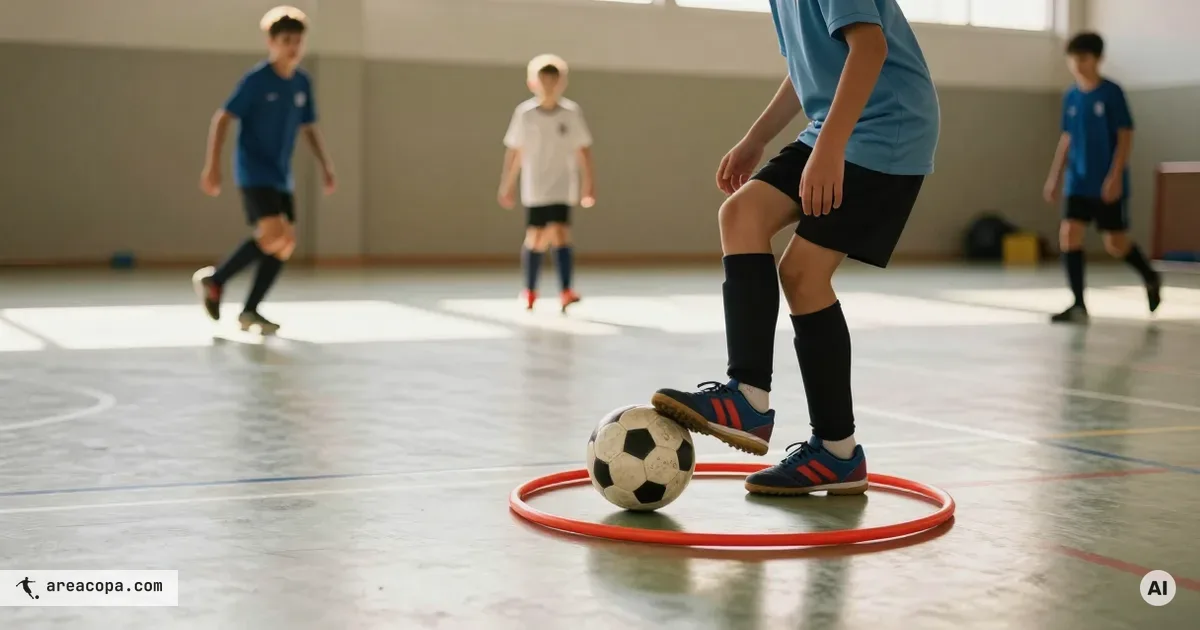
Instability (W3-4): soft surface plus disturbances. The same single-leg stance, now on a folded mat, a balance cushion or uneven grass. A partner gives light, unannounced nudges against the shoulder or hip. The task is to stand calm again immediately after each disturbance. This trains the fast corrections that also protect against rolling the ankle.
Dynamics (W5-6): ball and movement. The player stands on one leg and catches a thrown ball, passes it back and keeps the balance. Here the optional visual input comes in. Catching with closed eyes is too hard, but a colour or number call that the player says out loud before the pass adds a game-like stimulus.
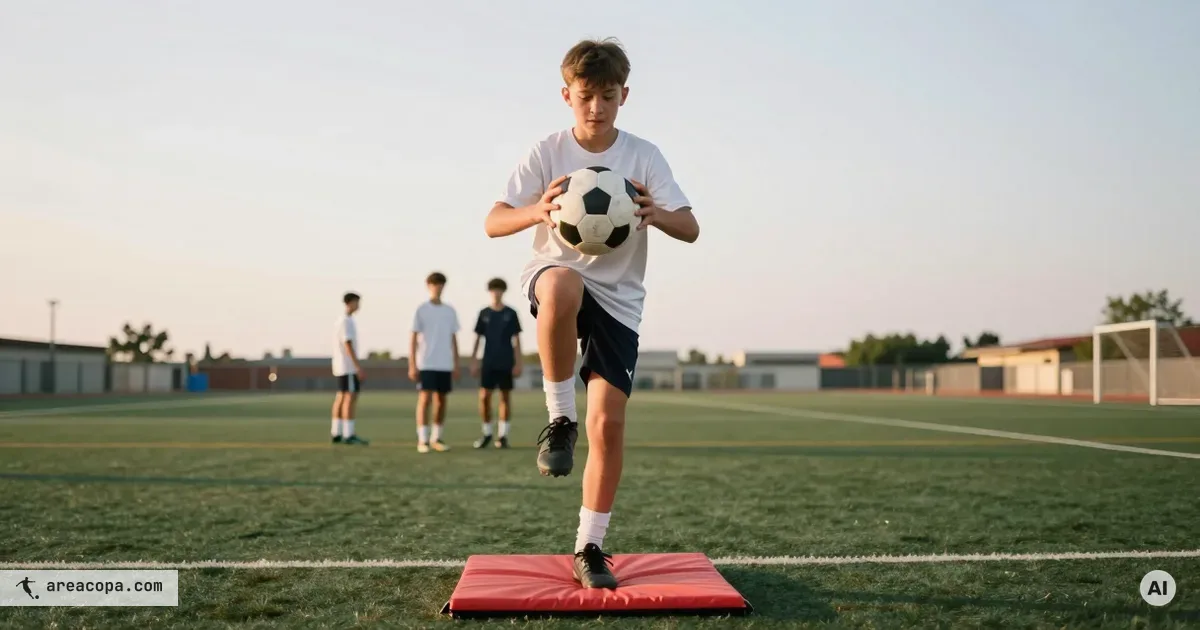
Game-like (W7-8): landing and change of direction. The player takes off, lands on one leg and holds the position absolutely still for two seconds, knee over the toes. Then they change direction from the stance and sprint off. This links balance with the first step and the landing, the way it is needed in the game.
Measuring progress: before and after
A program is only as good as your check on its effect. Two simple measurements are enough for that, which you take at the start and after eight weeks and note down. This before-and-after principle is the same test-and-retest idea that also carries neuroathletics.
The first value is the single-leg stance with closed eyes: how many seconds does the player stand calm before the foot goes down or the standing leg corrects sharply? The second is a simple Y-Balance reach: the player stands on one leg and taps the free foot as far as possible forward and to the side without toppling over. Measure the distance with a tape measure. Both values rise when the training takes hold, and they give players a visible sense of success. Read the numbers honestly before you celebrate an improvement as a training success: part of it is pure growth, and how big that part can be shows up in speed training in youth football, where a U14 player gets 2.4 to 3.1 percent faster every year without training at all.
What age, and how to adapt it
The program is built for U13/U14, because at this age the growth spurt makes the ankle especially vulnerable and the players can steer movements consciously. Downwards it works to U12, then with more playful packaging and fewer disturbances. Upwards to U16 you increase pace, jump height and opponent pressure in the game-like phase.
For younger kids under U12 you do not need a separate program. Tag and balancing games, climbing and varied romping cover the balance base on their own. An isolated single-leg-stance program would be wasted time there.
The most common balance-training mistakes
Four mistakes turn up again and again in club life. Whoever avoids them gets a lot more out of the same drills.
Skipping phases. The most common mistake is progressing too fast. Whoever still wobbles on the cushion has no business on the jumping leg under pace. The order of stable, unstable, dynamic, game-like is not a suggestion but the mechanism of action. Stay in a phase until it sits cleanly.
Practising at the end of training. Balance is head work. A tired player can no longer steer their perception cleanly, and the drill turns into ticking a box instead of learning. That is why the training belongs in the warm-up, when head and legs are still fresh.
Staying too static. A player who only stands calm on one leg for eight weeks gets good at standing calmly, not at the duel. The point of the late phases is exactly the transfer: ball, landing, change of direction and opponent pressure. Without this game-realism the effect fizzles out on the pitch.
Training without measurement. Whoever does not measure before and after does not know in the end whether anything has changed, and neither do the players. The single-leg stance with closed eyes and the Y-Balance reach cost two minutes per player and make the progress visible.
Build the program into training
You do not need an extra session. The phase drill fits into ten to fifteen minutes in the warm-up, two to three times a week. Keep the drills short and alert, tired balance training at the end of a session brings little. Stay honest about expectations: after eight weeks the players stand measurably steadier and roll the ankle less often, but it stays one building block alongside technique, tactics and strength, not a replacement for them.
When your team stands more stable, all that is missing is the real test against real opponents. A preparation tournament shows whether the new steadiness holds up in the duel under pressure too.
Plan my tournament for freeFree and no sign-upDownload the checklist
The complete 8-week program as a printable weekly tracker: the four phases, the core drills with dosage and the before-and-after measurements to fill in per player.
Balance Training – 8-Week PlanFour phases, core drills and a before-and-after testDownload PDF