Tuesday, 5 pm, one third of a sports hall: 18 kids, 90 minutes of hall time. In youth football, or soccer as it's known in North America, the first ten minutes decide whether the session flows or falls apart. That is why indoor warm-up games have to do more than the lap around the pitch outside. They need little space, keep every child moving at the same time, and cope with a hard floor and walls close by.
The twelve games below do exactly that for U8 to U13. They come from the DFB coaching portal (the German football association), from FIFA's futsal material and from Spain, where the sports hall is not a winter refuge but the normal case. On top of that you get the safety rules of the German accident insurers, a ready-made 20-minute sequence and a rule of thumb for the indoor tournament.
Why an indoor warm-up works differently
Outside, a warm-up forgives a lot. If the area is too small, you take more grass. In a sports hall four things change at once.
The space. A standard German triple sports hall (Dreifachhalle) measures 27 by 45 metres, so one third is 15 by 27 metres. With balls, bags and water bottles along the edge, you rarely have more than 15 by 20 metres left for the warm-up.
The time. Every minute spent explaining is missing from the final game. DFB coach Marc Kuhlmann therefore works with a rule of thumb: the warm-up takes at most a quarter of the match time. In short time slots two games are enough.
Floor and walls. A hall floor is hard and smooth, and the wall is often only a few metres behind the line. That decides which games are allowed at the start.
The cold. Not every hall is heated in winter. In a Portuguese futsal study the thermometer inside the hall read 14 degrees. For the cold season the DFB writes that an intensive warm-up becomes even more important.
What a warm-up game for children has to deliver
The DFB guide to indoor tournaments contains a sentence that surprises many coaches: because of their muscular structures, children "do not yet need a systematic warm-up". For U8 to U13 the warm-up is therefore not a medical must, it is the first part of the session. The children arrive, get the ball at their feet, switch their heads on and get quicker.
Fitness coaches call this build-up RAMP: first raise the pulse, then activate the muscles and move the joints, and finally get short and fast. In a children's session in the hall that means a tag game, a dribbling game, a reaction game and a small-sided game. For team sports, 10 to 15 minutes with rising tempo is well supported by research, and small-sided games explicitly count.
You can check whether a game fits this pattern with four points:
- Everyone moves at the same time. The DFB wants to "avoid long standing and waiting times as far as possible". US Soccer says the same from the children's point of view: at training they do not want to stand in lines, run laps or listen to lectures, they want to play.
- Nobody is knocked out. A child who stands at the side after 20 seconds is not warming up. That is why all the tag games below work with swapping roles or freeing teammates.
- The explanation is shorter than the game. The rule from the article on the U11 warm-up without equipment counts double in the hall.
- No long stretching. Holding a static stretch on one muscle group for a minute or longer costs an average of 4.6 per cent in performance afterwards. Children need no stretching routine before playing, movement is enough.
Before the first ball rolls: make the hall safe
A two-minute walk around the hall before training prevents the typical indoor accidents. The rules of the DGUV (German statutory accident insurance) and the regional accident insurers were written for school sport, but they fit club training just as well.
- Secure the goals. "Goals must always be secured against tipping over," writes the DGUV. Movable goals that nobody needs right now come out of the playing area. The English FA also warns against climbing or swinging on goals.
- Proper shoes. Unfallkasse Hessen, a German accident insurer, requires proper sports shoes and no running shoes, because it is easier to turn an ankle in them. A non-slip indoor sole belongs on the packing list for parents.
- A dry floor. Spilled water and sweat turn parquet into a slide. Water bottles therefore stand behind the line, not on the pitch.
- Distance. Keep a safety margin between the pitch and the wall, and between two groups playing side by side. Another group often trains behind the dividing curtain, and the curtain is not a rebound board.
- Jewellery off, watches and friendship bracelets included.
The wall is tempting because it returns every ball. Even so, a game off the walls does not belong at the start. Spanish futsal coach Adrián Martiño only brings it in later to prevent muscle injuries, because such games quickly get hard. Before that he secures hazards such as tables along the edge or lowered basketball hoops.
For the ball you can choose between an indoor ball and a futsal ball. Dropped from two metres, a futsal ball bounces only 50 to 65 centimetres high, as the futsal laws require. That keeps the game on the floor and makes passing and receiving easier on a smooth surface. How futsal changes indoor training as a whole is covered in the article on futsal for football coaches.
Four tag games where nobody is knocked out
The warm-up opens with games that create pace straight away without a long explanation. The first three come from the DFB coaching portal fussball.de, the fourth from the Spanish futsal school.
Rabbit in the cabbage patch
Pitch 15 by 10 metres, no ball. One or two children are hunters, one or two are rabbits, and everyone else spreads out as "cabbages" and crouches down. The hunter chases the rabbit. When it gets tight, the rabbit crouches next to a cabbage. At that moment everything switches: the cabbage jumps up and becomes the hunter, and the old hunter becomes the rabbit and has to run away. If the hunter catches the rabbit first, the two swap roles immediately.
No child knows when their turn will come. That keeps even the crouching children alert.
Tail tag
Pitch 15 by 15 metres. Every child tucks a bib into the back of their waistband as a tail, and two taggers hunt the tails. One of the taggers can also be the coach. The question for every round: can the taggers get all the tails in one minute?
In the variation every child is hunter and hunted at the same time. Everyone tries to win other children's bibs and protect their own. Captured bibs go into their own waistband.
Cops and robbers
Pitch 20 by 16 metres, with a 4 by 4 metre jail in the middle. Four cops chase eight robbers, each robber has a ball and escapes by dribbling. Caught robbers go to jail, and their gang members free them with a tap. The cops win when every robber is locked up. If at least one robber stays free for two minutes, the robbers win. Then you pick new cops.
Bridge tag with a ball
Every child dribbles a ball, and two or three taggers give chase. Anyone who is tagged makes a bridge on the floor with hands and feet. The child is freed when a teammate passes their ball through under the bridge. In Spain the game is called pilla del puente. It combines tag with an accurate short pass under pressure.
Three dribbling games with one ball per child
Once the pulse is up, every child gets a ball. The next three games work in a third of a hall with up to 18 children, as long as each has their own ball.
Musical islands
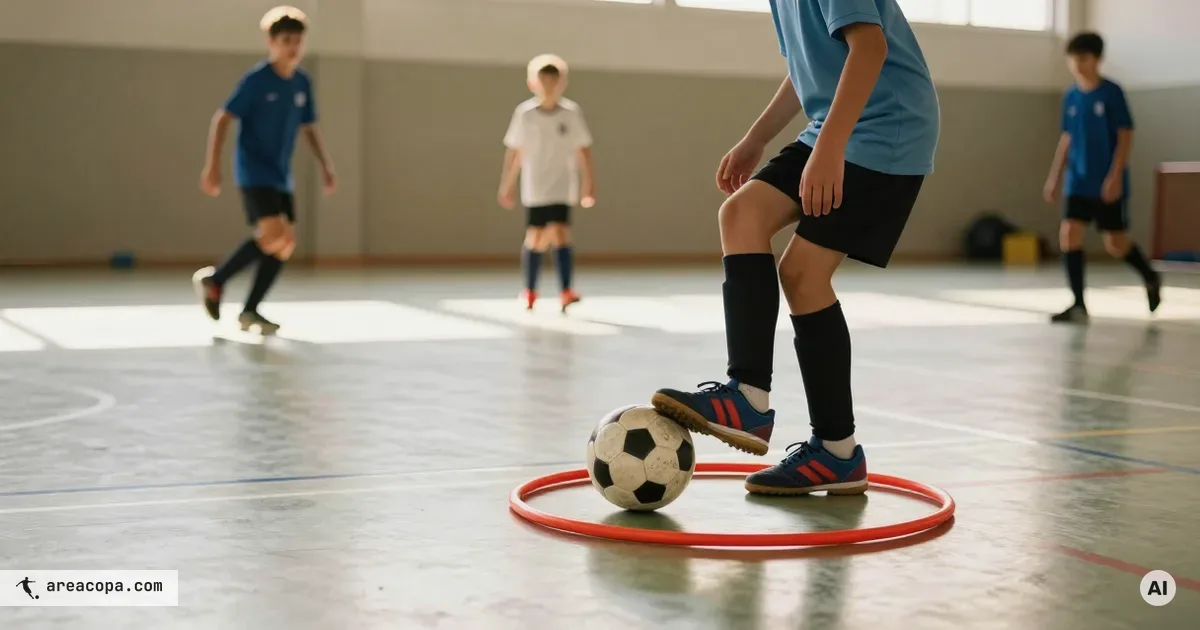
Gym hoops lie on the floor, two fewer than there are children playing. Everyone dribbles to music. When the music stops, every child looks for an island, dribbles the ball into the hoop and stops it with the sole. Each island can hold only one child. The two children without an island get a minus point and play on. Without a speaker, the search starts on a whistle.
Red light, green light with a ball
You stand at the side as the traffic light and call out colours. Green means dribble, yellow means tap the ball on the spot with alternate soles, red means stop the ball. Anyone who makes the wrong move goes back to the start line. Most children know the basic version without a ball. With a ball it becomes a ball-control exercise, because on red the ball has to sit still under the sole immediately.
Dribble tag
Ten children in a 10 by 20 metre area, each with a ball, and one tagger. The tagger tries to tag as many children as possible in one minute while keeping their own ball under control. Then a new tagger takes over. At the end, whoever caught the most children wins.
In the futsal version from the German magazine fussballtraining, the tagger plays without a ball and has to touch the other children's balls with the sole. A second variation: two taggers knock the other children's balls away.
Three passing and reaction games
In the third block things get more precise and faster. These games need a bit of organisation, but in return they prepare directly for the game.
Inside and outside
A square of 10 by 10 metres. Five children stand outside, five dribble inside, and each inside child has a ball. The inside children dribble freely and pass to an outside child, who takes the ball into the square with the first touch. Then the two swap places. In the variation the outside child plays the ball straight back, and after a while the groups swap tasks.
The exercise comes from the DFB piece on warming up before an indoor tournament. It needs only 10 by 10 metres, so it also fits at the edge of a crowded hall.
Cone grab
The children stand in pairs facing each other, with a cone between each pair. You call out body parts: "head", "shoulders", "knees", "feet", and everyone touches the part you named. On "grab!" both reach for the cone, and whoever gets it first wins. This is how the futsal warm-up progression of the FIFA Training Centre begins.
The game is short and explosive, just right for the last part of the warm-up.
Bench rebound
Four children per group, one long gym bench laid on its side, one ball. The children stand in a fixed order about five metres in front of the bench. The first child plays the ball against the bench and goes to the back. The next one has to play the rebounding ball straight back against the bench. Anyone who misses the bench gets a minus point. In the variation only the left or only the right foot is allowed.
The line is only three children long and moves on every few seconds. With five benches, 20 children play at the same time. The bench is also the safe form of a wall game: the ball comes back low, and nobody shoots at full power.
Two small-sided games to finish
The warm-up ends with a game against opponents. Both formats come from Adrián Martiño's futsal collection and work from U8 upwards.
Sit-down rondo
A big rondo, about 8 against 2. Every child in the circle who has touched the ball sits down on the floor. From sitting they can keep playing, but only with their feet. The attackers' goal: everyone is sitting. If the defenders win the ball, everyone stands up again.
With every touch the rondo gets harder, because the sitting children can only take short passes. Four more formats are in the rondo warm-up variations.
Clear the mini goals
Two teams, 5 against 5 up to 7 against 7, on the whole pitch. Eight or ten small goals are spread around, half in one colour, half in the other. Each team only shoots at the goals of its own colour, and every goal that is hit gets cleared away. The first team to hit all its own goals wins.
Not every hall has mini goals. Two cones one metre apart are enough as a goal if the ball has to be played through along the floor. Martiño uses the game as the last part of the warm-up because it combines pace, vision and finishing.
A 20-minute sequence for a third of a hall
All twelve games in one session would be too much. Five are enough for one session, in order from calm to fast:
20-minute warm-up in a third of a hall
From tag to a small-sided game. Intensity rises in every block, and the fastest part comes right before the main part.
Structure based on Ian Jeffreys' RAMP model, duration based on the DFB recommendation for U10 and U11.
The 20 minutes match what the DFB recommends for U10 and U11. For U8 and U9 you cut it to about ten minutes: one tag game, one dribbling game, the small-sided game. That matches the rule of thumb of a quarter of the match time.
The following week you swap each game for one from the same group: tail tag instead of rabbit in the cabbage patch, red light green light instead of musical islands, bench rebound instead of inside and outside, sit-down rondo instead of the mini goals. The sequence stays the same, the games change.
In a cold hall you shift the weight towards the end. At 10 degrees, an intensive warm-up kept jump height above the baseline for 20 minutes in the lab, while a moderate one only worked immediately afterwards. The training jacket stays on during the first block, rabbit in the cabbage patch gets two minutes shorter, cone grab two minutes longer. There is no long drinks break standing around between the warm-up and the main part.
For the main part, five exercises that also get by with little space are in the article on training in a small space.
Warming up at an indoor tournament: fresh before every match
At an indoor tournament space is even tighter than in training. The pitch belongs to the match in progress, and teams, parents and bags crowd along the edge. So instead of a long warm-up, the DFB recommends five minutes of intensive ball work in pairs for children, with one ball for every two children.
The real problem comes after the first match. "Waiting times of 45 minutes and more are nothing unusual at tournaments," says the DFB guide. What such breaks do to the body has been measured in adult footballers. During a 15-minute half-time break their muscle temperature fell from 39.4 to 37.4 degrees, and at the start of the second half they sprinted 2.4 per cent slower. Those who moved lightly during the break lost nothing.
That gives a rule of thumb: if more than 15 minutes pass between the warm-up and kick-off, about two minutes of re-warm-up with short sprints and jumps are enough. One caveat belongs with it. The measurements come from adult men and from half-time breaks. We found no study on youth tournaments with several short matches a day, whether in German, English or Spanish. The recommendation below is therefore derived, not measured.
For tournament day that means:
- Before the first match: inside and outside or cone grab, plus the five minutes of ball work from the DFB guide. You rarely fit more at the edge of the hall.
- About ten minutes before each further match: three minutes of passing in pairs, then two minutes of cone grab or short bursts, wherever the organiser frees up space for it.
- During the long break: shoes off, dress warmly, eat something. The DFB advises against filling every break with games. A quarter of an hour with the parents is part of tournament day.
How many matches a child can handle on one tournament day and what FIFA 11+ Kids looks like before each match is covered in the article on games per day at youth tournaments. The whole preparation, from packing to the starting line-up, is in preparing a youth team for a tournament.
Build warm-up windows into the fixture
As a coach, you can only plan the warm-up on tournament day as well as the fixture allows. If you don't know whether your next match starts in 20 or in 50 minutes, you warm up too early or not at all. As the host, it is in your own hands. You set fixed kick-off times and even breaks between each team's matches. And you keep a strip free at the edge of the hall where the next team can play passes ten minutes before kick-off.
How the remaining points fit together, from booking the hall to the prize-giving, is in the checklist for running an indoor tournament. You don't have to work out the fixture itself by hand: the kick-off times follow from the number of teams, the number of pitches and the match length.
Create my indoor tournament fixtureFree and no sign-upSources
- DFB/fussball.de Training & Service: Aufwärmen vor dem Hallenturnier (2018), Ballsack vergessen? Kindgemäßes Aufwärmen geht auch ohne Ball (Marc Kuhlmann, 2019), Fangspiele im Kindertraining, Aufwärmprogramm: Statt Rundenlaufen Spaß verkaufen, Ein Leitfaden für das Hallenturnier, Fußball im Winter: der kalten Witterung trotzen. Games inside and outside, rabbit in the cabbage patch, tail tag, cops and robbers; warm-up duration, rule of thumb, waiting times.
- fussballtraining 12/2011: Futsal: Aufwärmen (tag and dribbling with the sole variation).
- FIFA Training Centre: Futsal: Warm-up progression (cone grab).
- Martiño, A.: Calentamientos, collection of futsal warm-up games (sit-down rondo, clear the mini goals, bridge tag with a ball; notes on wall games and hazards).
- Zürngast, W. (2013): Fußball für Alle, University of Graz (musical islands, bench rebound).
- Beale, M. (2007): The Ultimate Soccer Warm-Ups Manual (red light, green light).
- DGUV Sichere Schule: Ballspieltore; Unfallkasse Hessen: Ballsport, aber sicher; The FA: Goalpost Safety Guidelines.
- IFAB/FIFA: Futsal Laws of the Game, Law 2 (the ball).
- Jeffreys, I. (2017): RAMP warm-ups: more than simply short-term preparation. Professional Strength & Conditioning 44.
- Silva, L. M. et al. (2018): Effects of Warm-Up, Post-Warm-Up, and Re-Warm-Up Strategies on Explosive Efforts in Team Sports: A Systematic Review. Sports Medicine 48. Duration and build-up of the warm-up, re-warm-up after a break of more than 15 minutes.
- Behm, D. G. et al. (2016): Acute effects of muscle stretching on physical performance, range of motion, and injury incidence in healthy active individuals: a systematic review. Applied Physiology, Nutrition, and Metabolism 41. Performance loss from static stretching.
- Rössler, R. et al. (2018): A Multinational Cluster Randomised Controlled Trial to Assess the Efficacy of "11+ Kids": A Warm-Up Programme to Prevent Injuries in Children's Football. Sports Medicine 48.
- Lopes, M. (2018): The FIFA 11+ injury prevention program in amateur futsal players. Dissertation, University of Porto. Hall temperature of 14 degrees.
- Mohr, M. et al. (2004): Muscle temperature and sprint performance during soccer matches: beneficial effect of re-warm-up at half-time. Scandinavian Journal of Medicine & Science in Sports 14.
- Chiba, I. et al. (2022): Warm-Up Intensity and Time-Course Effects on Jump Height under Cold Conditions. International Journal of Environmental Research and Public Health 19.
- US Soccer Grassroots Coach Education: Play-Practice-Play Model.