Three Games, No Goal: the Problem Is Not Talent
You are assistant coach of a U11 team, and after three games without a win you sit on Sunday evening with the match report in your hand: ten shots on goal, not one of them in. In training everything looks normal: the kids run, they play, they shoot. In matches they cannot convert, and you ask yourself: bad luck, poor form, or weak strikers?
Probably none of the above. Lack of goals in youth football, or soccer as it is known in North America, has almost nothing to do with talent. It is a question of repetition, pressure and training architecture. That can be turned around in two to three weeks. Five minutes of focused finishing per session is enough, instead of letting it run along as a "will sort itself out eventually" element.
This article shows you the five most common causes of goal drought in U11 teams and three drills of five minutes each that target exactly those causes. There is also a concrete three-week plan so you can see the difference at your next match.
Five Causes That Are Almost Always Behind It
Before you change your training content, identify exactly what is going wrong with your team. Usually it is one of the following points, and often two of them combined.
Cause 1: Too Few Shots on Goal per Session
In a U11 match a striker realistically gets two to five shots on goal. If in training he completes only five to ten more, that is, with one training session a week, at most fifteen shots per week. That is not enough to build routine. How big the difference is becomes clear in an analysis of English U23 football: winners shoot around 64 percent more often on goal than losers. Professional strikers reach three-digit numbers per week. At every age, volume is the first lever.
Shots on goal per match: losing vs. winning teams
Premier League 2 (U23): winning teams attempt 64% more shots on goal per match (p < 0.001). Shots on goal are the strongest single predictor of winning.
Winning in Premier League 2: a statistical model of technical performance indicators (2026).
Cause 2: Shots Without Pressure
When the striker in training calmly receives the ball, takes three steps towards goal and then shoots at an empty goal, he is practising warm-up. In a match a defender arrives, the goalkeeper stands ready, the ball bounces awkwardly. Shots without a defender and without time pressure have no transfer to the match situation.
Cause 3: Wrong Distance
Most goals in U11 matches come from the six-yard box, not from the edge of the penalty area at 16 metres. If your training only practises shots from 16 metres at an empty goal, you are training a situation that barely occurs in matches. Short distance, little reaction time, quick finish: that is the reality.
Cause 4: Shooting from a Standstill
In training: receive the ball, turn, aim, shoot. In a match: the ball arrives, the striker is running, and he has half a second to finish. Anyone who only shoots from a standstill cannot execute the shot on the move. It is a different motion, different foot position, different eyes.
Cause 5: Finishing at the End of Training
If your training order is "warm-up, technique, game form, finishing," your team shoots in the last ten minutes: heavy legs, concentration gone, everyone waiting for the game. Finishing belongs in the first thirty minutes, fresh and alert. That changes everything.
If your team also regularly loses the ball one-on-one in front of goal, more shooting will not fix that. You first need clean dribbling exercises for U9 to U11 before more finishing volume has any effect.
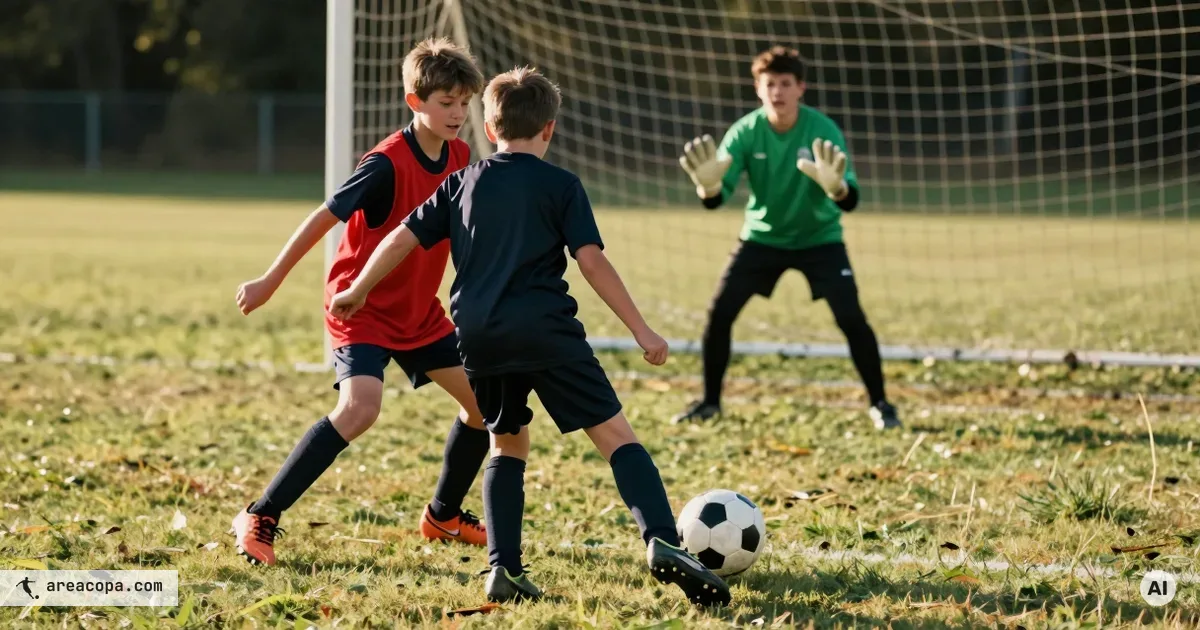
Drill 1: 1v1 vs Goalkeeper in Five Minutes at Frequency
Drill 1: Frequency Finishing
Two lines in front of goal, alternating ball pickup, two steps, finish, then join the other line.
Setup. One goal with a goalkeeper. Two lines in front of goal, one left, one right, seven to eight metres from the goal. A supply of balls at each line. One player from each line alternating: pick up the ball, two steps, shoot on goal, immediately join the other line. The next player starts as soon as the ball is in the goal or wide.
Objective. Thirty shots per player in five minutes. No aiming, no hesitating. Ball, step, shot. Volume is the core here, not accuracy.
Coaching cue. After every tenth shot, briefly stop and give one pointer: "Heads up, look at the goal, not the ground." No tactical corrections, no discussion. Just frequency and eyes up.
Why it works. Cause 1 (volume). A player who trains only once a week makes up in five minutes the number of shots they would otherwise get in two weeks. Your keeper faces just as many shots in the process, which lets the drill double as goalkeeper training without a dedicated GK coach.
Drill 2: 4-Goal Mini-Game in Five Minutes
Drill 2: 4-Goal Funino with Shooting Zone
3v3 on 12x18 m, four mini-goals in the corners. Goals only count when the shot comes from within the 6-metre zone.
Setup. A pitch twelve by eighteen metres. Four mini-goals, two per team to defend, in the four corners. Three versus three. Mark a shooting zone of six metres in front of each goal. Goals only count when the shot comes from within the shooting zone. No goalkeeper.
Objective. As many goals as possible in five minutes. Rotate teams after each round so everyone attacks and defends.
Coaching cue. "Look which goal is open, go there." Not sprinting to the central goal, but deciding. The drill is Horst Wein's Funino (3v3 with four mini-goals), which the DFB has recommended as the standard game form in G- and F-youth since the 2024 reform. The 6-metre shooting zone comes directly from Wein: "A goal is only valid if the scorer is within the shooting zone when taking the shot." The drill trains two things simultaneously: pressure (defenders are there) and distance (six metres, not sixteen).
Variation for time pressure. If your team already plays fluently, add a time rule: if 20 seconds pass without a shot, the ball goes to the opposition.
Why it works. Causes 2 and 3 together. The player shoots from realistic distance under pressure from defenders. That is the match situation that is missing from classic finishing training.
Drill 3: Finishing on the Move in Five Minutes
Drill 3: Finishing on the Move
Flat cross from the half-space, running player finishes first touch without stopping the ball.
Setup. One goal with a goalkeeper. Wide position (left half-space) with a supply of balls. A player starts running from the centre circle towards goal. The wide player plays a flat cross into the box. The running player finishes first touch on the move without stopping the ball. Immediately the next player goes.
Objective. Ten to fifteen shots per player in five minutes. Rotate the wide position after each round so the ball supplier also learns pace.
Coaching cue. "Movement first, then the shot." Anyone who stops the ball is slow and gives the defender time. The shot must come from the run, first touch on goal. UEFA Technical Observer Mico Martic in the 2026 U19 Futsal report put it briefly and unmistakably: "One-touch finishing is a must." The same applies to full-pitch youth soccer: one fewer touch means a faster shot.
Why it works. Cause 4 (finishing on the move). This first-touch finish is the most common goal-scoring situation in matches and the rarest in training. Three weeks of five minutes is enough to reverse that.
The 3-Week Plan: What You Do Now
The drills only work if you consistently embed them in your training structure. Here is the concrete plan for the next three weeks. For finishing against an opponent, the next step is the game for getting free to shoot from the small-sided games for 7v7.
Training architecture. Place the drills in the first thirty minutes, after warm-up and before the main game form. Legs are fresh, concentration is still high, which makes every shot more effective. The end of training is game form, not technique. The DFB coaching guide for Bambini to D-youth is clear on this: at least 50% of training time should be finishing play in various formats. Two levers combined: focused drills at the front, plenty of game time at the back.
60-minute training session with finishing block at the front
Warm-up, finishing drills in the first 30 minutes, then the game form, shown proportionally.
Structure follows DFB coaching guide Bambini to D-youth (at least 50% finishing play).
Weekly distribution.
Three weeks, each with a clearly defined focus. By the next competitive match you should see the difference in finishing situations.
Week 1: Volume
Drill 1 (frequency) at every session. Target: every player gets their 30 shots per session. Results show after just four days.
Week 2: + Pressure
Continue Drill 1, plus Drill 2 (4-goal Funino with shooting zone) in the second session. First match situations under pressure from defenders.
Week 3: + Movement
All three drills in rotation. First session: Drill 1 + 3. Second session: Drill 2. First-touch finishes are now in the repertoire.
What to measure. After every match, record the number of shots on goal and goals scored. After three weeks compare with the three matches before. If shots increase but goals do not, you still have a volume or distance problem. If both increase, the plan has worked.
If your next tournament is coming up in the next few weeks, you can prepare the schedule and team line-up in advance, instead of improvising the day before.
Set up my next tournamentFree and no sign-upSources
- Winning in Premier League 2: a statistical model of technical performance indicators (2026). Shots and shots on goal per match for winning vs. losing U23 teams (14.22 / 6.86 vs 11.22 / 4.18); shots on goal as the strongest single predictor of winning.
- Wein, H.: Spielintelligenz im Fußball. Funino ruleset, in particular the 6-metre shooting zone: "A goal is only valid if the scorer is within the shooting zone when taking the shot."
- DFB: Wettbewerbsformen im Kinderfußball, as of 09/2024. Recommends Funino (3v3 with four mini-goals) as the standard game form in G- and F-youth.
- DFB: Tipps für Bambini, F-, E- und D-Jugend (Munich Football School, DFB coaching guide). "At least 50% of training time up to and including D-youth should always be finishing play (in various formats!)."
- Memmert, D. (2011): Vermittlung von Spielfähigkeit. Recommends for finishing-focused game forms the rule "A shot on goal must be attempted within 20 seconds."
- UEFA Technical Report (March 2026), The Technician. Mico Martic on the U19 Futsal EURO: "One-touch finishing is a must" — applicable by analogy to full-pitch youth football.