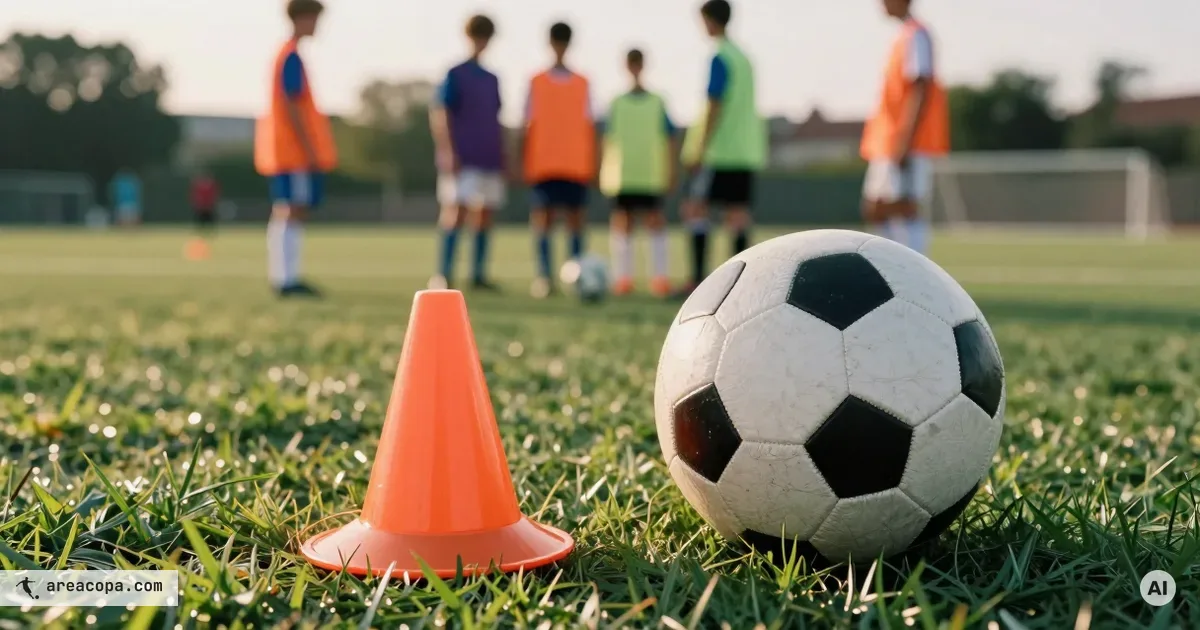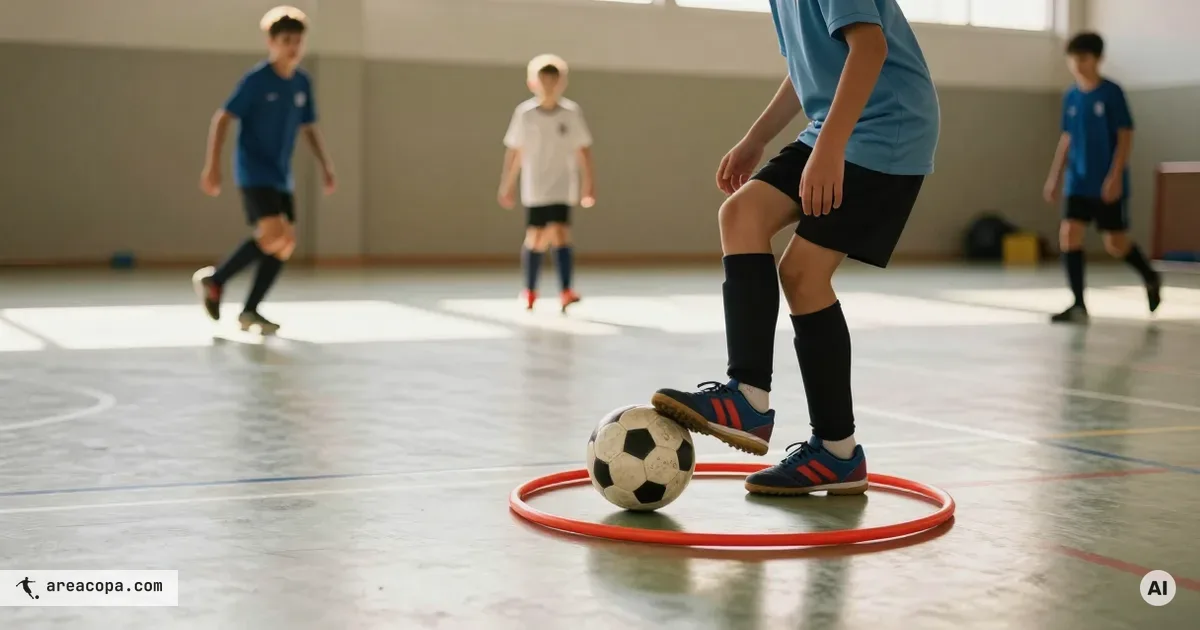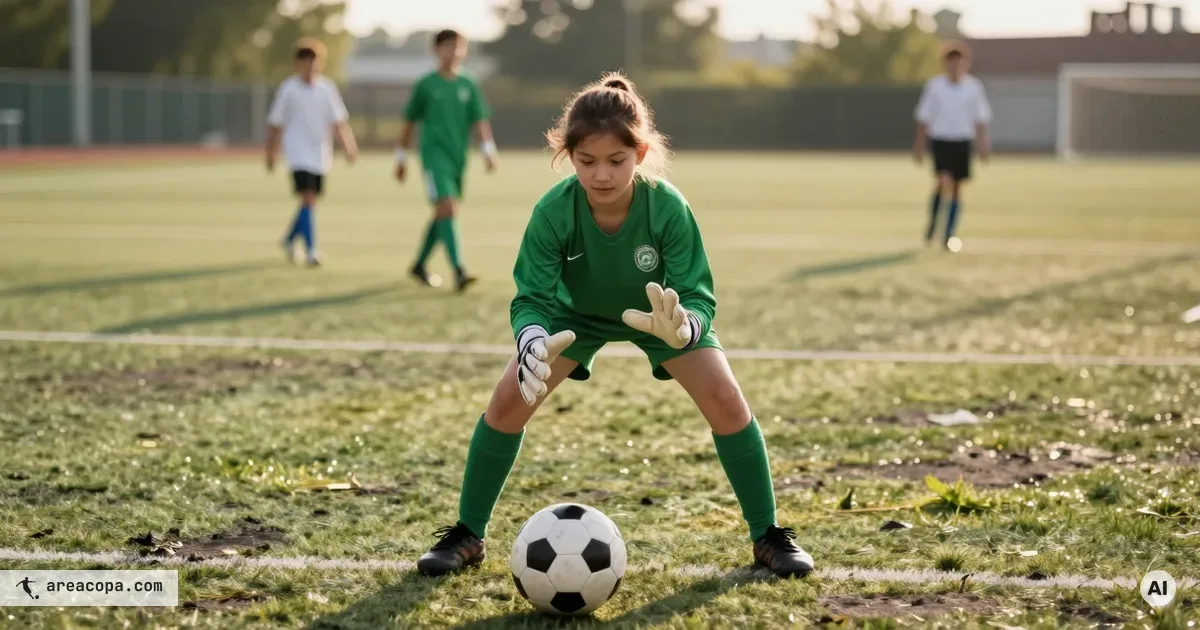
You take over a youth team, have no goalkeeper coach at the club, and some kid stands in goal on Tuesday doing more or less whatever they want. For the outfield players you have drills, for the keeper you do not. In amateur and grassroots football, or soccer as it's known in North America, this is exactly the normal case, and it is solvable without you ever having stood in goal yourself.
This article gives you three things: an overview of which goalkeeping technique even comes up at which age, concrete ways to build the keeper into your normal team training, and a ready-made 50-minute unit for U10 to U13 that you can take along as a PDF. Everything rests on youth development plans from England, Canada, the USA and FIFA, not on gut feeling.
Why the goalkeeper often gets lost in amateur training
The reason the goalkeeper gets left behind is rarely ill will. It is time. You plan a session for twelve outfield players, and the one in goal tags along. When it is their turn, it is as a shooting target during finishing. Catching, falling, crosses, playing out: all missing.
The problem with that shows the moment you look at what a goalkeeper actually does in a match. Among elite goalkeepers at major tournaments, around 62 percent of all keeper actions are offensive, that is, joining the play, and only 38 percent are defensive. By far the most frequent single component is positioning in build-up, followed by preventing goals. So the goalie keeps the game running more often than they make a save.
With children the ratio is different, but the direction holds: a keeper who is never challenged with the ball at their feet never learns exactly the skill that will later set them apart from the average most. And the good news for you as a coach without a specialist is: footwork, reactions and 1v1s arise almost on their own when the keeper is properly involved in team training.
Goalkeeper training by age: from the youngest to under-18s
A note on honesty first: the development plans this overview draws on use their own age bands (FIFA for example uses "football school 6 to 10", while Canadian and US plans only start at U11). Assigning them to the age bands below is my own overlay onto a common system, not the labelling used by the source. As a rough map it still works.
The common thread across all stages: secure catching first, then soft falling, then powerful diving. High balls and active build-up start only when the children move to the full-size pitch. And the position is tried out for a long time, not fixed.
| Stage (≈) | Catching | Falling and diving | High balls and crosses | Feet and build-up |
|---|---|---|---|---|
| Foundation (U6 to U9) | catch the ball and secure it to the body, playfully | at most rolling and tumbling, out of games | not yet | play with the ball at the feet, try the position out |
| U10 to U11 | within reach, catch everything instead of parrying | soft falling: tip sideways, low ball, in the 1v1 | only thrown balls without an opponent, for push-off timing | throw and kick with both feet |
| U12 to U13 | also balls above head height | powerful diving with a push-off; introduce punching | kicked crosses, also under opponent pressure | receive back-passes securely, first build-up |
| U14 to U15 | refine, react to unconventional balls | crosses in a challenge and with contact | active, further from goal | cut the angle, active build-up |
| U16 and up | secure under pace and pressure | all automated, against opponent pressure | command the box | organise the defence, manage the game |
Two points clear up most of the misunderstandings in practice. First: there is no age at which diving is "banned". Soft falling from the knees belongs in training as early as U10, powerful diving with a push-off only from U12, once the strength and body awareness are there. Second: strength training with added weight is not a topic until then; in the development plans it starts only from U14. Until then, bodyweight, jumping-power and explosiveness drills and coordination are enough.
How to build the keeper into team training
The most important rule is also the simplest: plan the goalkeeper in. Do not forget them when you write up the session. Their role develops best in connection with the team anyway, not in isolated special drills. One example is playing out in a pair with the goalkeeper, from the small-sided games for 7v7.
When you look more closely, your regular training delivers the keeper stimuli almost automatically:
- Finishing training brings saves. Your finishing training with the kids becomes a catching and shot-stopping unit for the keeper if you do not treat them as a living target but give them coaching points (ready stance, catch instead of parry, secure the ball).
- Small-sided games (4v4, 5v5) bring reflexes and 1v1s from short range.
- Possession and build-up drills bring the footwork that makes the difference in a match. Let the keeper join in as a passing option.
This is topped up by a short, targeted block. The rule of thumb: take what the team is working on that day and prepare the keeper for it ten minutes earlier. If the team trains crosses, the goalkeeper practises coming out and catching high balls beforehand. If 1v1s with the strikers come next, in the pre-block you do not work on high balls but on cutting the angle.
The block does not fully replace isolated specialist training, though, and you should know that: pure team drills deliver fewer of the short, keeper-typical sprints and braking movements than a position-specific block. So the honest message is not "specialist training is superfluous", but: integration into the team is the core, a short specialist block is the sensible addition.
This mix works for a simple reason. Goalkeeper coaches often spend 50 to 70 percent of their time on predictable, isolated technique training, even though they themselves name decision-making as the most important skill of a top goalie. Those very decisions cannot be drilled on a stationary ball. They arise where the keeper has to perceive, decide and act: in game forms and real match situations. Team training delivers them free of charge.
A ready-made keeper unit for U10 to U13
This unit works with one ball per pair, a few cones and a soccer goal. Two to four outfield players help as feeders and shooters, and you can let the rest of the team work in parallel at a station. The last two blocks run with the whole team anyway.
1. Warm hands: W-grip with a bounce (5 min). The keeper bounces the ball on the ground in front of them and catches it on the way up in a W-grip: thumbs almost touching, not overlapping, hands about a ball-width apart, elbows slightly bent as shock absorbers. Coaching: let the ball stick to the hands and secure it to the chest immediately.
W-grip with a bounce
Let the ball bounce in front of you and catch it on the way up in a W-grip, thumbs almost touching, not overlapping.
2. Low-ball pickup in pairs (8 min). Two children roll the ball to each other from five to eight metres. The catcher moves their feet behind the ball, gets down with open palms and fingers pointing down, and closes the legs as a second safeguard. Coaching: body behind the ball, do not reach beside it.
Low-ball pickup in pairs
Roll from five to eight metres. Body behind the ball, legs close as a second safeguard.
3. Soft falling from the knees (8 min). The pairs kneel upright five to eight metres apart. A rolls the ball sideways next to B, B falls to the side, stretches the hands to the ball and lands in the order knee, hip, shoulder. Then back on the feet as fast as possible. Coaching: never break the fall with the elbow, keep the ball in front of the head. Progression: from standing.
Soft falling from the knees
Roll the ball sideways next to the kneeling goalkeeper, they tip to the side onto the ball and get back on their feet quickly.
4. Turn and Receive (7 min). Three cones in a row, six metres apart, two feeders on the outside, the keeper in the middle. Feeder A throws, the keeper catches, returns it and turns immediately to feeder B. Eight to twelve reps, then switch. Trains catching under time pressure and quick reorientation.
Turn and Receive
Catch from feeder A, give it back, turn immediately to the second feeder B.
5. 1v1 through the gates (10 min). The keeper defends their goal and two gate goals right beside it. An attacker starts from the middle, dribbles in and tries to get through one of the gate goals. The keeper comes out, cuts the angle, stays on their feet for a long time and steals the ball with two firm hands, not with the foot. Coaching: control the approach speed, do not throw yourself down too early. Here outfield players join in as attackers.
1v1 through the gates
Two gate goals stand beside the main goal. Push the attacker outward, come out and cut the angle.
6. Final game with keeper bonus (12 min). 5v5 up to 8v8 with the keeper in the thick of it. Award extra points for a shot on goal from their own half, so the keepers are challenged, and let them open build-up with the foot. This is exactly where they train what comes up most often in a match: joining the play and deciding.
Final game with keeper bonus
The goalkeeper joins in and opens with the foot. Extra point for a shot on goal from their own half.
You get these six blocks as a printable training card that you slip into your bag on training day.
Download the training card
The 50-minute unit as a printable PDF: the six-block flow with times, the key coaching points and the most common mistakes at a glance.
Goalkeeper Session U10 to U1350-minute plan without a GK coachDownload PDFThe most common mistakes without a GK coach
- Only letting them face shots on goal. This is the most common mistake. Crosses, footwork and decisions then go missing entirely. Crosses in particular are among the hardest balls in the game, because the goalkeeper has to decide in split seconds between coming out, staying, catching or punching.
- Committing too early. Making a child a full-time goalkeeper at ten takes footwork and game understanding away from them. Until U12 the keeper belongs in the field too.
- Not warming up the hands. Cold, unprepared hands catch worse and injure more easily. Two minutes of catching-grip drills before the first hard shot belong in every session.
- Strength before technique. Powerful diving and heavy jumps before U12 achieve little and frustrate. Clean movement first, then pace, then distance.
Your next training session
You do not need a goalkeeper coach to move your keeper forward. You need three things: the right technique at the right time, the goalkeeper deliberately planned into your team training, and a short specialist block that fits the team topic. For the next session, take the 50-minute template, warm up the hands, and let the keeper open with the foot in the final game.
The strongest stimulus in the end comes from real games, where the youngster in goal has to decide again and again. Anyone who regularly organises games and small tournaments gives their team exactly these repetitions. Plan my tournamentFree and no sign-up