The throw-in rules in football fit on half a page, and the throw-in is still the restart that is most often taken wrongly and least often penalised. In youth football, or soccer as it is known in North America, the gap is wider still, because in England the restart does not exist at all below U11. The reason sits in how the law is built: it takes no interest in how the player gets to the ball, only in a single fraction of a second.
Law 15 Binds Everything to One Moment
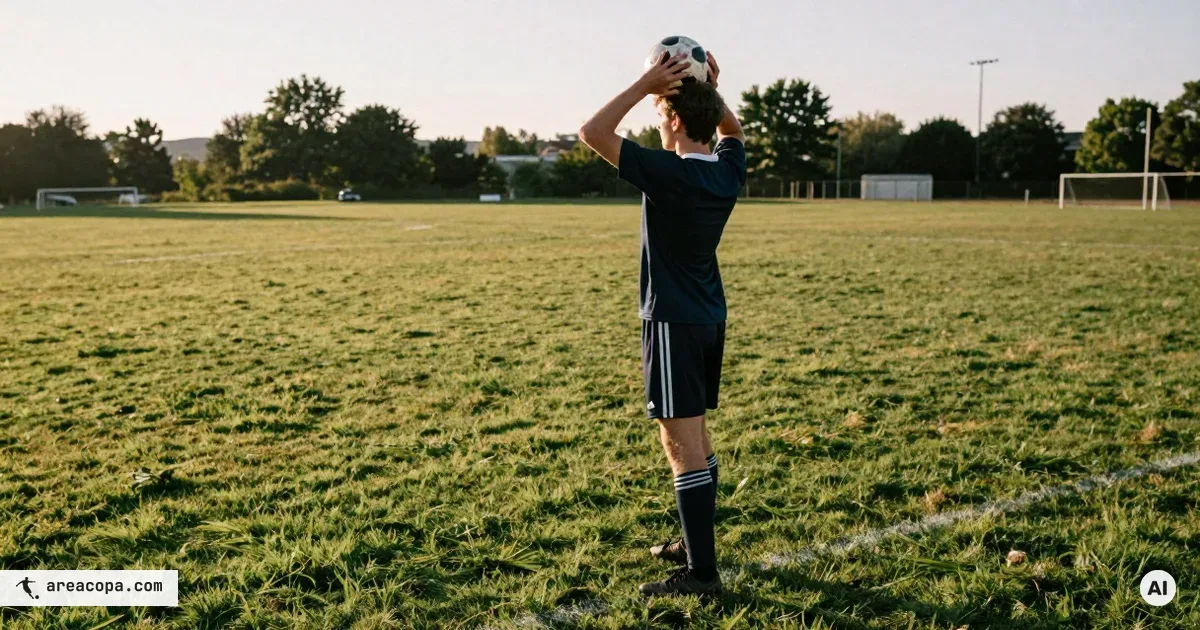
The decisive sentence in the law reads: "At the moment of delivering the ball, the thrower must: stand facing the field of play; have part of each foot on the touchline or on the ground outside the touchline; throw the ball with both hands from behind and over the head from the point where it left the field of play."
Four conditions, and all four are checked at the same instant. A player may take a ten-metre run-up, turn, hold the ball in the air. As long as the body, the feet, the hands and the position are right at the moment the ball leaves the hands, the throw-in is legal. The reverse is also true: the neatest starting position is worth nothing if the player comes off the ground during the throw.
There is a fifth condition that only applies afterwards. The ball is in play as soon as it enters the field of play. If it touches the ground before that, the throw-in is retaken, by the same team from the same position. That is a repeat, not a punishment.
What the Thrower Must Do at the Moment of Release
Stance and orientation. The thrower stands and faces the field of play. "Standing" rules out kneeling and sitting, but not a forward-leaning posture. The orientation requirement is more generous than many coaches assume: the body has to face the field, not the exact direction of the throw.
Foot contact. Part of each foot touches the touchline or the ground outside it. Both feet, in other words, and both in contact with the ground. The wording "part of each" matters: a toe on the line is enough, the heel may be in the air.
Hands and the path of the ball. Both hands on the ball, and the ball comes from behind and over the head. That describes a path of movement, not an end position. A throw that only starts above the crown of the head does not satisfy it.
Position. The throw is taken from the point where the ball left the field of play. The law names no tolerance. In practice a metre is rarely questioned, and in youth football almost never, but the rule itself knows no such margin.
What Cannot Happen From a Throw-In
Three things are ruled out, and all three matter more in practice than they sound.
A goal cannot be scored directly from a throw-in. If the ball goes straight into the opponents' goal, the restart is a goal kick. If it goes straight into the thrower's own goal, the opponents get a corner kick. Both directions are covered, and the second case is the one almost nobody thinks about.
There is no offside when the ball is received directly. Law 11 names the goal kick, the throw-in and the corner kick as the three situations after which a player may receive the ball directly without being offside. For attacking play this is a lever many teams never pull: at a throw-in a striker may stand as far forward as she likes.
Every opponent keeps at least 2 m (2 yds) of distance from the point on the touchline where the throw-in is to be taken. That is an obligation on the opponent, not a request from the thrower.
The Five Faults That Follow From the Law
One preliminary note that most guides on this subject leave out: there are no reliable figures on which throw-in fault is the most common. Neither The FA nor the German, Spanish or French associations publish that kind of statistic. Associations publish the law and individual cases, not frequencies. The list below is therefore derived from the text of the law and sorted in its order. It says what can go wrong, not how often it does.
- Turned away from the field. The body does not face the field of play at the moment of the throw, usually because the player turns towards the receiver instead of throwing the ball there.
- Foot lifted or jumped off. The classic on long throw-ins: the player builds momentum and lifts one or both feet off the ground. As soon as one foot is free at the moment of release, the throw-in is illegal.
- From the crown of the head instead of from behind it. The ball starts in front of or above the head and never travels from behind. The French referee teaching sheet published by UNAF names exactly this as the main cause of irregular throw-ins, though as an observation from 2016 rather than a measured frequency.
- Thrown one-handed or with uneven force. One hand leads, the other is only resting on the ball. Formally both hands are on the ball, yet the throw is still open to challenge.
- Taken away from the point. The player picks up a few metres of ground, usually towards the opponents' goal.
Which Sanction Follows Which Fault
The sanctions are shorter than the conditions, and they separate three cases.
Incorrect execution. Any breach of the four conditions means the throw-in is taken by a player of the opposing team. The ball changes hands, and there is no free kick.
A second touch by the thrower. If the thrower touches the ball again before another player has touched it, the restart is an indirect free kick. If that second touch is a deliberate handball, it becomes a direct free kick, and a penalty kick inside the thrower's own penalty area. The exception: if the thrower was the goalkeeper, it stays an indirect free kick.
Interference by an opponent. Anyone who unfairly distracts or impedes the thrower, and that includes stepping inside the 2 m, is cautioned. If the throw-in has already been taken, an indirect free kick is added.
When the Throw-In Actually Starts in England
If you coach U7 to U10 in England, you do not need this article, because there is no throw-in in your age group. The FA Mini-Soccer and Youth Futsal Handbook, version updated August 2025, lists in its overview "Mini Soccer at a Glance" for the 2025/26 season the row "Throw Ins" with "No" in all four columns from U7 to U10, and directly beneath it the row "Pass or Dribble In" with "Yes" in the same four columns. The wording next to the table is equally clear: traditional throw-ins will no longer take place and are replaced by a pass or dribble-in.
What that replacement looks like. The ball is placed on the touchline and stays still until it is played. Opponents stand 5 yards away. No goal can be scored directly from the pass-in. And, in a deliberate reversal of the rule for adults, the player who brings the ball in may touch it again straight away, which is exactly what makes the dribble-in possible.
The throw-in becomes compulsory at U11, in the 9v9 format. The FA guidance for U11 and U12 says nothing more about it than that Law 15 applies as per the Laws of the Game 2025/26. From that season onward the full chain described above is on the books, sanctions included.
Outside England the answer is set by your own national or state association, and those answers sit remarkably far apart. What stands out when you look across borders is that the associations agree the throw-in is not the right restart for small children. They agree on nothing whatsoever about what follows from that.
| Association | Throw-in applies from | Below that | Distance |
|---|---|---|---|
| The FA (England) | U11, 9v9 | pass or dribble-in | 5 yards |
| Norway | 5-a-side, age 8 | kick-in from a stationary ball | 2 m |
| DFB (Germany) | 7v7, E-youth | kick-in or dribble-in | |
| FFF (France) | U10 and U11, 8-a-side | "touche au pied": pass or dribble-in | 4 m |
| RFEF (Spain) | no limit, applies down to U8 | nothing, but a retake instead of a sanction | 2 m |
| KNVB (Netherlands) | 11v11, effectively U15 | dribble-in, passing and shooting expressly banned | 5 m |
Seven year groups separate the top and bottom of that table, from 8 years in Norway to effectively 15 in the Netherlands. You may also have noticed that Spain has no age limit in its row. That is not a gap in the table: there is none. Associations answer the question "when do children start throwing in" in three fundamentally different ways, and only the first is a number at all.
First: the throw-in is replaced below a line. That is how The FA, the DFB, France, Norway and the Netherlands do it. Below the line the child kicks or dribbles the ball in, above it the ball is thrown. Most coaches have this model in mind.
Second: the hand is allowed but not required. That is how Switzerland, Denmark, Italy and Czechia do it. Up to a certain age the team or even the individual player chooses: throw with the hands, pass along the ground or dribble in. No cut-off date, then, but a freedom of choice that ends at some point.
Third: the throw-in applies, but a mistake costs nothing. That is how Spain does it. The ball is thrown all the way down to the youngest age group, but the fault is not penalised. The referee explains it and lets the child take it again. The team only loses the ball on a second offence.
More on the formats behind all this is in our overview of youth football game formats.
Run-Up, Jump and Flip: What Is Allowed
This is where it pays off that Law 15 regulates only one instant. Three things follow directly from the wording.
A run-up is allowed. The law says nothing about how the player gets to the ball. A player may run up as far as she likes.
The jump throw is not allowed. If even one foot leaves the ground at the moment the ball is delivered, one of the four conditions is missing, and the throw-in goes to the opponent. This is where long throw-ins in youth soccer regularly fall down.
The flip throw is permissible on the wording, as long as the player has part of each foot in contact with the ground or the line at the moment of release and the ball comes from behind and over the head with both hands. A player who has the movement under control satisfies that.
What a Throw-In Is Worth Statistically
An analysis of 16,154 throw-ins from a full Premier League season provides the clearest figure on the subject. 83 percent of throw-ins led to a successful first contact by the throwing team, 54 percent to retained possession, and 8.8 percent ended in a shot at goal out of the possession gained that way.
More interesting than the overall figure is the breakdown by direction of the throw:
| Direction | First contact | Possession retained |
|---|---|---|
| backwards | 99.5 % | 83.5 % |
| sideways | 89.2 % | 64.0 % |
| forwards | 67.6 % | 48.3 % |
A follow-up study across five leagues with 71,220 throw-in phases confirms the pattern: 92.13 percent possession retained going backwards, 71.20 percent sideways, 49.75 percent forwards. It adds a second lever that has nothing to do with technique, namely speed. Throw-ins taken within five seconds reached the first contact in 94.4 percent of cases, those taken after more than fifteen seconds in only 78.31 percent.
In practice this means the long throw into the penalty area is the most eye-catching option, not the most productive one. You know the same logic from the corner kick routines for youth teams, where the short option is just as underrated.
How to Train the Throw-In
Technique. The five faults from section four give you the correction list. Two players throw to each other over five to eight metres while a third stands to the side and checks in a fixed order: orientation, feet, path of the ball, hands, position. Swap after ten throws. The value of the drill is not in the throwing but in the observer role, because the player checking has to apply the law instead of merely hearing it.
Distance. Here there is a solid number. A controlled study in the Spanish journal Retos examined four weeks of two-handed overhead medicine ball throwing in 2024, with fifteen players each in the experimental and control groups and an average age of around sixteen. Throw-in distance rose by 8.2 percent and the angular velocity of the throwing arm by almost 15 percent. The control group did not improve significantly.
The caveat matters: the study worked with sixteen-year-olds. Whether it transfers to younger age groups is open, and added load belongs in the hands of a coach who knows the individual player's capacity anyway.
Tactics. The numbers from the previous section produce an uncomfortable training priority. If balls thrown backwards and sideways keep possession while long forward balls mostly lose it, then the most important training task is not throwing distance but the receiving option behind the thrower. Two things can be drilled immediately: a reliable movement back towards the thrower, and the five-second mark, meaning pick the ball up and take the throw instead of waiting for the perfect solution.
For the defending team the Premier League analysis points the other way: press high and close off the backward and sideways options, so that the opponent is left with nothing but the long ball forwards.
Anyone who wants to work through all of this cleanly across a full tournament season needs one thing above all: enough matches for these situations to occur, and a schedule that is not put together at the last minute.
Create my scheduleFree and no sign-upSources
The quotations from the law come from the official IFAB Laws of the Game 2025/26 and the DFB rulebook for the same season. The age limits come from the respective association documents for 2025/26, above all The FA Mini-Soccer and Youth Futsal Handbook in the version updated August 2025 and the Hampshire FA guidance for officials of June 2025. The match analysis figures come from Stone, Smith and Barry (International Journal of Sports Science and Coaching, 2021), Stone, Kubayi, Smith and North (International Journal of Performance Analysis in Sport, 2025) and Casal and colleagues (PLOS ONE, 2023). The training study is Syafii and colleagues, Retos 54 (2024).